Hindsight is the curse of all political careers: While politicians have to make decisions based on the facts available to them in the here and now, their opponents always have the benefit of waiting for how things turn out before declaring that they, of course, would have made the better and more obvious decision.
So, before condemning Donald Trump for what increasingly looks like a historically ill-conceived decision to mount an air-war (as opposed to a full-scale invasion) on Iran, it is worth remembering that there was a strong case for action, and that recent weeks have reinforced that case, at base level. The Iranian regime has proven, since the conflict started, precisely why it was always so dangerous to tolerate its existence: They have, in response to an attack from two belligerents, waged a very effective war on the global economy. Shuttering the straight of Hormuz, and firing missiles at all of their neighbours, including last week’s attack on Gas production in Qatar, which is not at war with Iran.
The regime has funded Yemeni and Somali piracy, the destabilization of Lebanon, years of Palestinian terrorism against Israel, and – according to US intelligence – several assassination attempts on Donald Trump himself. It did all of this, it is worth recalling, during “peacetime”. Those who pretend that Iran was not a threat to global security are living in cloud cuckoo land.
But Trump’s actions have not been those of a decisive leader. It has, instead, been that of a half-interested amateur. Here he is this morning, declaring that the war is almost over but that it will be up to other countries to re-open the Strait of Hormuz:
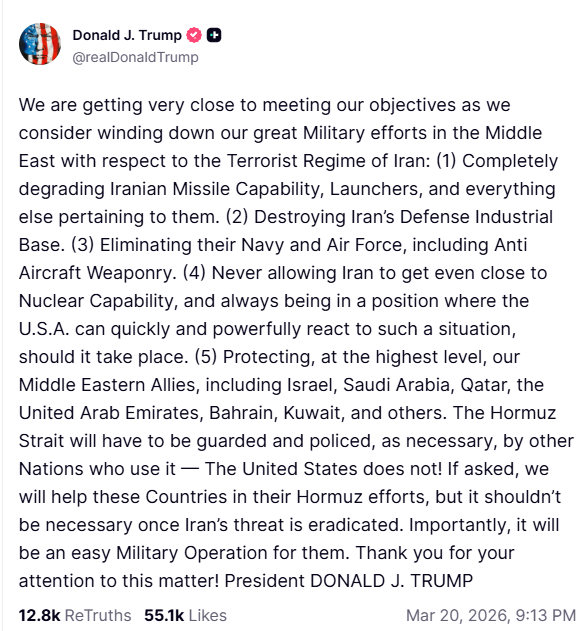
It is first necessary to note, without hesitation, that Donald Trump and his supporters backed his re-election to the US Presidency on the basis that Mr. Trump would end wars, not start them. He promised, but has failed, to end the Ukraine War. His “ceasefire” in Gaza is an achievement of sorts, but came on Israel’s terms and at a time of Israel’s choosing, with that country being perfectly happy for Mr. Trump to take the credit. His one absolutely successful intervention in foreign affairs – the toppling of the Venezuelan regime – came against an enemy much less fearsome than the Iranians.
Much of the “right-wing” opposition to the war in Iran has delved into the usual territory: Because Mr. Trump – much like God before him – is simultaneously seen as the all-powerful motive force in global politics and yet simultaneously immune from any blame for the problems he creates, the comfortable line has been that he is not truly responsible for the war at all. That he has, in effect, been tricked into it by the perfidious Israelis. This is obviously and transparently nonsensical: Mr. Trump cannot simultaneously claim, as he is, to be restraining the Israelis from waging a wider economic war on Iran while at the same time expecting anyone to believe that he is dancing to their tune rather than them to his.
If Israel was able at whim to compel the United States into war with Iran, it could have done so at any stage over the past forty-seven years, while Iran was much weaker than it is today. Yet, Israel was unable to compel President Reagan into war with Iran after Iranian-sponsored massacre of US marines at the Beirut embassy in 1983. It was unable to persuade either Reagan or Bush to intercede decisively in the Iran-Iraq war. It was unable to get President Clinton to act in the 1990s as Iran mounted terrorist campaigns worldwide, and had no success persuading George W. Bush that the Mullahs, rather than the nominally secular Saddam Hussein (an avowed hater of the Iranians who was mostly uninterested in war with Israel), was America’s real enemy in the 2000’s. Israeli influence over President Obama was so weak that it was unable to prevent him doing deals with Iran that saw billions of dollars in American cash paid to Tehran in bribes for not building nuclear weapons, over howls of protest from Jerusalem.
If Trump alone was so easily seduced, as some grifting right-wing podcasters would have it, by the perfidious Jew, then that speaks to a weakness inherent to Trump alone, rather than any diabolical genius by Mossad.
But all of that is, of course, trivia: Were Mr. Trump to succeed in this war, and remove the Mullahs from the geopolitical map, he would have done the world a service on anyone’s terms. He has, instead, half-assed it.
In the process, he has driven the price of oil and gas worldwide to sky-high levels, which presumably accidentally has the side-effect of making Russia the single biggest beneficiary of his military misadventure. He has demonstrated to China that that country has little to fear from the American ability to wage war. He has also – on his own terms and by his own account – fractured the NATO alliance that has underpinned western security for three generations.
It is understandable, I think, that his diehard supporters would wish to try and transfer blame elsewhere, whether that be by pretending to accept his absurd framing that NATO is to blame for his inability to re-open the strait of Hormuz, or by accepting the rubbish from podcasters that actually he was duped by the Israelis in a way none of his predecessors managed. But at the end of the day, the buck stops at the Resolute Desk. This is Mr. Trump’s war, started by Mr. Trump, on Mr. Trump’s terms, and it is being fought under Mr. Trump’s command. There is nobody else to blame for how it turns out.
He now has, in effect, two choices: He can cut and run, leaving a weakened but triumphant Islamic regime as the undisputed strategic victor of the war, having survived everything the world’s most powerful and the region’s most powerful militaries could throw at it, and enabling Iran to dictate terms to the world on the price it wants for re-opening the Hormuz strait. Or, he can double down and send in ground troops, risking a historic bloodbath for both Iranians and American GI’s.
Mr. Trump was supposed to make America Great Again. Why, then, does his country now look weaker and more impotent than at any stage since the Presidency of Jimmy Carter?
It may be, of course, that all of this still works: Perhaps an economically humbled and militarily weakened Iran will face internal revolution six months from now, when the dust settles. Perhaps Iran’s actions will bind the Arab states closer to Israel in a cordon sanitaire around the weakened Mullahs. Perhaps the ability of Iran to see off the Americans will finally persuade Russia that its hopes of military triumph in Ukraine are a fantasy, and perhaps China will look at this quagmire and decide Taiwan is not worth the risk. There are a lot of unknowables. For Israel, perhaps the opportunity to shorten its northern border by acquiring the Lebanese territory south of the Litani river will make it more secure.
But what we do know is that Mr. Trump’s actions have, thus far, not gone anything like to plan. And we know too that as “leader of the free world” he is to blame for the consequences. And the outcome of this war will, more than anything else, define his legacy as President.