On Wednesday myself and my daughter Ciara attended the Abbey’s staging of Sean O’Casey’s The Plough and the Stars which was presented for the first time in the old Abbey on February 8, 1926, almost exactly a century ago.
My Grandmother, then Esther Hannon, was in the audience one of the nights there were objections from anti-Treaty republicans in the audience. She was a Collins woman so certainly not in their company but I do know that she did not think much of O’Casey.
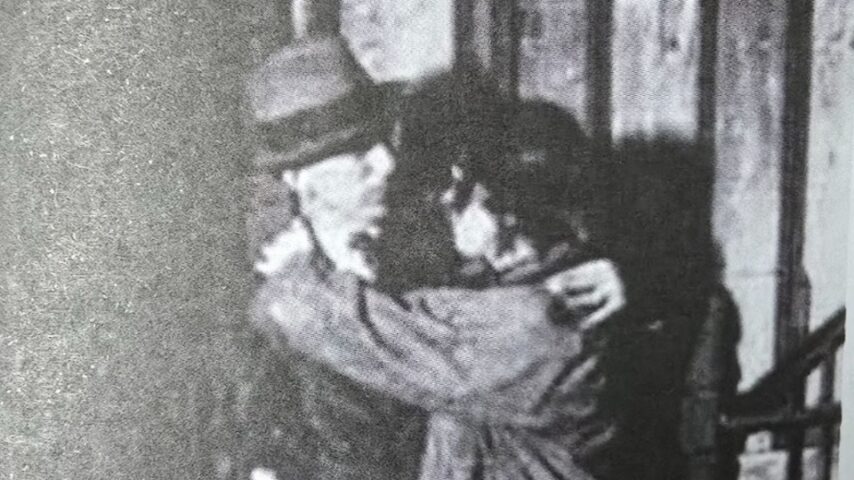
Her dislike of O’Casey was personal rather than political, as were most of O’Casey’s own dislikes as evidenced by his brilliant but acerbic autobiographies. He had a particular aversion to Griffith who was a friend of my great-grandfather who was the Treasurer of the Ard Craobh of Sinn Féin until the Treaty split.
O’Casey’s portrayal of Griffith, which often verged on ridicule, would have been sufficient to earn my Granny’s displeasure. Everyone who was part of the nationalist movement in Dublin knew one another, but that did not mean they were fond of each other. Plus ca change!
Nor were O’Casey’s personal views always or even normally based on politics. He had little time for James Connolly and clearly hated Countess Markievicz. Both of those antipathies related to a petty internal feud within the Irish Citizen Army of which O’Casey was secretary until he took the hump. It is not difficult to see The Plough partly as O’Casey’s settling of scores.
My granny and her sisters were devotees of all forms of Dublin theatre and she had a great fondness for the renowned actors, comedians and musicians who graced the stage of the Royal, the Olympia and the Gaiety in everything from melodramas to pantomimes and the plays by O’Casey, Synge and others staged in the Abbey.
There is a story about her brother Dan Hannon who did not share their enthusiasm turning up unexpectedly to a revue in the Royal some time in early 1920 much to the surprise of Cissie, Daisy and Kathleen. Apparently, his interest was in the drunken Tommies who were on a night out from the barracks. Their safe return was unlikely to have been his concern..
I have no idea what my grandmother thought of the play itself. She was an awful woman for pointing to a photograph in a book or when someone appeared on television and making an enigmatic remark which indicated that she had known them or that her family knew them and that she either greatly liked them or certainly did not like them. De Valera headed the pantheon of the demons who peopled her memory.
When I, as her ever attentive Boswell, would press further she seldom elaborated, especially if my mother or father were there and silent exchanges of looks would put an end to any further historical soliloquy. For she – despite her Free State and Blueshirt sympathies – was the embodiment of Conor Cruise O’Brien’s theory about Fenian grannies and mothers passing on the seeds of ‘extreme nationalism.’
Which is not how I would regard it and her matter-of-fact narration of what had taken place during her own adolescence. She was 12 when the Rising took place and her brother Dan had ended up in the Ballykinler internment camp by the time the Truce was called in July 1921.
What I do recall is her palpable disappointment about how the whole thing had ended. So while she would have had no sympathy with the looters of Easter Week – who included part of the cast of The Plough – she most likely shared at least some of the sentiments expressed in O’Casey’s trilogy of plays. They are all based on the reaction of Dublin tenement dwellers to the seismic events between the Rising which is the background to The Plough and the Stars, and the Civil War which had intruded into the chaotic lives of the characters in Juno and the Paycock.
My Granny’s side had ‘won’ the Civil War but she never gave me the impression that anyone had gained from it. She blamed Dev for the whole thing and she and other Dublin Fenians – who absurdly ended up voting for the likes of Henry Dockrell, Fine Gael TD for Dublin South Central and scion of the Protestant Unionist merchant dynasty – did better out of the ‘Irregulars’ in power than under their ‘own.’ Which I do recall being the subject of mostly mirthful jibing in the Treacy house in Drimnagh at election time in the 1970s.
As for the play itself, it is magnificently written and there is no doubting O’Casey’s mastery of the form, although I prefer the autobiographies which run to more than 1200 pages. Few people have caught ‘Dublinese’ better in words than O’Casey and the actors did justice to the mix of humour and pathos.
The only criticism I would have is that the scale of the set tends to overwhelm the actors in some scenes and detracts somewhat from O’Casey’s reliance on the richness of the language spoken by the characters. Which comes across better in more intimate surroundings like the bar in Act II.
What led to the objections and what has been described as a riot in 1926 had nothing to do with the technical aspects of the performance. Nor was it simply or mostly a spontaneous reaction by ‘right wing’ republicans in the audience to the appearance of the tricolour and the Starry Plough in a pub. Compounded by the earlier presence of Rosie Redmond, a prostitute, while a character O’Casey deliberately meant to be taken to be Pádraig Pearse declaims outside on the bloody virtues of war.
Far from being a gut response, the protests which were clearly designed to stop the play, had been organised beforehand by the great hero of the modern left, Frank Ryan, who was then on the Dublin Brigade staff of the IRA.
That is made clear in Seán Cronin’s biography of Ryan where he cites evidence that Ryan had solicited the aid of Cumann na mBan to initiate the off stage scenes in the Abbey. Cronin passes over the incident quickly as it sits uneasily perhaps with Ryan’s image as some bizarre prototype of latter day anti-nationalists.
Ryan’s confrere Peadar O’Donnell was also annoyed over the play’s portrayal of The Young Covey the doctrinaire Marxist. It is not unlikely that he was a caricature of the Communists around O’Donnell who were later expelled from the IRA or left to form the Revolutionary Workers Groups which later became the Communist Party of Ireland. O’Donnell was identified in intelligence reports as acting on behalf of the Comintern to infiltrate and split the IRA.
There was undoubtedly a resentment against the play and towards O’Casey across the range of republicans from those who in April 1926 were to split from Sinn Féin to found Fianna Fáil to the IRA and the tiny Marxist left.
That this was borne out of the humiliation of the Civil War and the perception that O’Casey who was nominally one of ‘theirs’ was seen rightly or wrongly to be mocking the beliefs that had motivated the Volunteers and the Citizens Army in 1916. It was bad enough to be defeated but worse to be almost ridiculed and have your noses rubbed in it. .
Certainly that was how the plays were pitched in the 1970s and 80s when they were easily incorporated into the narrative of revisionist anti-nationalism.
O’Casey left Ireland a month after the riots over his play and lived in ‘exile’ in England for the rest of his life. He remained a lifelong Stalinist; writing in support of the humiliating show trials and murders of Bukharin and others who fell victim to O’Casey’s hero Uncle Joe.
Which did not prevent him becoming an icon of the Irish liberal left for whom he was one of the symbols of their ‘suffering’ in a country that deeply undervalued them until they gained the upper hand over the peasantry. Through their control of the media and the academy they were then able with the aid of state censure and indeed censorship of ‘backward nationalism’ to set much of the tone of public discourse.
All that aside I thoroughly enjoyed my evening with Ciara. I suspect herself and her great granny would have gotten on like a house on fire with myself assuming the traditional Treacy custom of silence and listening. Because you always learn something new and uplifting.
The play itself – and I am more comfortable discussing its historical background than its artistic merits – has stood the test of time as an insight into Dublin in the troubled times.. The actors were well suited to their parts and it is well worth seeing.