A new report from the national electricity grid operator has warned of a “potentially challenging” outlook in the coming years as the industry figures out how to “meet the increasing need for energy without relying mainly on burning fossil fuels”.
EirGrid’s annual All-Island Resource Adequacy Assessment, which looks at the balance between electricity demand and supply in Ireland over 10 years found that to meet the country’s likely electricity demand between 2026-2028 “additional capacity is required”.
The assessment looks at demand (what Ireland needs); generation (what can supply the demand); and adequacy (the potential gap between the two).
Since 2016, EirGrid has warned of an “increasing tightness” between supply and demand.
According to the report, such factors as the weather, economic activity, and the electrification of heat and transport impact electricity demand.
However, noted as a “key driver” of electricity demand in Ireland for the next number of years is the connection of data centres and other new technology loads:
“In Ireland, there is approximately 2,100 MVA of demand capacity that is contracted to data centres and other new technology loads at the transmission level, and approximately a further 300 MVA contracted at the 110 kV distribution level (managed by ESB Networks).
“Based on EirGrid’s review of data centres and new technology loads, demand is expected to continue to rise from current levels as these customers build out towards their contracted load.”
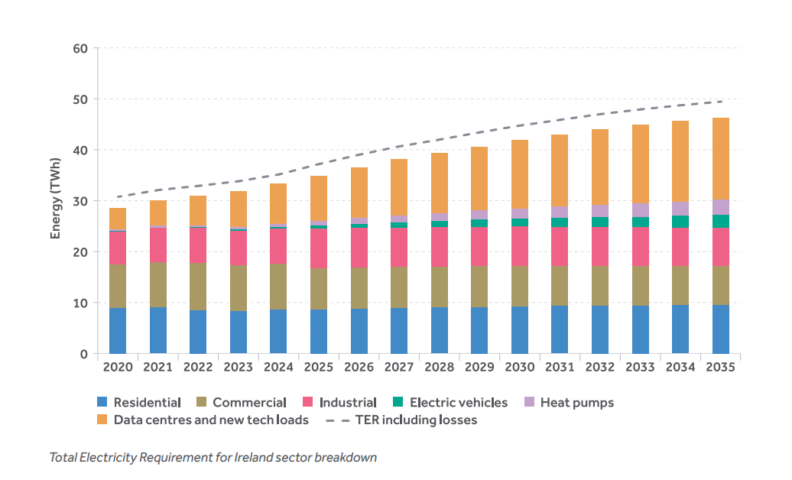
In its analysis, EirGrid sets out a range of scenarios to examine possible outcomes depending on a range of influential factors.
Three demand scenarios for Ireland are considered, which are median demand, low demand and high demand, the median secure demand scenario being EirGrid’s best estimate of what might happen in the future.
“Looking out to 2030 and beyond, the median scenario shows that electricity demand is set to continue to increase as consumers use electricity in new ways, with slower but sustained growth then out to 2035,” EirGrid says.
In its conclusion, the report states that over the next few years, “the assessment indicates a potentially challenging outlook in Ireland across the study horizon”.
“The electricity industry will have to find new ways to meet the increasing need for energy without relying mainly on burning fossil fuels,” it reads.
Commenting on the report, Head of Power System Insights and Research Design Authority at EirGrid, Marc Senouci said that “as we transition to a renewable-led transmission system, the electricity industry will need to identify new ways to meet growing demand for energy”.
“As the landscape of demand and generation supply changes, and as electricity demand increases, government policy will help guide the transition, but a coordinated effort to manage both the volume and type of new capacity will be needed.
“In addition, it’s crucial that the capacity market delivers new capacity efficiently, and the type and volume of capacity needed to underpin the energy transition,” Mr Senouci said.
The assessment can be accessed in full here.