Minister for Justice Jim O’Callaghan has made much of his tough new line on bogus asylum seeking and the headline figures at the end of 2024 would appear superficially to support him.
The overall number of asylum applications has fallen by almost exactly one third to just over 12,000, a fall of 5,500. Much of the reason for that being a stricter policy on countries which have been designated as safe. Georgia is the best example of this although there are still 2,800 Georgians in IPAS accommodation.
Georgians have featured strongly among the number of deportations although as we have shown previously, while the numbers deported have increased, it has been from a low base and the overall figures compared to the thousands who have exhausted all the other channels of being granted residency are very small.
There have been around 400 deportations this year compared to 162 in 2024. However, that has to be compared to the more than 4,000 orders issued. So perhaps the only thing that has changed is that you are more likely to hear about them.
The optics of that has convinced some that Jim is kicking butt. Rhetorically perhaps, and perhaps he even intends to do more, but he is hog tied by a legal system and a well-funded NGO nexus that is equally intent on frustrating him.
In any event, 12,000 new arrivals is still a large number and they all have to be accommodated. Which means that the State’s headache of finding places for them to stay has not abated. Proof of that is in the numbers who are under the direct responsibility of IPAS.
At the end of 2024, there were 32,702 people in what used to be known as ‘direct provision.’ At the end of the last week of reporting before Christmas there were 32,921. So that figure is still going up, just at a slower rate. Which begs the question as to where the 12,000 new arrivals are. Given that there has certainly not been a mass exodus of a similar number which would account for the overall total being up by just over 200.
Not even the obscure references made by the current Minister and his predecessors to ‘voluntary departures’ – which we now know from a PQ response last month are not people who have been issued with a deportation order – would account for the difference.
The State has lost several large existing or potential accommodation centres in Lissywollen, Crooksling, Coolock, Thornton Hall and others perhaps. These were to be the centre piece of the new strategy to lessen dependence on private contractors using mostly former hospitality accommodation. Given the loss of the large capacity centres, one wonders where every one is.
It is true that the moving of Ukrainians out of direct provision has freed up spaces but to what extent? I do not know and nor have I seen any evidence which would suggest that thousands of Ukrainians are now paddling their own canoe. Perhaps they are, I don’t know.
What we do know from pretty reliable sources is that Ukrainians at Citywest have been put on notice that they will have to find alternative accommodation now that the State has taken over from Michael McElligott and chums. The end of January has been mentioned, but the Ukrainians in Citywest are naturally not best pleased over having to change schools and so on.
Whatever plan there might have been to resolve that conundrum within the radius of Citywest might have been stymied by recent Court decisions, but I stress that is only speculation on my and others’ part. Informed speculation but speculation none the less.
It is also apparent to me as a planning nerd that there has been a notable falling off in the number of applications and notifications to local authorities regarding exemptions for new asylum accommodation. Which again begs the question as to where another 12,000 arrivals are currently crashing.
Again, there is the possibility that space has been freed up by the moving out of Ukrainians but I and others don’t see much evidence of that. What I do see – and this was highlighted by the murder of the young Ukrainian in a Tusla contracted apartment in Donaghmede – is that there is a burgeoning smaller scale accommodation sector that uses residential accommodation.
I have reported previously on situations such as in Portarlington where it appeared that private housing, seemingly unregistered with any official body, was being used to house asylum seekers.
And if you think that anything IPAS connected is clouded in opaqueness, try and get information on the contracts that Tusla has with private companies to provide accommodation for smaller numbers of ‘unaccompanied minors.’
Readers may indeed recall one example earlier in the year where I discovered and visited one such premises in Clontarf that had secured an exemption on the basis that it was simply a change of use from already existing care accommodation to accommodation for minors who were going through the international protection process. No such thing it seems, and it would not be unique.
All that aside there is an element of “Look over there!” when it comes to the optics of pitching O’Callaghan’s new toughness – for the simple reason that asylum applicants only account for a relatively small, and declining, part of the annual arrival of immigrants. Asylum only accounts for around 10% of the more than 100,000 immigrants this year.
There is obviously the difference that people arriving to work or study – although the latter is coming under scrutiny now – are here on their merits. The State itself recognises that the vast bulk of asylum applications are not valid. The problem there is how to remove that 80% or whatever the current proportion is.
So, asylum aside, the Irish state still faces a huge problem regarding immigration of all types. And you do not have to take my word for it. A few weeks ago, I noted that the ESRI had poured cold water on the housing targets and quietly, on December 19, the Central Bank itself added its sober judgement on the Great Housing Leap Forward.
In its final Quarterly Bulletin for the year, the Central Bank is slightly less pessimistic than the ESRI and forecasts that between this year and the end of 2028 that there will be 180,000 new house completions. The current Government plan is for 300,000 by the end of 2030 which would mean that around twice the current number of houses will need to be built in both 2029 and 2030 than this year if the target is to be reached.
That is unlikely but then so are the other figures if past delivery is anything to go by. Especially given that the Central Bank bases its projections on the most optimistic take on future expenditure, speeding up of planning, the availability of zoned land and continued growth. Failing any or all of these, the Bank states that this will “result in a lower level of completions than projected in the Bulletin.”
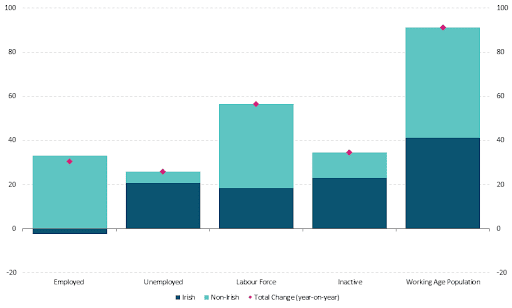
While the Bulletin does not directly address the issue of immigration, it takes it for granted that “net inward migration” will continue to be central to “meeting labour demand.” And indeed, the Bulletin includes a table which shows that non-Irish workers accounted for two thirds of the growth in the labour force to the end of the third quarter of 2025.
So while Jim O’Callaghan and his admirers might exult over a few dozen more illegal immigrants being put on airplanes, the Irish state remains on an inexorable demographic social transformation on an unprecedented scale. And it seems, the state will not have enough houses for them all.