December 25 2021 marks the 21st anniversary of the death of Fr Aedan McGrath. A truly remarkable man, he survived almost three years of torture and solitary confinement in a Chinese jail; a punishment for spreading the gospel in a communist nation. Despite the hardships he endured, Fr Aedan McGrath remained a man of “extraordinary vitality” who had “a tremendous capacity for friendship” right up until his death at the age of 94 on Christmas Day, 2000, just one month short of his 95th birthday.
An Irish Columban missionary priest in China, he was the person largely responsible for the spreading of the Legion of Mary through China in the late 1940s and early 1950s. For those not familiar with its work, the Legion of Mary was founded by Irish man Frank Duff in Dublin in 1921, and blazed a trail throughout the world during the 20th century through its service to the sick, needy, forgotten and vulnerable; its evangelisation of people from all backgrounds, cultures and classes; and its spiritual direction and sturdy teaching of catechesis.
Fr McGrath was a huge component in the apostolic association’s mission, and he quickly gained prominence, becoming much-admired and respected for his tireless work in China as a Catholic missionary priest. His persistent spreading of the Gospel in an authoritarian communist state eventually led to his imprisonment and torture by the communist People’s Republic of China.
When he was eventually released from captivity two years and eight months after his arrest, Fr McGrath showed true resilience, resuming his work with his beloved Legion of Mary and reaching many more souls, ministering zealously to the people of the UK, the US, Canada, and the Philippines.
Born in Drumcondra, Dublin, on 22 January 1906, he was one of six children, five boys and one girl; three of whom became Columban fathers. Speaking of the three vocations to the priesthood in his family, he recounts in an unearthed audio from years ago: “Three of us became Columban fathers. In 1918, the eldest of the three, he joined the Columban fathers in Galway. “I joined the Columbans then in 1923, and a third brother joined them in 1929.”
His parents, Gertrude and William McGrath, both came from across the border in County Down. His father, William, a King’s Counsel (Barrister) and County Court judge, was tragically shot dead, reputedly by the Black and Tans, outside his home in 1920 when Aedan was just fourteen years old.
Fr McGrath received his early education at home with a governess, and later attended Belvedere College. In 1923, his family set off for England, and he continued his studies at King’s College, London. He joined the Columban Fathers that same year, being ordained a priest in Galway in 1929.
“In my early days I was in Belvedere College. Actually, I played football with poor Kevin Barry, and have lots of friends still alive who were at Belvedere College at that time. I loved the college, I wasn’t brilliant by any means, but I did enjoy the classes, and the sport,” Fr McGrath recounted.
In 1930, after six months of ordination, at just twenty-four years of age, Fr McGrath was sent with several other young Columban fathers to Hanyang in China. “At that time, it wasn’t a plane. We took the ship and it took us six weeks. It wasn’t all that pleasant a journey but it was tolerable. When I got to Hanyang, it was the first diocese of Columban fathers, […] Bishop Galvin welcomed me to the diocese. Things were difficult enough.”
Fr McGrath arrived just in time for severe flooding. The Yangtze and the Han rivers met and overflowed and millions of people drowned. “Well, the rivers overflowed in the summer after I got there (1931), and I had sixteen feet of water in my room. Obviously, it destroyed my books and destroyed my clothes. I didn’t get into that room for six months. We had to go into the house in a boat. And that was the beginning of many incidents of this kind that would occur in my life in China.”
Following a couple of years in Hanyang, he was sent to T’sien Kiang: “The Bishop was short of priests. One day he called me. I didn’t have very much Chinese at the time. And he said to me, ‘Aedan, I want you to go up to T’sien Kiang.’ It was about over 100 miles north, but would take two or three days to get there. He said, ‘You’re the first priest to go there. I’m afraid there’s no church, and I’m afraid there’s no rectory, there’s no house. I don’t know what you’ll do, but in God’s name, go.’”
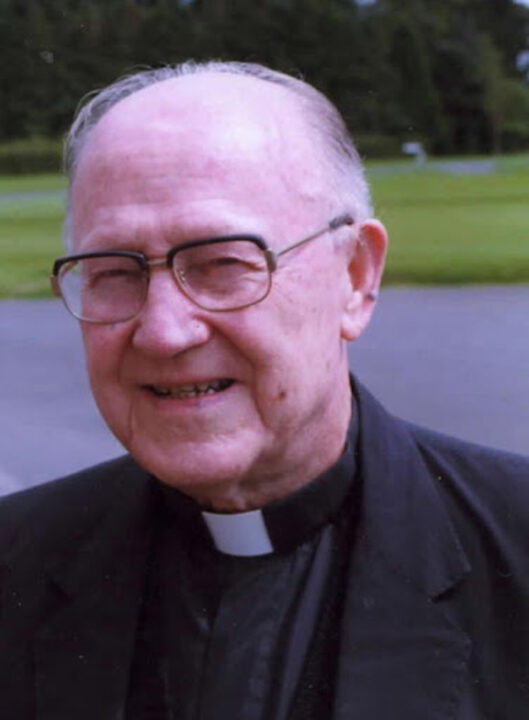
Bishop Galvin told him that, as far as he could see, Fr McGrath would never have a church, or a house. for that matter. Recounting his words, Fr Aedan said that the Bishop’s primary concern was the spreading of the gospel to the people of China: “I might say here in parenthesis, that Bishop Galvin was so concerned about evangelisation and about the fact that these Chinese were not as privileged as we were and were not baptised, that was the top priority. Houses were details – and I would always admire him for that attitude.”
The young priest set off for T’sien Kiang, a small town, and remained there for sixteen years as parish priest. The first house he lived in was a rented house on the street which he could not afford, so he eventually moved in with a Buddhist family.
In an old audio, he recounts years later: “There were three generations: a grandfather, three sons and 20 grandchildren. They had a pickle factory. Life was simple […] The main thing about the family I lived with was that they were superb. They were not Christian, but they were brought up on the philosophy of Confucious: that man is probably not well enough known. He was marvellous. He did not know of God but he (Confucious) spoke about the heavens; there was something in the heavens that he couldn’t understand, but that was ruling things.”
“I was quite happy there. I had a small room. And very soon, the old man, he picked up a catechism and he read it with great relish, and he said, ‘Father, this is good.’ And, after a while, he asked for baptism, and of course the three sons followed suit, and I baptised their wife and children and we were a Catholic home. And I lived there for sixteen years.”
He had 24 missions which took place across a wide area: “I spent three days in each mission, staying in a straw hut. I brought my own blanket. There were no roads or buses. I walked.”
When, overwhelmed by his heavy workload, he asked the Bishop for another priest or sister to assist him, he was sent a copy of the handbook of the Legion of Mary and told him to start it in his parish.
Reluctantly, he agreed to do this, and was subsequently astonished at how, after starting with six normal men from the local area, he was able to inspire them to do an incredible amount of apostolic work.
“I called in six men with no particular qualifications. I did not think it would work, I intended to give the book back to the bishop when it failed. To my utter amazement, those men were able to do many things that I could not do.
Six months later, he had five Presidia (groups) of men under him, made up of “135 first-class Legionaries”. He realised that the Legion was an incredible gift to the Church – a way that the power of a single priest could be multiplied to an extraordinary degree.
In 1939, the atrocious “rape of Nanjing” took place, a brutal episode of mass murder and mass rape committed by Imperial Japanese troops against the residents of Nanjin, which was, at the time, the capital of China. The massacre occurred over a period of six weeks, starting on 13 December 1939, during which the city was burned, and Japanese troops, determined to break the spirit of Chinese resistance, launched a campaign of unspeakable atrocities against civilians. The Japanese killed an estimated 150,000 male “war prisoners,” massacred an additional 50,000 male civilians, and raped 20,000-40,000 women and girls of all ages, many of whom were mutilated or killed in the process.
During the ordeal, 4,000 Japanese soldiers arrived in Fr McGrath’s parish, and the women ran to him looking for protection. Perhaps fitting evidence that, in the words of Romans 8:28, “In all things, God works for the good of those who love him,” he was able to provide shelter for the women in his compound for six months thanks to an acquaintance he made with the actress Loretta Young while on a visit to Hollywood in his earlier years. Remarkably, a Japanese officer who liked Miss Young placed the priest’s residence off limits.
He recalled: “The women ran to me looking for protection. I was supposed to keep the Japanese army out. God directed me to one particular soldier. We started talking about movies. He asked me if I liked Loretta Young, and I said `She’s a personal friend of mine’. I had met her in Hollywood. He was very excited to learn that I knew his love in Hollywood. He wrote something and sealed it and put it on the door. The soldiers all saluted and stayed away. The women stayed with me for six months. They were all baptised at that time.”
Fr McGrath was later expelled for two years from T’sien Kiang because Eamon de Valera – who was then President of the League of Nations – accused the Japanese of trespassing when they went into Manchuria. On his return, he was surprised to find that his parish was still intact and functioning perfectly.
“When I was allowed back, I expected to find nothing. Instead, the parish was working perfectly without me. The Legion of Mary had kept everything going, baptising the babies, instructing the children, performing marriages.”
Following a visit to Dublin in 1946, he returned to T’sien Kiang and was given the instruction to start the Legion all over China. “Within half-an-hour, the first praesidium was formed in what was probably the most sophisticated university in China at the time in Shanghai.
“From Shanghai, I went to central China, Hankow, and did the same. Then up to Beijing. Within two years we had 2,000 magnificent groups. “The work was not lost on Mao Zedong. He sent out people to search and find how the church was still alive . . . He called the Legion public enemy number one.”
His extraordinary work in China ground to a sudden halt in September 1951 following the Communist establishment of the People’s Republic of China two years prior. The Legion of Mary became a proscribed organisation, with its founder, Frank Duff (whose cause for Canonisation is underway at the moment) was declared a “reactionary guardian of the interests of the ruling class.”
Fr McGrath suffered because of his association and his activities on their behalf, and was arrested by Chinese authorities. He was imprisoned by the regime in Shanghai in September 1951, remaining in jail in harsh conditions for almost three years. He spent most of those two years and eight months in solitary confinement and endured torture.
“It was like a miracle”: VIDEO of Fr Aedan McGrath: Fr Aedan talks about his time in solitary confinement in China and how a bird miraculously warned him whenever the guards arrived.
“I was put in a tiny cell, like a dog box. It was solitary confinement for three years. There was no table, chair or bed. I could lie on the floor. I was never allowed to close my eyes, talk or sneeze,” Fr McGrath, whose work in China has been told in Enemies Without Guns, by James Myers, recounts.
Fr McGrath, who was not allowed to sleep during the day, made sure that his entire day was occupied with prayers, including reciting the prayers of the Mass. He also did other mental activities, so that he didn’t lose his mind, as happened to more than one prisoner. One way he kept his mind alert was by creating poems which he memorised.
From the beginning of his imprisonment, he possessed a strong sense that he was being protected by his Blessed Mother, Our Lady, although prison life was difficult. He slept on thin mats of concrete floors, had little to eat, and was not allowed to talk to other prisoners, though they eventually found a way of secretly writing and passing each other small bits of communication, including Christmas cards.
His night-time interrogations, of which there were many, lasted many hours, during which he would patiently explain that the Legion of Mary was a peaceful religious society. Despite this, he was castigated and accused of being a liar, and that unless he confessed to the crimes of the Legion, he would receive no leniency. Nevertheless, he endured and did not relent.
Rather than being executed, he was finally released and expelled from China on 28 April 1954, which was, fittingly, the feast day of St Louis de Montfort. He movingly noted that he heard his first words of “decent kindness” in three long years when he crossed into Hong Kong, and a British policeman said to him: “Welcome, Father!”
After his release, he returned to Ireland, where he was greeted on arrival with a huge reception in the National Stadium attended by President Sean T. O Ceallaigh, Taoiseach Eamon De Valera and Fine Gael politician and former Taoiseach John A. Costello, and of course, the Legion founder, Frank Duff.
Fr Aedan McGrath credited his survival to his Columban formation, through which he had learnt how to meditate. Following his release he travelled widely, promoting the Legion of Mary.
In 1955, now 49 years old, Fr McGrath worked with Irish emigrants living in England, and over ten years later, in 1966, travelled to the USA and Canada to work full-time for the Legion of Mary. His zeal for souls and self-giving energy still intact, he travelled to the Far East in 1977 to speak about the Legion, making his way through Japan, South Korea, Indonesia, Sri Lanka, Hong Kong and Taiwan.
Those who knew him recount that, although small in stature, he possessed extraordinary vitality and energy, and still enjoyed a game of golf in his old age. In August 1999, just months before his death, a celebration for Columban jubilarians (those celebrating seventy years of the priesthood) was held at Dalgan park in Meath.
The homilist was no other than the platinum jubilarian, Fr Aedan McGrath, who earlier had joked to a friend: “I think you will have to call me a platinum blonde.”
After attending his last Legion of Mary council meeting in December 2000, he died on Christmas Day 2000, aged 94 and was buried in the Columban Dalgan Cemetery.
Fr Aedan McGrath’s story is an astonishing, wonderful tale of perseverance and courage, where concern and love for God and for others over self is always firmly at the forefront. He was a man – who along with many ordinary Chinese Catholics – courageously stood up to the communist system despite huge consequences, strengthened at every stage by the spirituality of the Legion of Mary.
Fr Aedan McGrath & the Legion of Mary on the Missions in China 1929-1951 – YouTube