Describing disinformation as a “serious challenge that can only be met with a whole-of-society response,” Minister Patrick O’Donovan last week welcomed the publication of the National Counter Disinformation Strategy, which was a recommendation of the Future of Media Commission three years ago.
“This strategy is a first step in setting out what that response looks like,” Minister O’Donovan said.
The report wastes no time in making the case that a response is needed, because according to the Chair of the National Counter Disinformation Working Group Martina Chapman in her foreword, disinformation is a “a dynamic and ever-evolving problem”:
“Disinformation is a complex global challenge that threatens human rights and democratic values. It deceives citizens, distorts evidence, and erodes trust. But this is not new.
“Powerful actors have always weaponised disinformation and used it for financial gain, political influence, and social advancement.
“What is new is how the attention economies of the online world are able to propel disinformation faster and further than ever before…”
The strategy makes use of the European Democracy Action Plan’s (EDAP) definition of disinformation throughout, which describes it as “false or misleading content that is spread with an intention to deceive or secure economic or political gain and which may cause public harm”.
It follows this definition by noting phenomena that don’t constitute disinformation, by this definition’s standard: “misleading advertising, reporting errors, satire and parody, or clearly identified partisan news and commentary”.
Ms Chapman concludes her foreword by saying that “this Strategy is not about anyone, including Government, deciding what is or is not disinformation”.
“This Strategy is actually about allowing people in Ireland exercise all their rights – the right to freedom of expression alongside the right to privacy and the right to freedom from discrimination. No one right or set of rights is absolute or trumps other rights – a functioning democracy must balance these rights. Disinformation disrupts a functioning democracy by sowing artificial divisions. This Strategy will help us all to deal with its damaging effects, strengthen our society and make Ireland a better, safer country.”
The strategy is framed around five “key principles,” each of which is linked with “countering disinformation: “Protect Freedom of Expression using a Rights-Based Approach”; “Building Resilience and Trust at Individual and Societal Levels”; through “Increased Cooperation, Collaboration and Coordination”; through “Corporate Accountability and Regulatory Enforcement”; through “Evidence-Based Countermeasures and Interventions”.
In elaborating upon the first principle, formulated in response to freedom of expression concerns, the strategy states that all members of society should be enabled to seek, receive and impart information and ideas, “while acknowledging that the right to freedom of expression must be balanced with rights such as privacy, protection from discrimination and data protection under the GDPR”.
It further states:
“Disinformation can be used by bad actors to violate and abuse these rights, and can impact people’s ability to make free and informed choices. However, measures taken to counter disinformation may themselves limit freedom of expression and media freedom, and should therefore comply with the principles of legality, necessity and proportionality.”
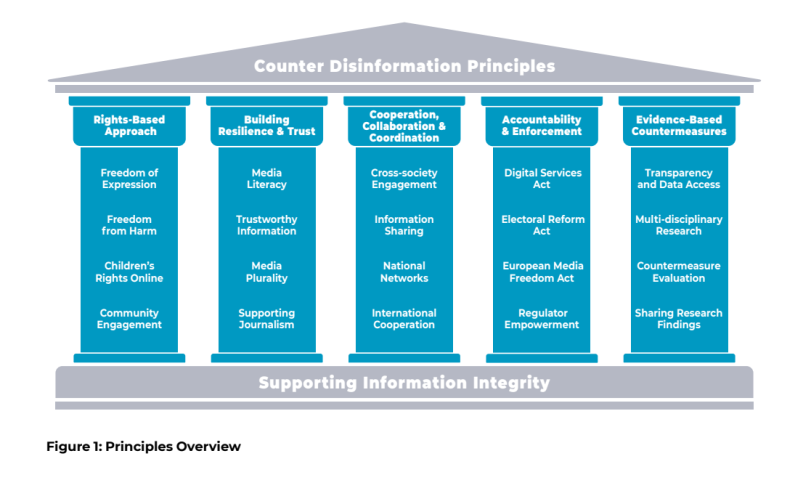
Under those five principles, the Working Group agreed to nine commitments, composed of 36 actions designed to “make the principles a reality”:
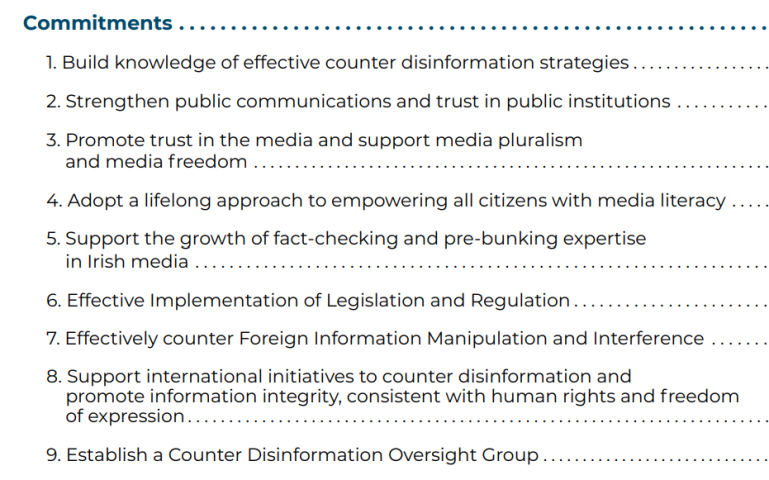
Among the more notable elements here are the commitments to developing “pre-bunking” expertise in the Irish media space, alongside the plans to counter “Foreign Information Manipulation and Interference” and to establish a “Counter Disinformation Oversight Group”.
“Pre-bunking” is a practice that arose as a result of the perceived failure of the “de-bunking” approach for things deemed mis- and/or dis-information, and aims to actively counter narratives before they spread.
This is despite the position held by free speech advocates, who have argued that labelling certain ideas or narratives as harmful or false, including prematurely, could have a chilling effect on legitimate but controversial discussion.
‘Foreign Information Manipulation and Interference’ (FIMI) also features prominently in the strategy, and is described as a pattern of behaviour that threatens or has the potential to negatively impact “values, procedures and political processes”.
“Such activity is manipulative in character, conducted in an intentional and coordinated manner. Actors can be state or nonstate, including their proxies inside and outside of their own territory,” the definition reads.
The strategy states that since March 2022, there has been a “sharp increase” across the continent of “malicious” FIMI campaigns. Russia itself, as well as Russian “proxies and aligned groups”, are identified as the primary antagonists, although the European External Action Service (EEAS) is cited with reference to a statement that other foreign actors are also carrying out the “intentional manipulation of public conversations”.
In relation to the commitment to “effectively counter” FIMI, various Government departments are tasked with leading different measures. For example, the Department of the Taoiseach, supported by the Department of Justice, the Department of Foreign Affairs and the National Cyber Security Council, is to head up a “coordinated national approach to countering FIMI”, which is to be elaborated in the upcoming National Security Strategy.
Similarly, the Department of Foreign Affairs is to take the lead on cooperation with the EU when it comes to developing anti-FIMI strategies, while also working on Ireland’s relationship with other countries and international organisations to develop Ireland’s counter-FIMI capacity.
The establishment of a “Counter Disinformation Oversight Group” is also committed to in the strategy, “to ensure coordination, monitoring and implementation of the Strategy’s commitments and actions”. The group’s first meeting is to take place within four months of the strategy’s publication.
The Department of Tourism, Culture, Arts, Gaeltacht, Sport and Media is designated the lead organisation on this, and is also required to support the oversight group in the accomplishment of one of the other actions: agreeing a review process to monitor progress on implementation of commitments and actions in the Strategy, including consideration of where new actions may be of benefit [italics added].
The theme of disinformation as a threat to “electoral integrity” also receives attention in the document, with a description of the phenomenon as one of the “biggest threats to democracy in the 21st Century” cited at the beginning of that section.
Two studies, one conducted by the International Institute for Democracy and Electoral Assistance (International IDEA), the other by the European Digital Media Observatory (EDMO), are noted to have observed “widespread” disinformation campaigns against and during elections in a number of different countries.
However, the strategy adds that while “neither of these studies focused on Ireland, there is no reason to believe Ireland would be immune from similar activity”.
Additionally, the World Economic Forum’s identification of “disinformation and misinformation” in its Global Risks Report as the “most severe global risk anticipated over the next two years” is pointed to as evidence of the need to tackle the issue.