As Gript exclusively revealed on Saturday, an application to install an accommodation centre for persons seeking International Protection in part of a shopping mall on Moore Street in Dublin has been rejected by Dublin City Council.
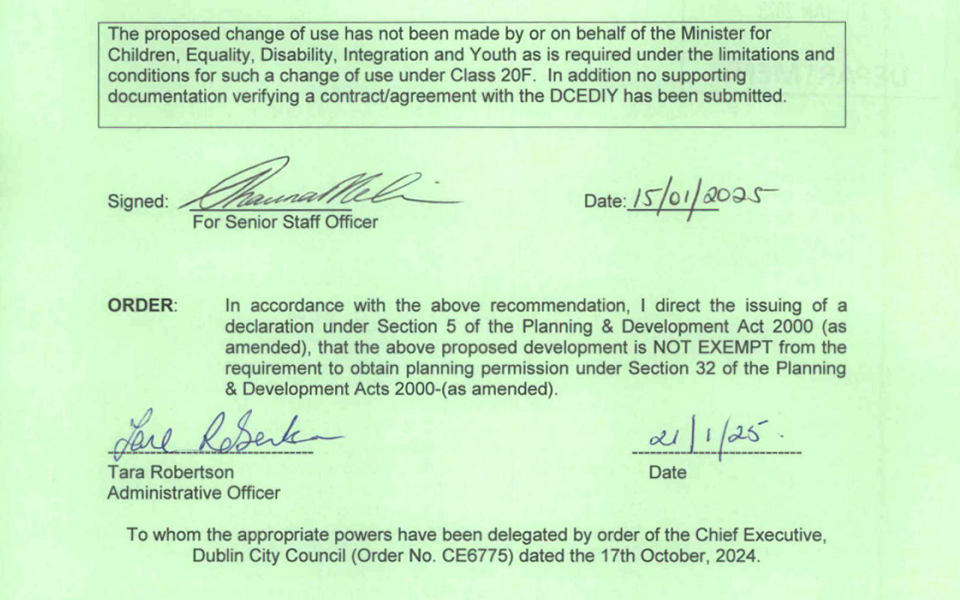
In its decision the City Council decided that the proposal as outlined in the application dated December 16 last was not exempt in accordance with Class 20F of Schedule 2 Part 1 of the Planning and Development Regulations 201 to 2023 and Section 4(1)(h).
The agents for the company concerned, Secure Accommodation with an address in Drogheda, had also claimed that the proposal was being made “on behalf of the Minister for Children, Equality, Disability, Integration and Youth to assist in meeting Ireland’s legal obligation to provide accommodation to displaced persons or persons seeking international protection.”
It went on to state that “The Minister’s Department has confirmed that the planned renovation works will make it suitable for its temporary use as accommodation for displaced persons or persons seeking international protection.”
However, as part of the decision document from the City Council states bluntly, the proposal “has not been made by or on behalf of the Minister” – and “no supporting documentation verifying a contract/agreement with the DCEDIY has been submitted.”
Gript contacted IPAS, the Department of Justice, and the architects McKevitt King in Drogheda – who are the agents in this matter for Secure Accommodation – asking them to comment on the apparent contradictions between the claims made regarding the approval or otherwise of the former Minister with responsibility for IPAS contracts. We had received no response prior to publication.
Without either of the parties answering our query it is impossible to know what exactly happened. Did Secure Accommodation and its agent believe that the Department had given some indication that their application was likely to be granted an exemption pending renovations, or were they in error?
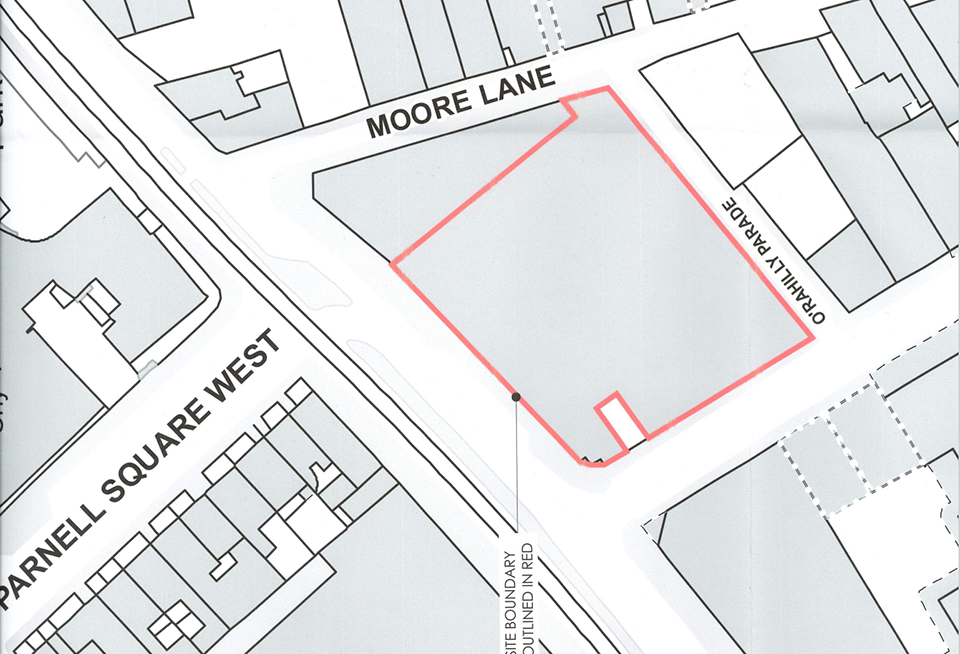
The decision made on the basis of a site inspection and with reference to the above lack of approval by the Department is also interesting as it provides details on what was intended to be done on the site. The proposal to use part of the premises was that “the facility would be able to cater for 235 persons within 56 rooms/cabins.”
Floor plans of the proposed works to accommodate the temporary accommodation have been submitted. At the ground floor adjacent to the entrance from Parnell Street, it is proposed to provide a communal kitchen area, Manager’s Security Office and bin storage area. At first floor, it is proposed to provide 56 sleeping accommodation rooms with 31 of the rooms indicated for women in addition to bathrooms, communal recreational spaces, women’s kitchen and women’s dining area. Four separate escape stairs are also proposed.
I visited the site in question and it would be difficult to imagine how that many people might have been comfortably accommodated in the part of the first floor stated in the application. The mind boggles at the reference to cabins and what they might look like and where they might be placed in order to provide living space for an average of more than four people per room or cabin.
The site notice inspection refers to the premises being in a part of the city centre with a Z5 designation, the objective of which is “To consolidate and facilitate the development of the central area, and to identify, reinforce, strengthen and protect its civic design character and dignity.” A somewhat ironic, if laudable, aim given the squalid and seedy character of much of the surrounding area, including Moore Street itself.
The inspection report sets out the criteria governing the granting of planning exemptions under Class 20F which allows for the “Temporary use by or on behalf of the Minister for Children, Equality, Disability, Integration and Youth to accommodate or support persons seeking international protection ….”
The list of the sort of premises it then describes that can be used for such a purpose and thereby claim an exemption includes more or less any building you might care to think of with the exception of residential dwellings. They range through schools, hotels, shops, art galleries, sports facilities, health care facilities, and even churches.
The report then states that the site had been granted a change of use from retail to family entertainment under an earlier application 4200/08 and that this had been granted an extension. It would appear that this was to be a part of Dr. Quirkey’s entertainment operation which currently has a large, garish presence on O’Connell Street.
Secure Accommodation had apparently argued in a covering letter to the planning authorities – which is not part of the documents available on the City Council planning site – that the transfer of use to family entertainment had not taken place and that therefore the premises was still to be considered as for retail use. Consequently, the “the proposed change of use of the building for the temporary accommodation of international protection applicants would be exempted development in line with Class 20F, i.e. change of use from shop to temporary accommodation.”
The Dublin City Council report states – having considered and rejected the claim by the applicant that the premises had not been designated for use as a “family entertainment centre” – that the proposal to use part of the building as an accommodation centre “contravene the provisions of Class 20F Exemption as set out under Part 1 of Schedule 2, entitled ‘Exempted Development – General’ of the Planning and Development Regulations 2001, as amended.
“The permitted use of the subject structure, as a family entertainment centre, is not included within the list of ‘certain specified structures’ which Class 20F permits a change of use for the purpose of providing the necessary facilities for international protection applicants.”
And there the matter rests it would appear. The scrutiny of the site and the vigorous scrutiny of the application is to be welcomed. Some would question whether such diligence is always carried out given that the only obligation strictly speaking on the part of the applicants for a Class 20F exemption is to simply notify the relevant local planning authority.
Speaking of the sector more generally, and not referring to this situation in particular, we are well past time to increase the level of public scrutiny requests to build asylum centres.
Contractors have been submitting requests to the local planning authorities that would be consigned immediately to the bin if they were to be submitted on behalf of a normal commercial business or someone wishing to build an extension to their home.
It is time for greater diligence and scrutiny, and for the local authority to retain power over such matters – as Westmeath County Council has demanded – before these centres are placed in the middle of business and residential communities who neither want them nor are given a say over them.
The same must be extended to a full public and independent inquiry into the manner in which contracts are being awarded for this purpose, and most of all to whom they are being awarded. The Irish citizens have a right to know about this given the billions it is costing them on top of all the other collateral damage that it brings.