The TG4 poll for the Kerry constituency would appear to point to no change in the destination of the seats which split last time between the two Healy-Rae brothers Michael and Danny standing as independents; Norma Foley of Fianna Fáil, Pa Daly of Sinn Féin and the Fine Gael seat going to Billy O’Shea who will replace Brendan Griffin who retired earlier in the year.
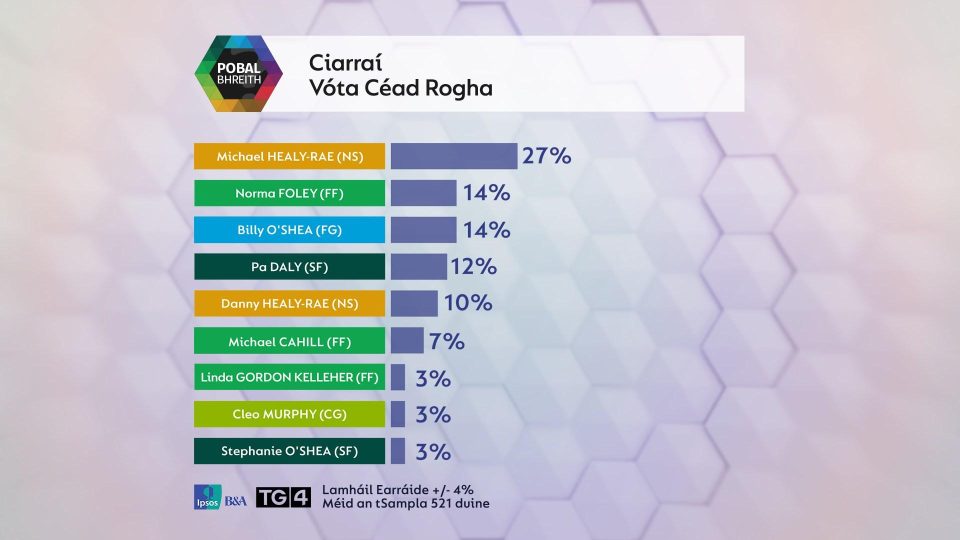
That no change on the face of it is pretty dull but does underline the prevailing view that Sinn Fein has no chance of taking a second seat. That in itself had been tacitly accepted by the party in its late and reluctant decision to stand Stephanie O’Shea as a second candidate alongside sitting TD Pa Daly who was elected for the first time in 2020.
O’Shea had stood in the Kenmare local election area in June and was not even the highest polling Sinn Féin candidate. She only received 431 votes, a mere 2.9%, and the local talk was that she was only selected for the purposes of persuading a reluctant Daly to take on a running mate. She also serves to boost the Sinn Féin quota of female candidates.
According to the poll, Sinn Féin – which has held a seat here since the election of Martin Ferris for the former Kerry North constituency in 2002 – is on 15%, with Daly on 12% and certain to be elected on later counts. That is very close to the 14.5% taken in the June local elections but 5% lower than what Daly took in 2020 when he was comfortably elected on the first count with a surplus of 2,788.
Daly was beaten into second place by Michael Healy-Rae and there was much talk that SF might have been in a position to challenge for a second seat this time by targeting the seat of Healy-Rae’s brother Danny who was elected on the seventh count in 2020. However, according to the TG4 poll, the Healy-Rae’s vote is projected to increase from a combined 33.8% in 2020 to 37% assuring both of almost certain re-election.
The Sinn Féin vote here is several points lower than it was on last night’s Red C overall showing of 20% – which is the same gap as there was more or less in 2020 between the party vote in Kerry and their 24.5% statewide on polling day.
For Norma Foley there must be an element of relief as there had been whispers that she was “in trouble” as they say. Not according to this poll, as she sits on 14% and the party on a total of 24% – up from 20.7% in 2020 – which does put Michael Cahill in with a better if still slim hope than the Shinners of unseating Danny Healy-Rae.
For Fine Gael, Billy O’Shea’s 14% as their sole candidate is almost sure to be enough to retain the seat held by Brendan Griffin but their total, if the poll is accurate, is down by more than 4% since 2020.
Returning to the national poll and the last debate on Tuesday night, there are a number of things that stand out. I had been under the impression that Mary Lou’s performance in the three cornered debate between herself, Micheál Martin and Leo Varadkar had been a key factor in boosting the Sinn Féin vote in the final days of the last election. .
I did watch that one in 2020, and had been struck by the optics of two big men standing either side of an average- sized woman and both spending most of their time engaged in attacking her, sometimes at the same time. As my brother said to me, if you saw that at a bus stop or in work you’d be inclined to intervene, or at the very least form a sympathy for the woman in question.
But my memory betrays me. For it seems that Sinn Féin’s roll had already taken them to 25% according to the Ipsos/Irish Times poll published days before the debate and a week before polling day on February 8. A Red C poll on January 30 was also pretty accurate as it had Sinn Féin on 24% and all of the other parties on within a point or two of their final showing when the boxes were opened.
Which begs the question as to how important the debates are any more. This has also been debated in the wake of Donald Trump’s victory over Kamala Harris where it has been argued that far more people were engaged through social media and podcasts than through “legacy media” and the tired old leaders debates formula whose integrity has been questioned with regard to bias. Social media and Taylor Swift or Joe Rogan don’t have to pretend to be impartial.
On Tuesday, just over one million people – 1,060,000 – tuned into our leader’s debate. That is a significant drop compared to 1,500,000 who tuned in at some stage to the larger format leaders debate in 2011. The average viewing figure for that was 961,000 compared to 565,000 on Tuesday night. That surely tells us something.
There are over 3,500,000 people registered to vote. That means that less than 30% of those registered bothered to tune in at any time on Tuesday night. Around 16%, if we take the average viewing figure as a guide, were sufficiently interested to stay the distance.
Turnout on Friday is expected to be around 63%, somewhere in the region of 2,250,000. Less than half of them will have seen the debate. Possibly as many will have seen or heard of Simon Harris’ engagement with the care worker in Kanturk last week. Which, if either, event will make a significant difference?
Curiously, the combined exit poll of 5,300 on polling day in 2020 was less accurate than the two last polls particularly in its over-estimation of the Fine Gael vote by 1.5% and underestimating Sinn Féin by 2.2%.
However, if previous election polling and results are an indication it is unlikely that there will be a huge discrepancy between what we see as the party totals on Saturday and what the polls are telling us now.
The devil of course is in the detail and that is why Gript shall be in the RDS pouring over tally sheets like persons demented and waffling between ourselves and with guests over the tea leaves and where we might end up, with a weather eye and stringers in the provinces beyond the Pale adding their tuppence worth.