Patrick Moore, one of the founders of Greenpeace, became an environmentalist because he was familiar with the natural world. He lived in a beautiful area and he thought that these things should be preserved. He believed that preservation was necessary for humanity and out of reasons of compassion and love for nature itself, and for living things.
He got out of Greenpeace in 1986, because, in his view, they had turned away from this project towards pseudoscience. He said that of all the people on the board of greenpeace, he was the only one that actually had a science background. The rest of them were some type of activist. Moore argues that his involvement in the organisation was to address issues with a human and social perspective, guided by a rigorous scientific analysis. He judged that as they turned away from a culture of humanitarian values and towards what they termed scientific issues, that they turned environmentalism into a pursuit of pseudoscience.
Moore’s early activism involved saving baby seals from being clubbed to death, and standing in the way of whalers to prevent them from killing whales in the ocean and wiping them off the face of the Earth. The danger of extinction was real. It was tangible. You could see it. It wasn’t an invisible danger – it was real people with actual mechanized harpoons exterminating beautiful creatures.
As well as preserving the natural world, his motivation in Greenpeace was to promote peace amongst people. Mankind is also part of the natural world, he argued, and our nature-loving world view should also involve the flourishing of mankind. Although Moore claims he is not religious, this worldview he has is very religious in nature: It is hard to see it as anything other than a recognition of man’s spiritual nature. This observation is crucial in understanding the corrupt philosophy that has crept into environmentalism, where people are viewed as a cancer on the earth.
The recently-nominated as US Health Secretary, Robert F Kennedy Jr, had an interesting take on this which he discussed during an interview with Tucker Carlson interview. Kennedy spent many years as an environmentalist lawyer who took cases directly on behalf of communities suffering from things like the consequences of hazardous chemical dumping. In the interview, he said that the new environmentalism of the left is “so weird”.

“The Democrats have become subsumed in the new carbon orthodoxy. The only issue is carbon. What that has done is it has forced them to do something that you should never do if you are an environmentalist, which is to comodify and quantify everything. Everything is measured by its carbon footprint. You’re basically putting everything in that box of being able to quantify and explain its value numerically.
“The reason we protected the environment is the opposite. There is a spiritual connection. There is a love that we have. A connection to the fish, wildlife, birds, whales, and the purple majesty of the mountains. God talks to human beings through many vectors. Through each other, through organized religions, through the prophets, through the great books of those religions, but nowhere with the detail and texture and grace and joy as through creation. When we destroy nature we diminish our capacity to sense the divine, to understand who God is and what our own potential and duties as human beings.
“It’s not about quantifying stuff, that’s what the devil does. He quantifies everything. That’s what he wants us doing; put a number on it. The reason we want to preserve these things is because we love our children. Nature enriches us economically, spiritually, culturally, historically. It connects us to the 10,000 generations of generations that were there before laptops.”
I’m sure there are many people who will point out that Kennedy might not be a holy man living an ascetic life in some mountaintop cave, and his position on abortion in particular (supporting it without restriction to 6 months) has sparked opposition to his recent nomination as Health Secretary, but on this issue he does make a very evocative argument, which strikes a compelling spiritual note.
(And by the way, anyone who dismisses spirituality and can’t tell me what is the optimal atmospheric percentage of CO2, and what is too much, and what is too little, and why; should question why they have such superstitious sounding fear of this naturally occurring gas. A gas which is not poisonous to any living creature at even ten times its atmospheric concentration.)
There is a visible difference in the issues that concern rural environmentalists and urban environmentalists. Rural environmentalists are still concerned about things such as how policies affect local communities. Urban environmentalists – because they don’t actually touch the environment, they’re not actually physically in it – are concerned with a pseudoscientific, almost mystical, understanding of the issues. They reduce complex issues to naive and poorly informed Manichean metanarratives.
They are concerned with things that you can’t see, or sense, or understand.
Recently, I was talking to a woman from a rural part of Ireland. An activist type, very committed to activisim in a range of different causes. Her big environmental concern – and she was an environmentalist – was wind turbines. Not just the affect of them. Her concern was that the wind turbines brought no benefit to her community.
She told me that multinationals were getting the contracts for the wind farms, and that they were giving nothing back to the community at all.
Incidentally, that was one of RFKJr’s biggest criticisms of the new renewable industries. That the profiteers of all the investment and licensing are corporations such as Blackrock, and that the industries they are investing in, with the aid of public subsidy, don’t work. “It’s just all a boondoggle, and that’s what’s become of the environmental movement, and if you depart from that orthodoxy you are expelled from it,” he told Carlson.
Think back to the Rossport protests against Shell – they were centered on the local environment and got zero attention amongst the carbon cultists. What was appreciable about the Rossport protests was not that they were concerned about a global issue, but they were really concerned about a local issue. This is the big difference between the old environmentalists and new environmentalists. The new environmentalists are really all oriented towards building a global system. A global system to supposedly control the weather which can only be done by controlling all of society.
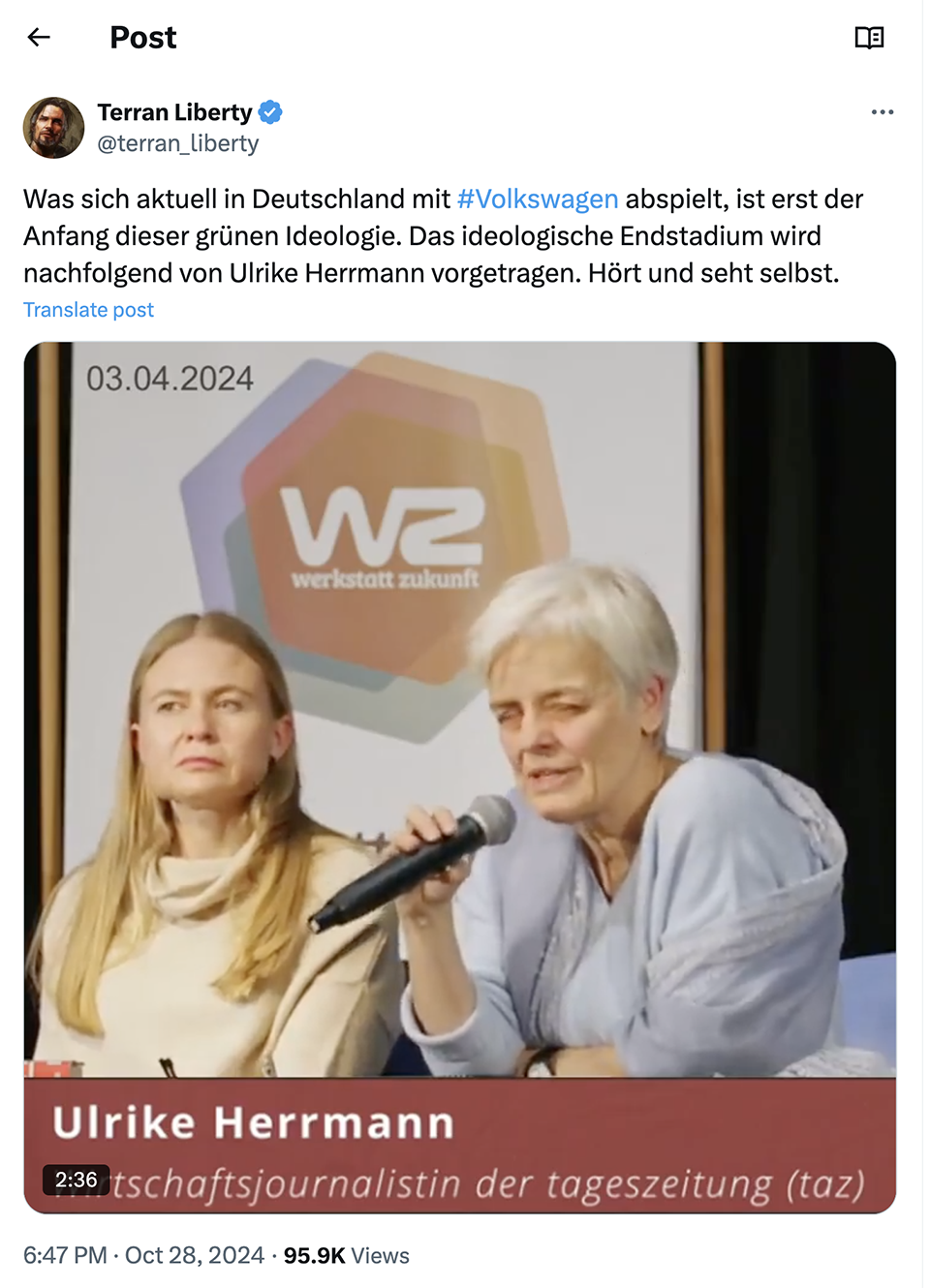
They also do it by establishing this new infrastructure of the green energy industry, which is a strange collection of different opportunists who are all responding to different incentives. These include entrepreneurs who are on to the new opportunities that come with subsidised industries. Then there are the true believer degrowthers who want to establish a new type of a medieval order where everything is rationed out – everything from living space to meat, to the amount of kilometers you can travel over a year. That’s the agenda of Ulrika Herman, a prominent person in the German green movement, who recently proposed such rationing.
At the heart of all of this is what Moore has called a “fake and invisible catastrophe” and the claim that we can control the weather from now and into the future, if only we give a carte blanche in spending and policy formation to a bunch of experts. The experts’ access to funding depends on the existence of insoluble problem, of course, but let’s not be pedantic about incentive structures and motivated reasoning.
This ‘rule by experts’ mandate, is the thing that the urbanites get fixated on. It’s the collectivist approach, which of course is the one favoured by lobbyists and opportunist bureaucrats. It’s also the approach easiest to sell to urban dwellers, because they don’t have a real connection to nature, so they don’t understand what an environment is. This is why green policy wonks go completely deranged and start attacking farmers, like they did in The Netherlands in an attempt to seize farm lands which peaked in the Dutch farmers protests in 2022.
But they do understand, or at least they think they understand, something like policy and collective action, so it’s easy to sell them on this stuff. This is why urban green movements target the young – because young people know nothing and it’s easy to sell them on some pseudoscientific thing. The greatest argument the Green movement have is that there is a consensus. In other words that people that know better are telling you that this is so, and therefore you should act in such a way. It’s all very vacuous and emotionally reactive. It’s hard not to agree with Moore and conclude that it’s designed to be that way.
As Moore has said, this is pseudoscience. We are never presented with scientific proof. We are presented with correlations, which could be just random chance. We are presented with models which are supposed to predict the future. We should all look with extreme cynicism at predictive models, as Nobel laureate in Physics Niels Bohr, has said “Prediction is very difficult, especially if it’s about the future!”
But environmentalism has moved from the domain where people worried about their surroundings, such as polluted rivers and diminishing fauna, to a sort of existential crisis of urbanites concerning things they can’t see and they don’t interact with. As Moore concluded many years after he left Greenpeace because they had focus shifted away from human flourishing and nature, to a lobbyist controlled regime of ideas laundering and pseudoscience; the new environmentalism is a NIMBY complex which centers around “Fake invisible catastrophes and threats of doom.” Threats that are too far away and too invisible to see.
The people that swallow this voraciously are typically urbanites. Modern environmentalism is, in effect, a very, very, expensive cult of doom.