A total of 790 persons from countries outside of the EU were ordered to leave the Irish state in the second quarter of 2024. This represented a more than doubling of the orders to leave made in the first three months of the year. It also compares to 300 in the second quarter of 2023 and 1,060 orders made in the whole of last year.
However, the ratio of deportations actually carried out remains at around a quarter of the number of orders to leave that are issued. As we have shown before the rate of return remains consistently low. This is mostly due to the numbers of appeals made, the prolonged nature of such appeal, and the high percentage of successful challenges to deportation orders.
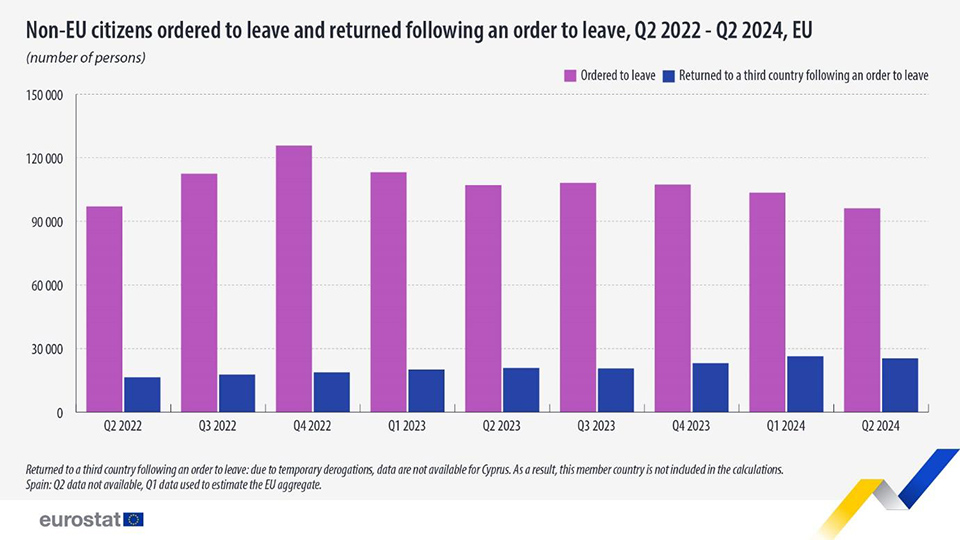
There were a total of 96,115 orders to leave issued across all of the EU member states. However, that compares to the 25,285 deportation orders that were carried out. Which means that for every 100 deportation orders made, that just over one in four are carried out.
Deportations do not always take place in the same period that orders are issued but the overall trend confirms the low number of returns that take place compared to orders.
In the whole of 2023, there were 435,705 orders to leave issued by EU member states to persons from outside of the EU. Just 110,860 or 25.4% of that number were actually deported.
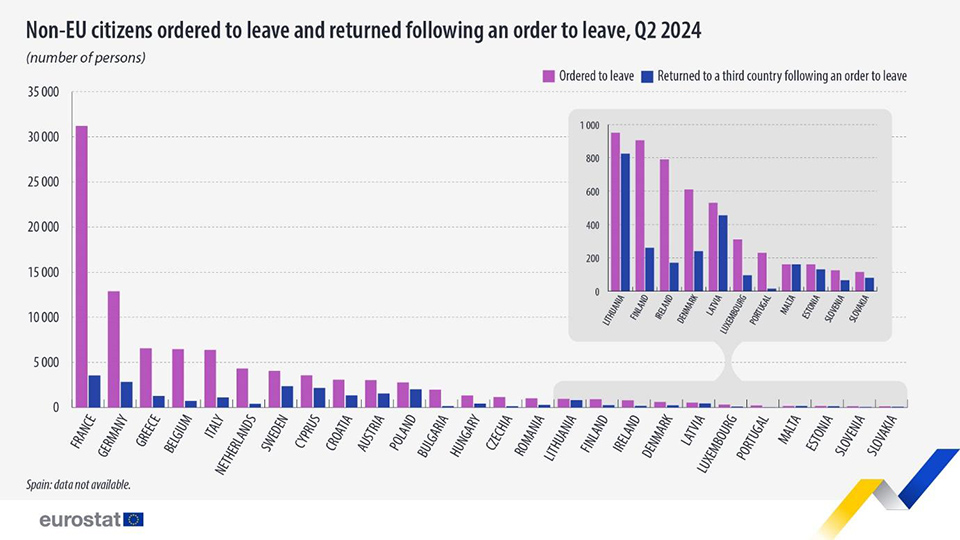
The statistics for the Irish state are similar. While there were 790 orders to leave issued in the second quarter of this year, there were 175 deportations effected. For the first 6 months of 2024 there were 1,070 orders made but the number of deportations carried out was 280 or 26%, almost exactly the same as the EU average. Likewise, the percentage of deportations made in 2023 equaled just 27% of the orders issued.
Where the Irish state does buck the overall EU trend is that while the number of deportation orders made by all member states was down 7% on the first quarter – and the number of deportations carried out down by 4% – those figures doubled here in the case of orders, and were two thirds higher in the number of deportations effected.
Both of those figures possibly reflect the fact that there had been large numbers of persons from countries now designated as safe, including Georgia and Algeria, whose citizens comprise a significant number of those currently in IPAS accommodation and who are now more likely to be ordered to leave the state.
However, while there are 393 fewer Georgians now in IPAS accommodation compared to the end of September 2023, the overall numbers of persons from the four main now safe countries of safe origin in accommodation – Georgia, Algeria, South Africa and Botswana – has risen from 8,184 to 8,223.
In fact, Georgia accounts for almost all of the reduction and there are 435 more persons from South Africa and Botswana in IPAS accommodation than there were at the end of September 2023.
All other figures continue to rise so while any increase in the state’s desire to tackle bogus asylum applications must be welcomed, the statistics show that the numbers involved are small, particularly when it comes to removing persons who have no business being here.