A certain amount of resentment is sometimes understandably felt by disappointed election candidates. They would not be human were they not to experience such emotions. Whether it is wise to share them is another matter, and of course that is not as easily avoided nor retracted in these days of social media saturation.
Thus, former Sinn Féin South Dublin County Councillor Sarah Holland has been tweeting about how she regards her political enemies, and by implication those former Sinn Féin voters who have now gone all For Roysh on their ass.
Holland had been elected for the Rathfarnham ward in 2014 but lost her seat in the Firhouse-Bohernabreena ward in 2019 when her vote fell to 6.5% of the valid poll.
Last Friday was even worse, for not only did she lose another 248 votes to finish on a skimpy 4.3% but she also suffered the indignity, as she would and obviously did see it although she did not refer to him by name, of finishing behind Yan Mac Oireachtaigh the National Party candidate.
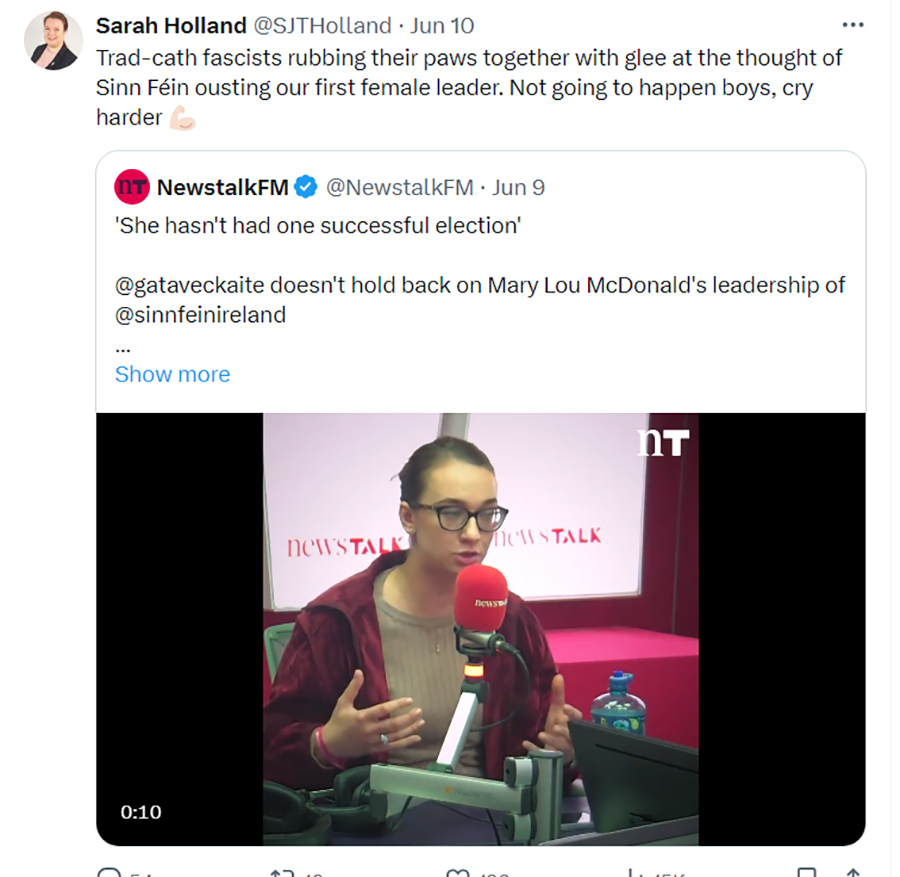
What Holland’s tweets do evidence, however, is the type of fissures present within Sinn Féin and tensions over how the party is responding to the threat from more nationalist parties and independents. That is what is being aired and will undoubtedly be aired in greater depth behind closed doors over the coming weeks and months.
Most interesting is that Holland, despite being a native of Belfast, clearly finds herself at considerable odds with the founding principles and motivations of her own party, what was once Provisional Sinn Féin. Ironically one of the tweets supporting Holland came from the Belfast branch of the Communist Party of Ireland.
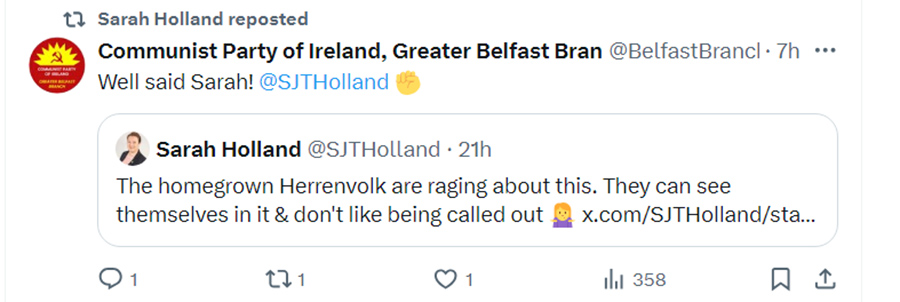
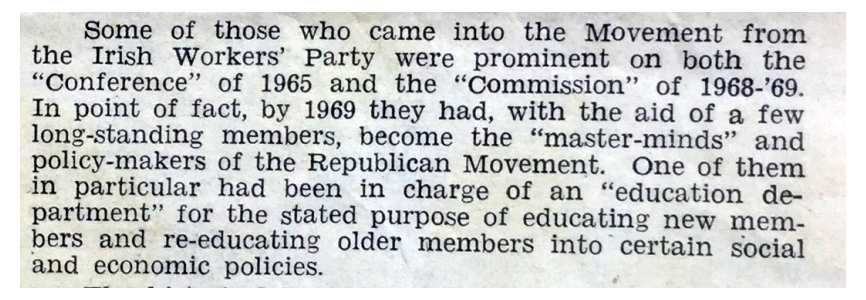
The CPI, or Irish Workers Party and Communist Party of Northern Ireland as it was partitioned prior to 1970 but basically the same entity under the supervision of the Communist Party of Great Britain, was the key agent named by the leaders of Holland’s own party in its founding statement as having infiltrated and helped to split the republican movement in the 1960s.
In one of her tweets, Holland – who worked for four years with the Palestinian mission in Dublin – referred to “trad-Cath fascists.” These nefarious elements were apparently “rubbing their paws together with glee at the prospect of Sinn Féin ousting our first female leader.”
This requires parsing and deconstruction for several reasons. Firstly, Mary Lou McDonald is by no means the “first female leader” of Sinn Féin. Margaret Buckley was the first President of Sinn Féin and served in that position between 1937 and 1950. She was from Cork and had a long history of involvement in the movement from the foundation of Inghinidhe na hÉireann in 1900 through the Easter Rising, Tan War and Civil War. Buckley spent several periods in prison, being arrested as an old woman in the late 1950s, and was on hunger strike during the Civil War. You would imagine Holland might have heard tell of her.
Máire Drumm from Newry was vice President of Sinn Féin during the 1970s and was serving in that position when murdered by loyalists in the Mater hospital, Belfast, in October 1976. It was the same party that Mary Lou leads although the resemblance is perhaps increasingly less evident as years go by. Drumm or Buckley would never have led a party that was part of the British administration in part of Ireland.
Then there is the “trad Cath fascist” part. Seriously. The Provisional IRA built its reputation and credibility at the Battle of St. Matthews Church in June 1970. They fought a force of armed loyalists who were effectively allowed by the police and British army to mount the assault on the Church and school and the Short Strand community for two nights.
The Belfast Brigade Provos were led by Billy McKee, a devout Catholic and a staunch opponent of Communist influence, infiltration and ideas in the IRA and Sinn Féin. Holland may or may not be aware of the fact that if the exact phrase “trad Cath fascist” was never used by opponents, and particularly leftist ones, of the Provies then words and phrases almost identical to them were.
Just as they were by the same media outlets and political parties in this part of Ireland who now deploy them against rural and working class communities who oppose the establishment line on mass immigration and many other things which have been grafted onto the current Sinn Féin.
From an intellectual perspective, the reference to “trad Cath” evinces ignorance of the influence which Catholic social thought had on the republican movement for generations. That influence, aligned with Irish nationalist ideas on co-cooperativism and support for small farmers, workers and small business people was theorised in the Comhar na gComharsan programme later refined as Éire Nua.
That was jettisoned first by the Stalinist influenced leadership of the 1960s and later by people who are sometimes depicted as Marxists within the Provisional movement but were in actual fact and as is evident now no more than social democrats with a whiff of cordite rather than Prosecco and tofu.
Radical Irish nationalism – “trad Cath fascism” if you prefer – is a far more radical and coherent set of ideas than the hodge podge of poorly digested Marxism for Dummies. It stood, and stands, for national sovereignty, decentralised local and national government, and an economy founded on the best use of Irish natural and national resources through local individual and community enterprise. Not one controlled either by multinational corporations, nor by a socialist state.