Three years ago, Gript reported how a proposed heroin injection facility at Merchant’s Quay on the south Dublin quays had been refused permission following a High Court review of objections from the local community including the board of the nearby St. Audeon’s national school.
High Court Justice Simons had overturned the granting of permission by An Bord Pleanála and noted that “The persons involved in the supply of the drugs will, presumably, be guilty of an offence.”

Justice Simons also accepted the most salient aspect of the objection which was that “the facility is to be located immediately adjacent to a primary school” and that the sale of alcohol was already prohibited close to the school.
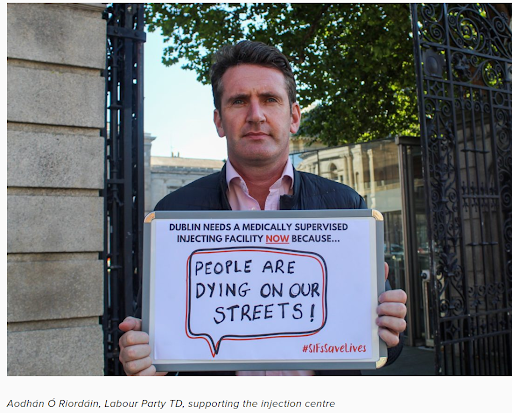
Unfortunately for the local community, the case was returned from the court to An Bord Pleanála, which, as summarised below, allowed the centre to be built. ABP somewhat bizarrely decided that “The proposed development is in accordance with the area’s proper planning and sustainable development. Given compliance with specified conditions, it is not expected to significantly harm property amenities, impact residential character, or compromise public safety and convenience.”
The local opposition has not abated and was the main contributory factor in persuading local man Pat Coyne to run as an independent candidate in this week’s local elections for the South West Inner City ward in which the proposed centre is located.
Coyne claims that this has already contributed to the further running down of the district, saying “Since permission to build the centre was granted, Dublin City Council has allowed many tourist hotels and hostels to convert to homeless services clustered around the quays, creating an ever-expanding doom loop. The most recent hotel to seek a change of use is the Paramount Hotel on Parliament Street, awaiting An Bord Pleanála’s decision.”
He further claims that the proposal for the injection centre “and the related increase of homeless services in that area is decreasing the property value and deterring new businesses from opening there. As a result, few people now view tiny terrace houses as unsuitable for families with children, and many of them, now owned by landlords, are being rented out as short-term lets.”
Observations in the area would tend to bolster the view that the area around Merchant’s Quay is in further decline. Coyne claims that the priority of the Gardaí and the City Council ought to be “enforcing bylaws and zoning regulations to reduce minor offences such as public drinking, begging, and open drug scenes in the city centre.”
That view was clearly not shared by those politicians and NGOs which supported the siting of the injection centre at Merchant’s Quay. Coyne has questioned both the wisdom of this and intends to raise the role and funding of the NGOs concerned if elected to the City Council.
Coyne also rejects the attempts to marginalise objections to a harder line on drug abuse, crime and the impact of uncontrolled immigration as manifestations of a “far right” which he claims has little presence.
Rather that it is “the rise of “woke” political correctness that is causing divisions and disrupting Irish culture, values, and identity. We must stand against those who seek to suppress our fundamental right to free speech through hate speech laws or European directives.”