Over €6.6 billion has been paid in carbon taxes since the the tax was introduced in 2010, Gript can reveal.
According to figures acquired from the Department of Finance, a total of €6,650,871,066 was taken in by the State between the years 2010 and 2023, with the annual amount being paid increasing almost every year since the tax’s introduction.
While the State took in €223 million initially in the year 2010, by 2020 this figure had more than doubled to €493.5 million, and then grew even more dramatically, soaring to a provisional figure €935 million in 2023.
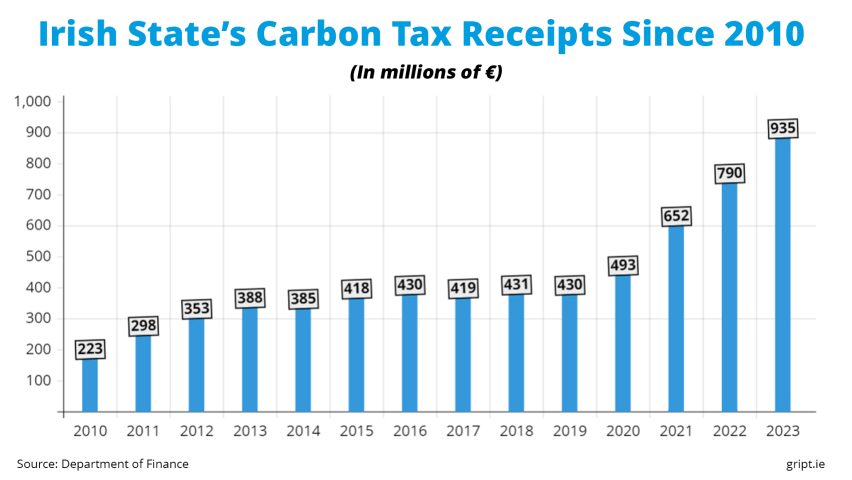
A total of €2.8 billion worth of carbon tax has been taken in during the lifetime of the current Fine Gael, Fianna Fáil, and Green Party government coalition, which came to power in 2020.
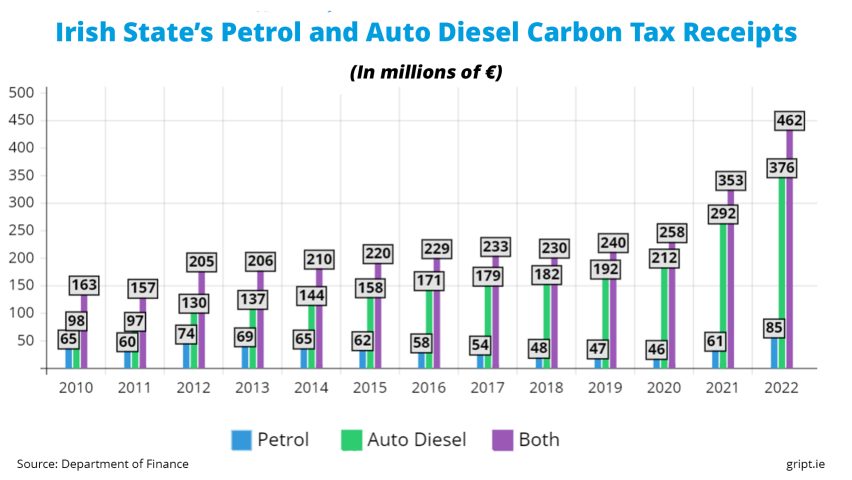
Moreover, between 2010 and 2022, the government took in over €799 million in carbon tax on petrol, and over €2.3 billion on auto diesel, coming to a combined total of €3.1 billion. This also increased significantly under the current government, spiking dramatically in 2022.
By contrast, over the same 12 year period, carbon tax on aviation gasoline only yielded €599 thousand euro for the State, while kerosene – another fuel commonly used in planes – brought in over €694 million.
Regarding home heating, €214.5 million in carbon tax was paid on “solid fuel” – such as coal, wood, or charcoal – between 2013 and 2022, while natural gas – often used in heating, cooking, and electricity generation – was taxed to the tune of €716.8 million.
Other fuel sources taxed included Fuel Oil, Marked Gas Oil, and different forms of Liquid Petroleum Gas (LPG).
The carbon tax is required to be increased every year by law due to the Finance Act 2020, which requires the tax to be raised by €7.50 per tonne of CO2 up until 2029, and €6.50 in 2030, when the rate is set to reach €100 per tonne of CO2.
According to the Parliamentary Budget Office, these funds are then “used to finance green initiatives and other climate related policies such as home retrofits”.
The tax was initially introduced under a Fianna Fáil and Green Party coalition government in 2010, but was maintained by subsequent governments since that time, with then-Transport Minister Shane Ross saying in 2019 that he wanted to force motorists out of their cars using carbon tax to avoid a “climate apocalypse”.
'We want to force private motorists out of their cars' https://t.co/gVpZva6goa pic.twitter.com/dfDHvRNKMq
— Irish Independent (@Independent_ie) June 18, 2019
Last year, Gript asked Finance Minister Michael McGrath if the government would consider suspending carbon tax amid an energy and cost of living crisis.
He replied that they would not, because they were needed to fund “anti-poverty measures” in social protection and to fund retrofitting of homes.
"Does hiking taxes help during a crisis?" Gript presses Finance Minister Michael McGrath on carbon tax hikes, and how he plans to help those in energy poverty.
FULL VIDEO: https://t.co/fLObC2ju6Q pic.twitter.com/K7FYbW511C
— gript (@griptmedia) January 5, 2023