One of the tropes thrown about by some with regard to the Irish housing market is that the ambition to own one’s own home is somehow a bit of a selfish thing really these times.
Some people on the left would have you believe that it would be much better for everyone if we all were paying rent to the state, while some people on what when I was a lad was the right, would prefer that you rented from a private landlord, which increasingly means a rental company rather than an individual.
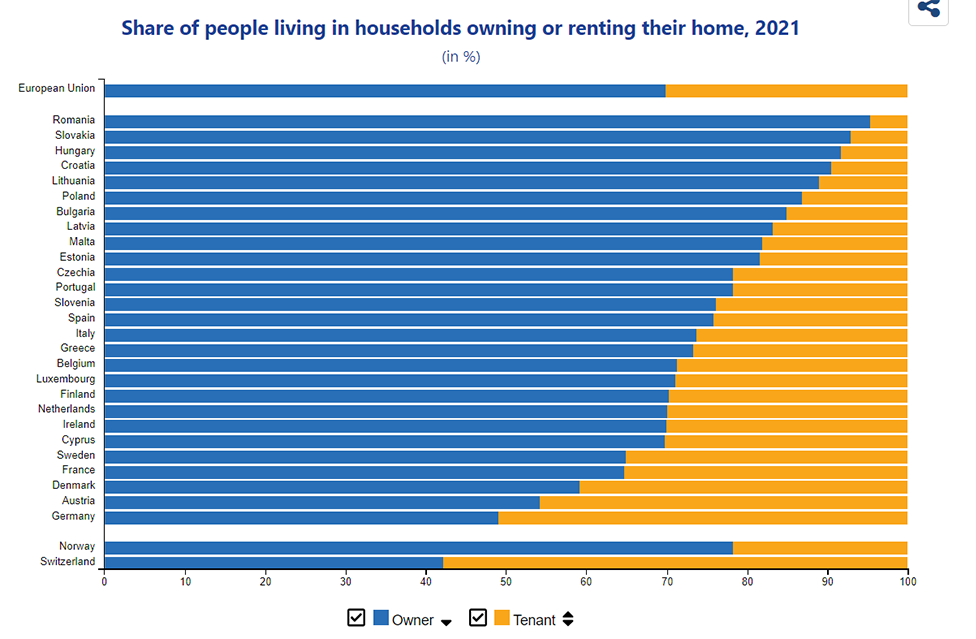
A comparison of statistics within the EU would suggest that, far from being exceptionally high, home ownership in the Irish state is pretty average. The rate of homeowners in Ireland in 2021 at 70% was in fact almost exactly the EU average of 69.9%.
Nine of the top ten countries in terms of home ownership were once under Communist rule, which suggests that people who endured socialism value the security and independence that ownership brings. They certainly do not appear to be clamouring for the sort of housing proposed by Sinn Féin and the other left parties.
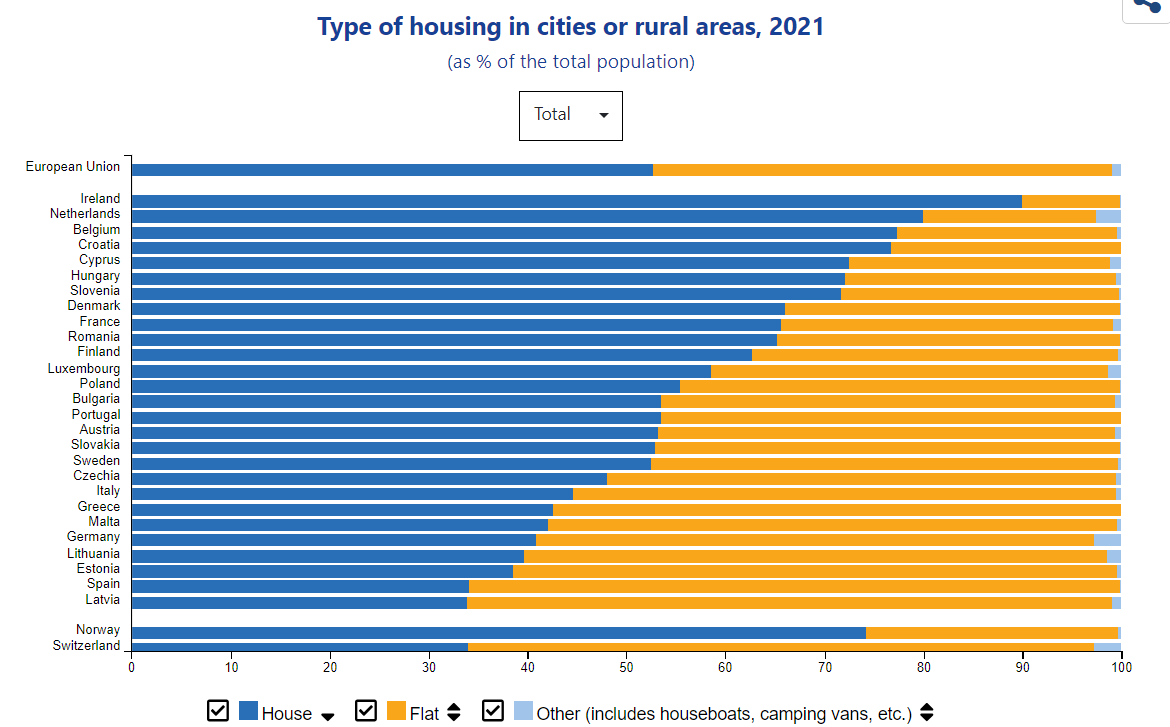
Where Ireland does still differ is that most homeowners own an actual house rather than an apartment or flat. That is reflected in the fact that 90% were living in a house, compared to the EU average of just under 53%. Both factors are changing simultaneously here as the growth in high rise apartments is mirrored by the fact that the vast majority of these are rented rather than being bought.
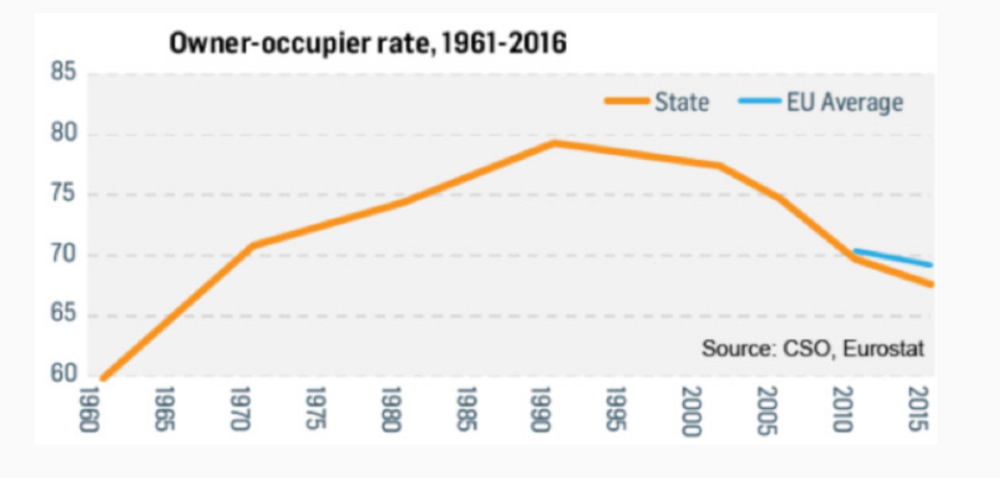
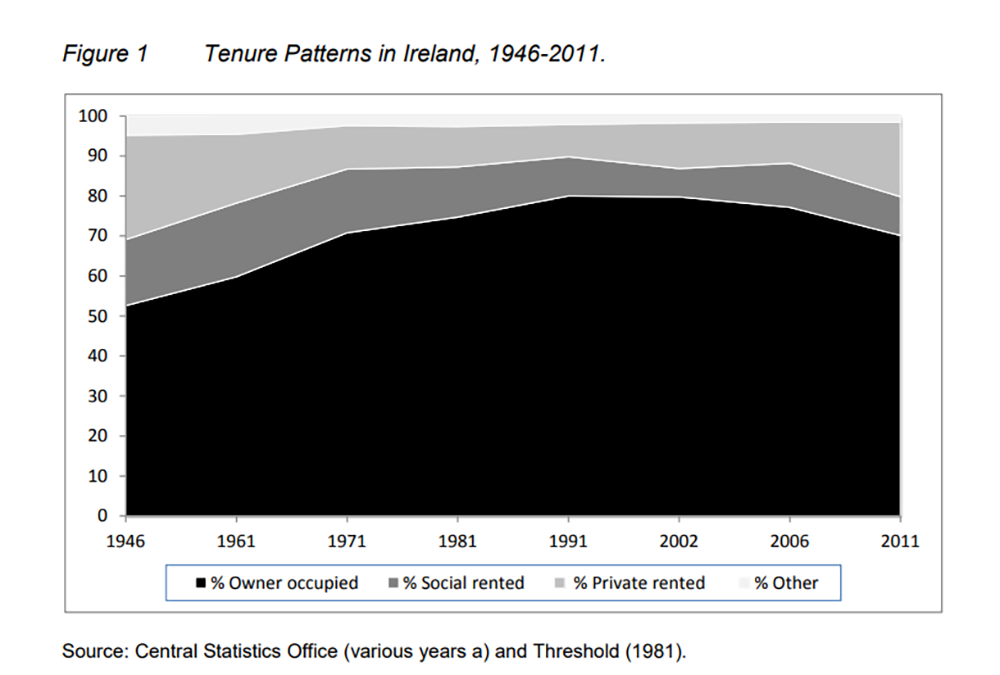
What the historical statistics do show over the history of the Irish state is that home ownership, having risen steadily from the 1930s onwards, peaked in the early 1990s and has declined and is continuing to decline sharply since.
Interestingly, the decline in homeownership declined at the same time as the economy, wages and house completions – which peaked at over 88,000 in 2006 – were all booming.
That, of course, ended in the property crash and the accompanying financial disaster – all of which were exacerbated by successive governments who were happy in the first instance to allow the developers and mortgage lenders a virtually free hand, and then went to extraordinary lengths to bail them out of their own disaster at the expense of the rest of us.
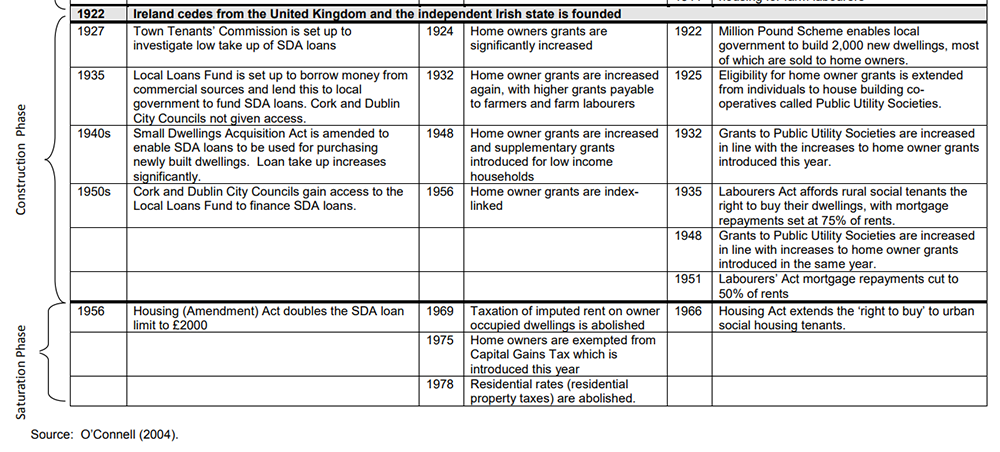
The growth of home ownership in the Irish state after 1922 was no accident nor the product of market forces. Rather the state, particularly when Fianna Fáil was in power, intervened strongly in the market to ensure that home ownership was spread as a central part of the social policy of that party.
The table below shows some of the key legislative and financial decisions which facilitated this. Much of that policy was pursued from the 1930s onwards through the construction of local authority housing funded by the state but later made available to tenants to buy with fairly easy terms offered.
This contrasted with the policy of the British Labour Party for example which also pursued a programme of state house construction but actively discouraged and even prevented tenants buying their own homes.
This was to become one of the reasons for the Conservative Party’s electoral successes after 1979 when it allowed such purchases, thus enabling working class families to buy their own home and to sell it if they wished to do so.
It could also be argued that the quality of public housing here was superior as the state eschewed the dreadful high rise flat complexes which some on the British left – particularly those of other than proletarian stock – believed was conducive to some misguided project of communitarian social engineering.
The 1932 Housing Act, one of the most significant pieces of legislation brought forward by the new Fianna Fáil government, facilitated the clearances of the slums that had blighted Dublin and other cities. Not only did they get rid of the tenements but they replaced them with proper single family occupied houses rather than replacing them with flat complexes.
By 1946 more than half of all households in the state were owner occupiers. That was a hugely significant shift and one that has only begun to go into reverse in the past 30 years. The rate at which home ownership is falling is quite alarming, and that trend is much more marked in urban areas.
This has contributed to placing housing at the centre of people’s concerns, especially as the prospect of ever owning one’s own home seems increasingly remote for a growing proportion of the population.
Not only is that a financial impossibility for considerable numbers of working people, but is even becoming logistically less likely as an increasing share of completed dwellings are being placed directly into the rental market by large developers and funds.
One wonders, indeed, if this was another factor in the defeat of the recent referendums as the superficial “vision” of the new Ireland shared across the political establishment rings hollow with people.
Especially so given, as I pointed out two weeks ago, that the vision of working families being able to own their own home and have a comfortable and stable existence – something to be sneered at by certain people – is far from the reactionary one depicted by the bourgeois liberal left.
Perhaps many working people, and many working women in particular, actually realise that it is far more difficult for working families to own their own home and to achieve a certain level of comfort within stable settled communities than it might have been for their own parents or even grandparents.