This week, Coimisiún na Meán which has the responsibility for overseeing and implementing the provisions of the Digital Services Act – which was signed into law by President Michael D. Higgins on February 11 – published guidelines on how to apply for the position of “Trusted Flagger.”
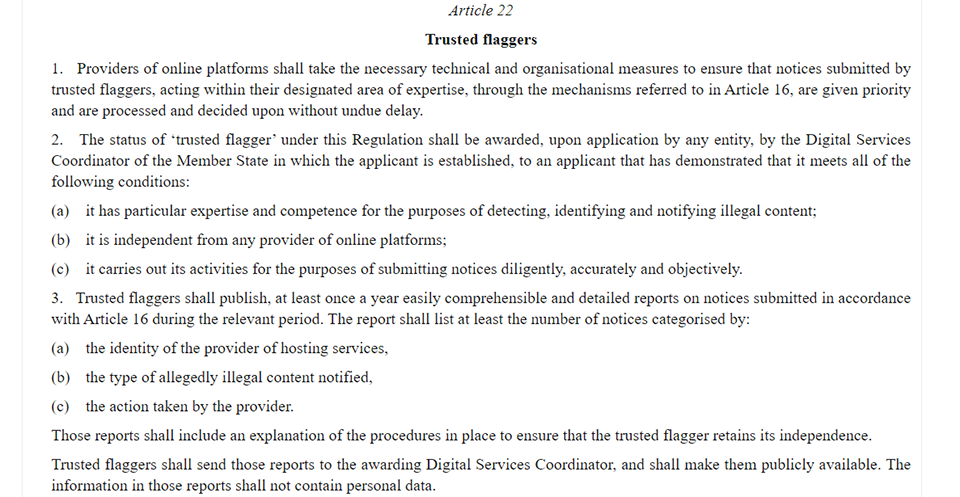
The Act is simply the transposition into Irish law of European Union Regulation 2022/2065. An Coimisiún refers directly in its text to Article 22 of the Regulation rather than the corresponding section of the Act passed by An Oireachtas. That is found in Part 15, Chapter 2, 190.
That section was sought to be amended at Committee and Report Stages by Louise O’Reilly of Sinn Féin. As we pointed out at the time, the amendments that O’Reilly proposed were certainly not designed to mitigate any concerns about possible restrictions on the exercise of free speech.
Instead, they could be interpreted as wishing to ensure that entities with a left liberal bias would be granted favoured status when the positions of “Trusted Flagger” came to be filled.
O’Reilly had tabled an amendment which put that demand in the context of a proposal that “applications from a recognised trade union or an NGO for approval as a vetted researcher will be considered.” She went on to explain that this was on the basis that it “would not be right to exclude trade unions and other vital NGOs.”
Well, I do not recall that anyone had proposed that trade unions or other “vital” entities on O’Reilly’s side of the barricades would be excluded, did you? In fact the only one proposing that anyone be excluded was Comrade O’Reilly herself. She made this crystal clear when speaking on a related amendment when she said that “there is a need to ensure entities with a partisan agenda, an agenda which is intent on shaping or controlling content to suit their own agenda and their own needs, are not permitted.”
Seriously, do some people not even have the modicum of self-awareness to realise the complete double standard, and dare I say it, hypocrisy that is baldly laid out here. While on the one hand, those who share the left liberal consensus are to be given access to powers of censorship – for that’s what is proposed – “entities” which demur from such a view are not even allowed object to this hoped-for scenario in which one side can not only say whatever they wish, but ensure that they also have a veto on what others say.
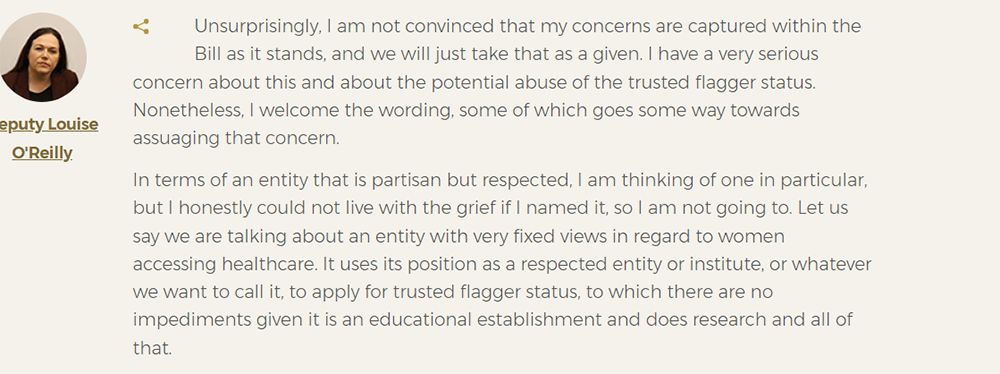
Nor was O’Reilly being shy about stating exactly which “entities” to which she was referring. At Committee Stage she made it clear that she was determined that “a respected entity or institute, or whatever we want to call it” might have a view on issues related to “women accessing healthcare.” Healthcare being abortion of course.
While the Minister, Dara Calleary, opposed the amendments, he was clearly sympathetic. He stated at Report state that he certainly did not wish to exclude the trade unions or the NGOs – the very idea! – but he also pointed out (in deference to the actual framers of the legislation in Brussels) that the lowly Oireachtas could not insert things that had been overlooked by the Empire.
Happily, his assurances to O’Reilly were sufficient to set her mind at ease and she withdrew her amendment on the promise of the Minister that he was confident that her fears would be assuaged by the manner in which the provisions of the legislation would be put into effect.
And now we have the official body responsible for appointing such “Trusted Flaggers” employing wording that is very similar to that of O’Reilly’s amendments, and therefore reflective of the lobbying that undoubtedly has and continues to take place on the side of left liberal organisations who crave such a position.
The guidelines as to “How to apply for Trusted Flagger status” published on Monday explicitly refer to “Bodies such as non-governmental organisations, industry federations and trade associations, members of established fact-checkers networks, trade unions, non-regulatory public entities and private or semi-public bodies may become Trusted Flaggers.”
That is as close to fulfilling O’Reilly’s and the trade union and NGO demand as can be, short of including that wording in the legislation itself, and the only reason they did not as Minister Calleary hinted was because its not for their sort to be amending the decrees that are issued from the Imperial Palace.
Those categories are also listed in the application form and guidance for anyone applying to become a “Trusted Flagger.” One of the exclusions set out is that a flagger is “independent of online platforms” which appears to be Facebook and Twitter and others.
Of course, there are currently other forms of “online platforms” which are busy ‘flagging’ – and it is not even beyond the bounds that some of the persons connected to them might apply to be a Trusted Flagger. I would be fairly confident of who some of the applicants will be, and they have already have substantial influence within mainstream media and elsewhere when it comes to monitoring and attempting to censor views with which they dissent.
And we already know that there was, and is, considerable such monitoring and censorship carried out within certain powerful social media platforms. It’s notable that they are never the subject of attack from the left – not least because they resent the influence which they had within just one of the tech giants being diminished.
Potentially giving these kinds of people official status under the Digital Services Act should be a cause of concern for all who value the free expression of opinion. The doctrinaire left never has, but at least in the past it has had to capture state power in order to suppress such freedoms. Is it wise that they be given the cover of those same freedoms to undermine them when exercised by others?