The impact of Covid lockdowns on children’s education looks likely to have contributed significantly to a record drop in reading and maths scores which could set back the chances of increasing global economic growth by up to 40 years, according to the Organisation for Economic Cooperation and Development (OECD).
The February 2024 interim economic outlook from the OECD examines issues such as global growth and inflation, in addition to geopolitical risks such as trade disruptions such as attacks on ships in the Red Sea which they say have raised shipping costs sharply and lengthened delivery times, disrupting production schedules and raising price pressures.
However, in is in regard to the education and its impact on growth, productivity and knowledge that the OECD makes what is being described as a bleak prediction, describing the deterioration in educational performance as “particularly concerning” for global growth prospects.
“Human capital is a key foundation for growth, affecting productivity, innovation and knowledge diffusion, and ensuring access to employment opportunities for all,” it says.
“The 2023 OECD PISA report is particularly concerning, showing that between 2018 and 2022 – a period spanning the outbreak of COVID-19 – there was an unprecedented drop in performance in many countries for 15-year-olds tested on reading and mathematics,” the report continues.
Lower scores could effect school grades, future college and employment opportunities, and innovation and productivity down the line, experts fear.
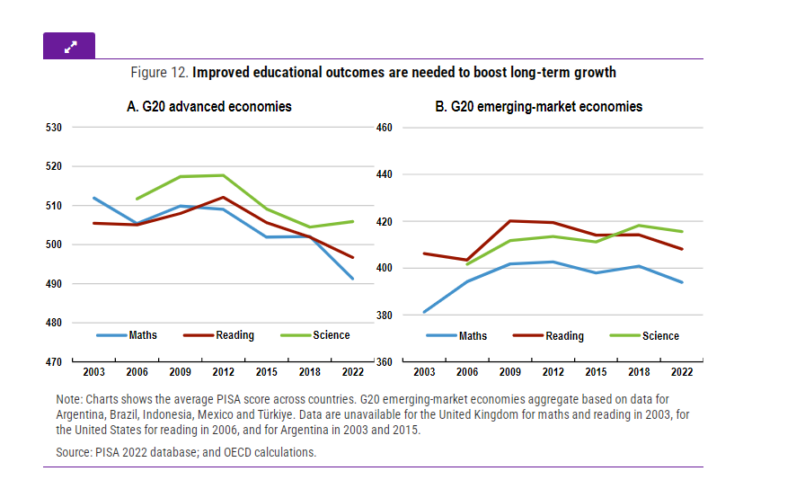
OECD said its “empirical work suggests that this decline in PISA scores could have a persisting negative impact on the level of productivity over the next 30-40 years”.
PISA is the OECD’s Programme for International Student Assessment. PISA measures 15-year-olds’ ability to use their reading, mathematics and science knowledge and skills to meet real-life challenges.
The PISA report noted a “record” drop in the performance in mathematics of 15-year olds, which fell across OECD countries by 15 points from 2018-2022.
“Reading fell 10 points, twice the previous record, whereas science performance did not change significantly. On average, reading and science trajectories had been falling for a decade, though math had remained stable between 2003-2018,” the report said, though noting that Colombia, Macao (China), Peru and Qatar improved in all three subjects on average since they began to take part in PISA.
The PISA report said that “the OECD average dropped by almost 15 points in mathematics and about 10 score points in reading compared to PISA 2018. Mean performance in science, however, remained stable.”
“The unprecedented drops in mathematics and reading point to the shock effect of COVID-19 on most countries,” it noted.
OECD said that “school closures during the pandemic may have contributed to the recent drop in test scores, particularly for disadvantaged students who were unable to benefit fully from on-line teaching”.
“However, the recent decline in performance continues a downward trend in test scores prior to 2018, pointing to longer-term issues in educational systems in some countries,” they noted.
“Countries need to act to improve education and skills outcomes. Key education reforms include measures to improve teaching quality and teachers’ qualifications; enhance the effectiveness of resources targeted to disadvantaged students and schools; expand vocational education and lifelong learning; and strengthen the responsiveness of vocational and university education to labour market needs,” the OECD report said.
For Ireland, average PISA 2022 results were down compared to 2018 in mathematics; about the same as in 2018 in reading; and up compared to 2018 in science.