As we repeatedly point out, the Government and the main opposition parties agree on almost all matters which seriously impact on the lives of citizens.
(There are of course the optics and the personality conflicts that arise when they are squabbling about things that they support when they do them and oppose when the other crowd do them
The Digital Services Bill which may well have serious implications for the manner in which opinions are policed on social media platforms is one such example. As I wrote previously, the Bill is simply the transposition of yet another EU Directive into Irish law. Regulation EU 2022/2065 seeks to tackle what is described as “misinformation.”
Although there were speakers who were critical of the Bill at Second Stage in December, very few amendments were tabled either at Committee stage and last night the Bill was passed after a “debate” that lasted around 20 minutes.
All of the opposition amendments were either withdrawn or defeated without a vote being called. Not one TD was present to oppose the Bill and it now goes to the Seanad.
The only opposition TD to table amendments last night was Sinn Féin’s Louise O’Reilly. Far from seeking to protect the expression of opinions, her main amendments were designed to ensure that, once in place, that the “trusted flaggers” would be ideologically reliable.
Under the legislation, organisations that wish to identify illegal online content can apply to qualify officially as “trusted flaggers”, who take on the role of identifying and notifying platforms of content on their site which could potentially be illegal.
Minister for State Dara Calleary merely pointed out that the legislation could not specify the categories sought by O’Reilly because the EU Regulation did not allow for any national parliament of a member state to change the decree. That, in itself, is an indication of where the sovereignty of the Irish state is at these days.
O’Reilly’s wished to ensure that persons or organisations entrusted with “vetted research” and as “trusted flaggers” would be “a recognised trade union” and a “Non-Governmental Organisation” – once an entity fitting such a description was found to have made an application “pursuant to a public service mission recognised by a Member State.”
We can see or vividly imagine the idea that lies behind this. It is quite obvious that many on the Left – which let us be honest is the descriptive that covers both of the categories referred to – would not only wish to be in a position to monitor and potentially restrict free expression on social media, but have done so and still do so in some circumstances.
The ongoing criticism of the owner of a certain social media platform is obviously linked to their having been in the past able to impose quite stringent controls on opinions that dissent from the left-liberal line. That line was conterminous with the interests and restrictions of many states during the Covid Panic, for example – and still aligns with the EU consensus on immigration.
What O’Reilly and those who came up with this notion want to do is to embed such controls not only in the culture and structures of the corporations which still deploy restrictions against certain categories of free speech, but within the legislation and structures and culture of the state.
Now, O’Reilly, her staff, and the NGO and union lobbyists who thought that this might be a good idea clearly do not do irony. For in her next amendment she referred to people she would prefer are specifically excluded from becoming involved in “vetted research” or accepted within the context of the Bill as a “trusted flagger.”
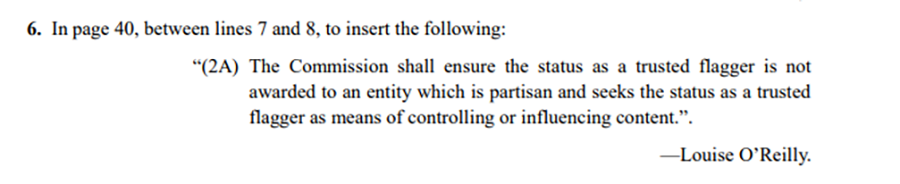
Her amendment proposed that “The Commission shall ensure that the status of trusted flagger is not awarded to an entity which is partisan and seeks the status as a trusted flagger as a means of controlling or influencing content.”
To whom might she have been referring? Well, she did in fairness provide a clue because in the course of speaking to the amendment Comrade O’Reilly referred to “vested interests” which might even disguise their true intent under a title such as “Institute.” She wittingly added that “we know who they are.”
Indeed, we do know who they are. O’Reilly was more explicit regarding this at the actual Committee stage on January 17 when she referred to her target being a “respected entity of institute, or whatever you might call it,” who might hold “very fixed views in regard to women accessing healthcare.” For healthcare, read abortion.
And we know who they are not, at least from O’Reilly and the NGO Left perspective. One of the “institutes” that is big on controlling “misinformation” is the Institute for Strategic Dialogue. The ISD is certainly one of the “institutes” that might be likely to put in a bid to become such a researcher or flagger.
O’Reilly also mentioned “people with the deep pockets” who would be able to afford fees in order to presumably dictate the manner in which all the research and flagging and complaints are processed. I don’t generally use jargon such as “gaslighting,” but when a supporter of NGOs being given the role of censor attempts to justify this on the basis that it will help to combat others who might use the powers contained in the Bill “to shut down people they disagree with,” it is a perhaps a fitting descriptive.
Well, there are few with deeper pockets than the liberal left, which includes the party which she is a member of. The NGOs and the “institutes” and the “fact checkers” are all heavily subsidised by both the state and wealthy benefactors in the corporate foundations.
Sinn Féin has been a major beneficiary of state funding and large amounts of money from billionaires such as Chuck Feeney, who gave so lavishly to Friends of Sinn Féin amongst others. The party has also been accused lately of using the threat of expensive legal actions to deter potential critics or those who shed light on the party’s transformation from one which O’Reilly and others would never have considered joining until it was house trained.
Meanwhile, those of us now consigned to the category of “dissident,” as was once also occupied by Sinn Féin itself prior to incorporation, will continue to monitor who these new potential restrictions on free expression of opinion operate in practice.