Research prepared for the Houses of the Oireachtas has shown that, in most counties, areas providing migrant accommodation are more disadvantaged, on average, than areas without such accommodation.
The figures released by Parliamentary Budget Office show that, in some counties, the differences were stark. One area in Longford with a migrant centre scored -25 on the Deprivation Index Score (where -10 indicated deprivation), while the affluent area in the country (indicated by a score of 10+ on the score) provided no asylum accommodation.
A similar picture was seen in Mayo, where areas providing asylum accommodation had deprivation scores which more than twice as severe on average than areas without migrant centres.
The data showed that the county had 6 centres in areas which had high deprivation scores – including scores of more than -25. However, affluent areas in Mayo did not have any asylum accommodation centres.
In its Summary Profile, the PBO said that all areas could be grouped into four categories, Affluent, Marginally Above Average, Marginally Below Average, and Disadvantaged.
It found that while Marginally Below Average areas accounted for 30.8% of all local areas, it contained some 43.5% of all asylum accommodation centres. “International protection accommodation centres are underrepresented in the other three deprivation index score classification groups,” the report said.
In Roscommon, 4 out of 5 of the asylum accommodation centres in the county were in areas with negative deprivation index scores – meaning they were more deprived – while none were in affluent areas. The majority of areas in the county, in common with most others, are clustered between -10 and +10 on the index.
Outside of Dublin, only a handful of counties have migrant accommodation centres in areas described as affluent. In Dublin, more centres are recorded in affluent areas, but a mapping of the areas by the PBO showed that very few of the most affluent areas in Dublin such as Killiney and Malahide had migrant centres.
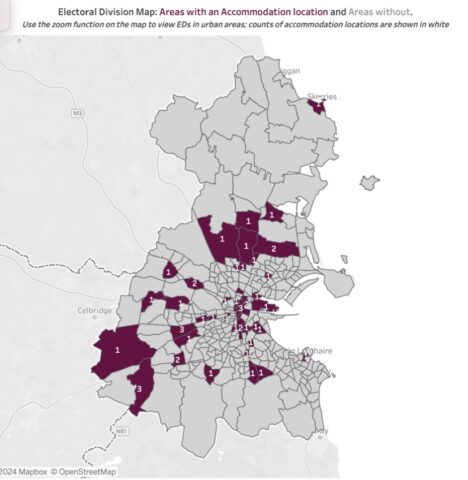
Areas in the inner city, such as Inns Quay and Rotunda B were included as affluent areas, as was Springfield in Tallaght.
Commenting on the findings, Carol Nolan TD said that the research showed that “disadvantaged communities are bearing a significant brunt of the states chaotic, mismanaged, and contentious accommodation policy”.
“This is precisely what I have been saying for some time. It is the vindication and the validation of the concerns raised by working class and indeed deprived communities,” the Independent TD said.