During the debate on the Rural Independents private members motion on immigration, Minister for Justice, Helen McEntee, referred to those who had been removed from the state on foot of a deportation order as evidence of a newly vigorous approach to the issue.
The Minister stated that those who are not found to qualify for protection here “must return to their home country.” This means that they are issued with a deportation order, although the Minister did not use that term.
The difficulty with that, as Gript has previously highlighted, is that deportation orders are largely left up to the individual themselves. They are expected to voluntarily deport, and it is generally only when they are found not to have done so, that the state enforces the order.
Minister McEntee stated that 285 removals have taken place so far in 2023.
However, in a reply to a Parliamentary Question from Sligo/Leitrim TD Marian Harkin on Tuesday, the Minister stated that while the numbers of deportation orders issued and signed this year has increased to 736 from 539 in 2022, that just 34 people have been physically deported.
It should also be noted that the numbers supplied to Deputy Harkin, on the number of orders signed, differ significantly from the numbers of deportation orders actually issued, as supplied in response to a Freedom of Information request supplied to Gript in November.
I am not certain as to what explains the discrepancy between the 549 deportation orders signed in 2022, and the 271 deportation orders issued in the same year according to the FOI response.
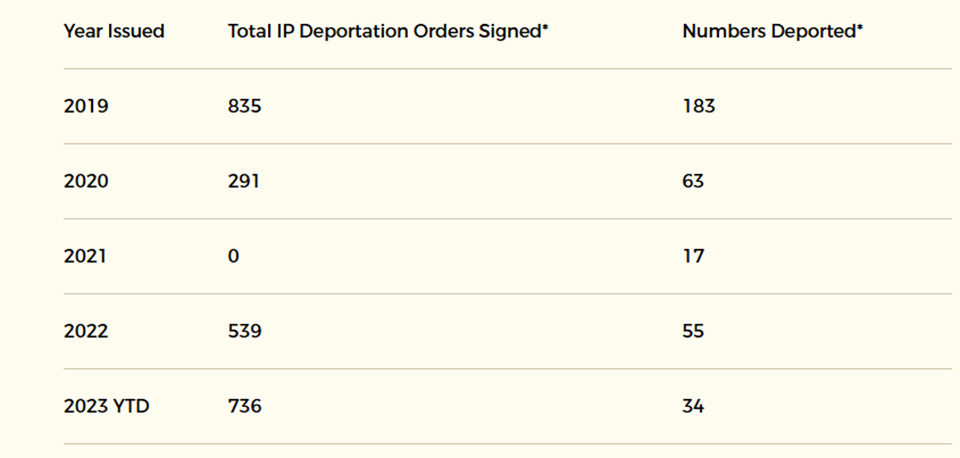
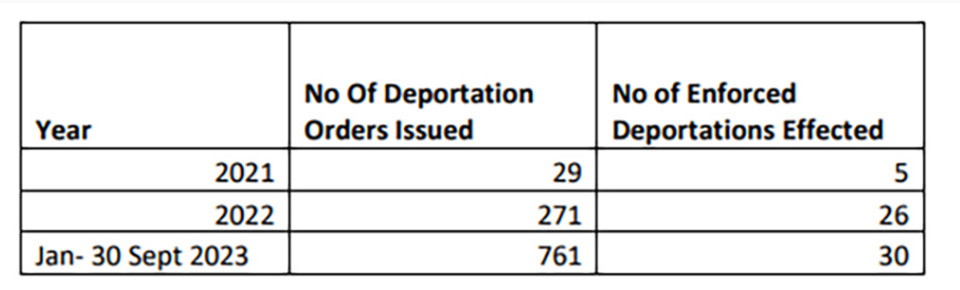
Given that the first table shows that a total of 2,401 deportation orders have been signed since the start of 2019, but that just 352 people have actually been deported, as in having left the state, questions need to be posed regarding the numbers of removals. The numbers from the second table incidentally show that under 6% of the numbers of deportation orders appear to have been “effected.”
The chances of being deported on the figures supplied by the Department are less than 15% or under 6% depending on which one you accept. Presumably then, the numbers of removals are just a minor increase on those numbers if the authorities eventually do catch up with someone who has failed to “voluntarily remove” themselves from the state?
In a separate question from Clare TD Michael McNamara, the Minister supplied statistics which indicate that whatever about the good intentions on the part of state officials to expedite the asylum process, particularly with regard to countries such as Georgia which she herself clearly believes is a problem, that the system will continue to be bogged down in appeals.
The total number of appeals lodged so far in 2023 is 4,057 which is more than the total of 3,186 appeals accepted by IPAT over the previous three years.
That, given the length of time which it takes for appeals to be processed is creating an insurmountable backlog, fuelled by an NGO activist sector and legal business with a clear interest in all of this.
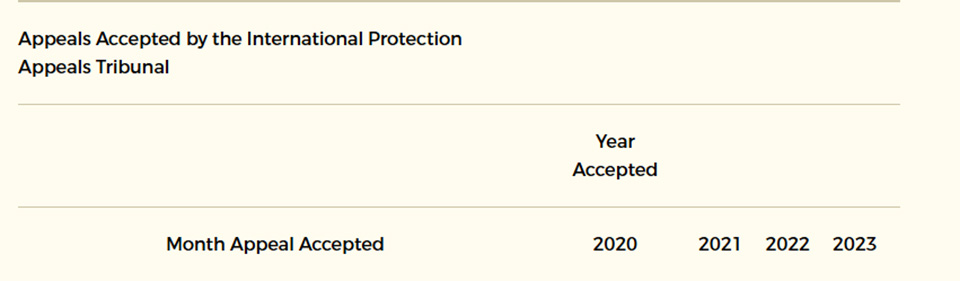

The Sisyphus-like mountain that is faced by the appeals process is underlined by the fact that while the number of appeals accepted by IPAT in 2023 represented an increase of 2,882 or 245%, that the number of final decisions made only amounted to 1,425, an increase of just 125 or less than 10% on 2022.
Do the math, or the compound interest perhaps.
Figures also supplied to Clare Deputy Michael McNamara are an indication that Government sources who have been implying that the numbers applying for International Protection have fallen, and will be down over the entire year, might have waited until the end of the month.
While the numbers applying had fallen between March and July compared to the same period in 2022, the past four months have seen an increase year on year of 659 on the same period in 2022. Given the daily number of arrivals, 51 per day in the week ending December 3, the overall figure for the year will be close to the total for 2022.
What all of these figures, mutually contradictory as they might sometimes seem, prove is that not only is all of this a fit subject for debate but that there is no indication that the state is any closer to finding a solution to the crisis.