Last week, the South East Technological University (SETU) was presented with an award by the European University Association of Lifelong Learning (EUCEN) for its work on “inclusive gender equality and LGBTI+ inclusion.”
The award was made at the EUCEN SMILE event held in Barcelona on November 16 and 17.

In celebrating its achievement, reference was made to the Equality and Diversity Inclusion (EDI) policies that are in place at the SETU.
Perhaps the awarding body was unaware that SETU has recently been at the heart of a dispute involving one of its lecturers, Colette Colfer who specialises in World Religions, and who has described how her simple questioning of the narrative being pushed there brought her into unexpected and unwanted conflict with the institution.
In October, Colfer was reported as expressing her reservations about the SETU Gender Identity and Expression policy that was launched in Waterford on October 4.
The President of SETU, Professor Veronica Campbell, welcomed the document as “a roadmap for SETU in its continued efforts to recognise the strength of diversity as an organisation.”
All very well and good, but as Colette Colfer and a very few others including Gript pointed out, that document contained claims that were simply untrue.
Colfer posed the question: “Are all staff and students at higher education institutions required, by law, to use a person’s preferred pronouns? Is it legal for a higher education institution to dictate to staff and students that they must do this?”
That was the claim made in the document that was launched in October. One that contained the following section:
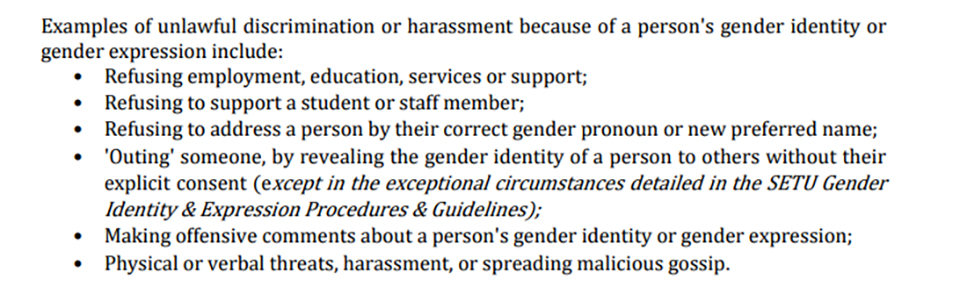
That was the version that was in place in October, as approved by the governing body on April 4 this year, and the one that can still be found on the University’s website.
This, despite the fact that it makes a claim that it is simply not true. “Refusing to address a person by their correct pronoun or new preferred name” is not “unlawful.”
How do we know this? Well, we know this because unlike the nodding dogs of the mainstream media who appear mostly to unthinkingly regurgitate anything they are told by someone in authority, Gript’s Ben Scallan went to the trouble of asking the relevant people.
Although Minister Roderic O’Gorman evaded stating whether he believed that SETU’s legal claim was valid, Taoiseach Leo Varadkar when asked stated that he could not envisage the state prosecuting any person for misgendering another person.
"That's not an answer to the question": Ben Scallan accuses Irish Equality Minister Roderic O'Gorman of "evasion" for refusing to say whether or not "misgendering" someone at work could constitute unlawful discrimination or harassment.#gript pic.twitter.com/MDONaRHfTs
— gript (@griptmedia) October 5, 2023
The legal position was definitively clarified by the Minister for Justice Helen McEntee who in an interview on Newstalk stated categorically that “misgendering somebody will not be a crime.”
And yet we still have the South East Technological University apparently standing over that in their official policy document – and then being presented with awards on the basis of their work in this area.
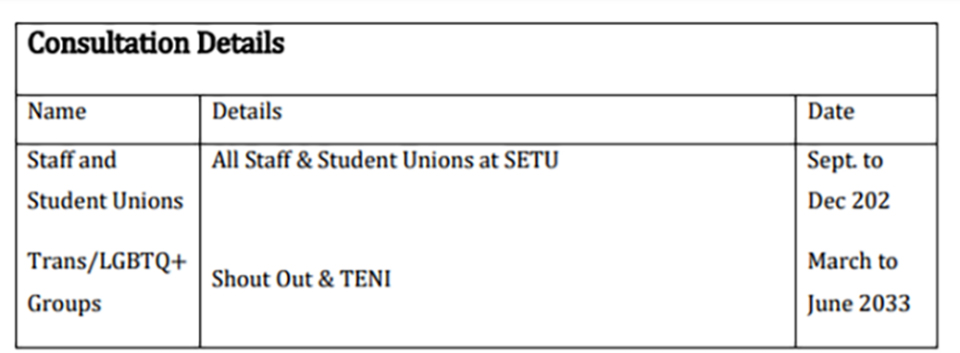
Given that the policy document names the Transgender Equality Network and Shoutout as external organisations that were part of the consultation, the question must be asked as to who told them that something was unlawful when it is clearly not?
And secondly, why have they not removed it? Do they accept the word of activists above the Minister for Justice, and indeed An Taoiseach?
The same question has to be posed with regard to the deference with which the Higher Education Authority and the institutions under its remit have shown to an English NGO, Advance HE, which has succeeded in having its Athena SWAN charter adopted as a qualifying criteria for the awarding of third level research grants.
For the simple fact of the matter is that the SETU Gender Identity and Expression Policy includes a statement that is based not on the relevant legislation in force within the Irish state, but which is more in line with the Athena SWAN Charter. That is simply a surreal situation for any Irish institute of higher education to find itself in.
The same also applies to Trinity College whose Gender Identity and Expression policy claims that “refusing to address a person by their preferred gender pronoun or name” constitutes “unlawful discrimination.” It does not. So too does the still extant UCD document. It states that “Refusing to address a person by their correct gender pronoun or new name” constitutes “unlawful discrimination.” Eh, no.
Note too, the almost identical language to the SETU document. What a happy meeting of minds. Or is it the case that all of the similar policy documents are following a template? And if so, who designed that template? And if An Taoiseach and the Minister for Justice have publicly contradicted that claim, why are our leading centres of higher education still standing over it? Why have the documents not been amended to correct what is a pretty significant error.
It is not as though this is some trivial matter. This is the policy of institutions which, as Colette Colfer states, and which formed the basis of her position – had nothing to do with “good manners” as some would have you believe – clearly implies that not only might a member of the faculty or a student be disciplined by the institution by refusing to comply with the Athena SWAN Charter, but that they might be arrested and charged.
That is outrageous. It is on a par with an employer issuing a contract that made unfounded claims in relation, for example, to an employee’s legal rights and obligations. Perhaps too, the EUCEN and others might actually check out what SETU is saying and doing, and how it deals with its own staff in relation to all the stuff before it hands out more bongs to an institution that is collecting awards and varicoloured stars from some English NGO for complying with their charter.