Bereaved family members of those who died in care homes during the Covid-19 lockdown have held a commemorative service in Dublin, calling on the government to investigate the deaths, saying families were “frozen in time” because they were denied knowledge of how their loved ones died.
Care Champions Ireland, who advocate for better representation for those in nursing homes and other residential care centres, placed a black wreath with 26 white roses representing every county in the Republic in the Garden of Remembrance yesterday.
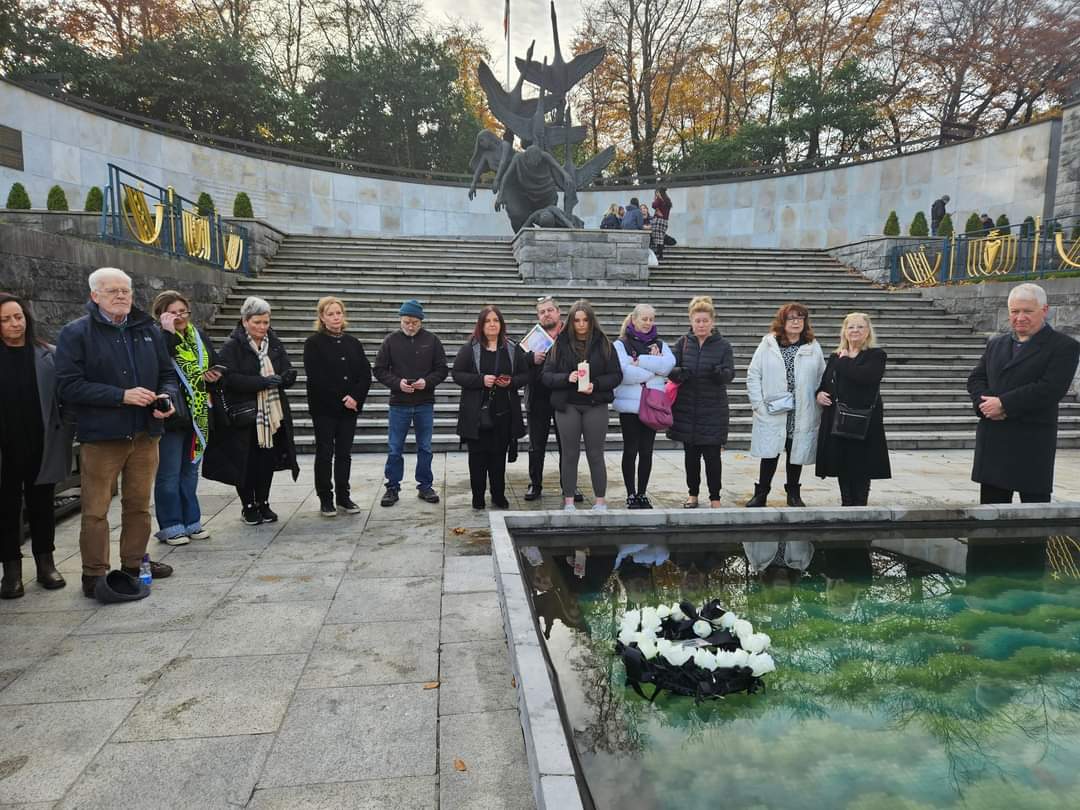
Photo credit Care Champions Ireland/X
Remembering all those lost during the Covid_19 pandemic this afternoon at the Garden of Remembrance in Dublin.
Today, 26 representatives, one from each county, are laying a black wreath for those who @CareChampions2 believe have been ignored and disrespected by the Government. pic.twitter.com/0C3DDROTjR
— CM Haughey Solicitors (@CMHaughey) November 21, 2023
One in three of all Covid-19 deaths in Ireland in the first two years occurred in nursing homes and other residential care institutions.
The campaign group also presented a letter addressed to An Taoiseach Mr. Leo Varadkar, Tainiste Mr. Micheál Martin, Minister for Health, Mr. Stephen Donnelly, Minister for Mental Health and Older People, Ms Mary Butler, and Green Party leader Eamon Ryan at the Dáil.
“We write to you today as bereaved family members who lost precious loved ones in residential care settings during the pandemic,” the letter began.
“Our surviving families remain fractured as a result of the enormous loss we endured. We are frozen in time, due to the lack of knowledge we have been furnished with in relation to the circumstances of our loved ones deaths, in residential care settings, during the pandemic,” it continued.
“We feel our loved ones’ memories have been discarded by the Government, as a result of no support or consultation with bereaved family relatives.”
“Despite evidence of harm, the experience of thousands of people continues to be dismissed by the Government.”
They said that “evidence based learning must inform future policy in all residential care settings,” and that “this evidence can only be gathered through consultation with surviving residents, bereaved families and staff.”
“We will never allow those we lost to be forgotten. Today, 26 representative families, one from each county, have come to Leinster House, to present this letter to you.”
“This will be followed by a black wreath laying ceremony in the Garden of Remembrance to honour those who, we believe, have been ignored and disrespected by our Government,” the group said.
“We have made numerous attempts to engage with the Government, but this has been rebuffed on all occasions. We offer, yet again, another invitation to the Government to engage with us.”
A message from Bereaved families to Government.@MaryButlerTD @LeoVaradkar @DonnellyStephen @MichealMartinTD @EamonRyan @davidcullinane @Toibin1 @Fergusodowd @ivanabacik #Humanrightsinquiry #TheyStillMatter #NotCollateralDamage pic.twitter.com/mHwwhp0X8E
— Care Champions Ireland (@CareChampions2) November 21, 2023
While a public inquiry into the State’s handling of Covid 19 was promised, it has been slow to materialise. Writing on this platform in 2020, Niamh Uí Bhriain pointed out:
It was obvious from the outset that the coronavirus seems to have a particularly devastating effect on older people, which makes some of the government’s decisions in regard to nursing homes completely inexplicable.
Nursing homes actually moved quickly to restrict visitors when the COVID-19 spread first became an obvious global emergency. By March 4th, Nursing Homes Ireland had issued a general restriction for homes nationwide, banning all non-essential visiting, children or groups.
Then on March 10th, the Department of Health, in an act of sheer lunacy, lifted the general restriction, saying the ban was “not recommended” by the National Public Health Emergency Team. They claimed that the ban on visits was premature and would have a negative impact on residents who would miss the social interactions visits allowed.
It should go without saying that the negative impact of a life-threatening virus should surely have been of paramount concern. At this stage Italy was already in lockdown.
Having made such a devastatingly bad call, the Department of Health then compounded the error by failing to provide protective clothing to nursing homes, even though it was very likely that asymptomatic visitors and staff were bringing the deadly virus into the most vulnerable population in the country.
The obvious danger of clusters in nursing homes and residential centres should have been flagged from news reports emerging from Seattle and elsewhere, so the bizarre decision to lift a ban on visits was most likely prompted by a desire not to panic people – the same misguided thinking that ensured those who travelled to the packed festival at Cheltenham sailed back into the country without any testing or requirement to quarantine, or that saw the St Patrick’s Festival cancelled only because of a public outcry.
The abject failure of the government to roll-out widespread testing for the coronavirus would also have exacerbated the rise in clusters. Nursing home staff should have been tested as a priority, but that didn’t happen.
For its part, Nursing Home Ireland has complained that Minister for Health Simon Harris had failed to meet them or to issue specific guidance for the crisis to the homes they represent. This is also inexplicable, given that the population being served by nursing homes are most at risk.