Finance Minister, Michael McGrath, and Minister for Public Expenditure, Paschal Donohoe have delivered a bumper Budget 2024 and it contains some good news for landlords, for those on the minimum wage, along with some positive news for taxpayers.
Minister McGrath announced a total spending package of some €14 billion – with core spending and tax reliefs set to cost of €6.4 billion, and €2.7 billion for once-off measures, and €4.75 billion for non-core expenditure.
Mortgage holders have been granted a once-off measure in recognition of the difficulties homeowners face because of hikes in interest rates. .
The relief will only apply to principal private residences – not rental properties – with an outstanding mortgage balance of between €80,000 and €500,000 on December 31st, 2022.
The scheme will give 20% tax relief on the increased amount of interest paid in 2022 compared to the calendar year 2023, capped at €1,250 per property, with some 160,000 people entitled to benefit.
MINIMUM WAGE, RENT RELIEF, AND HELP FOR LANDLORDS
The minimum wage will increase to €12.70 in January.
The rental tax credit will be increased from €500 to €750 – and parents who pay for student children in full-time accommodation will be able to claim the credit, which will be backdated to allow for claims in 2022 and 2023.
The budget also provided assistance for landlords, in a bid to help with rental markets.
The temporary measure will provide a tax break worth between €600 and €1,000 each year.
Next year, €3,000 of income will be taxed at the standard 20 per cent rate rather than the higher rate, garnering an additional €600 to the landlord. This will increase to €4,000 in 2025 – meaning a benefit of €800 in pocket, and €5,000 for the subsequent two years.
The vacant property tax will be increased from three to five times the rate of Local Property Tax.
TAX RELIEF FOR WORKERS & FAMILIES
Personal tax reliefs – credits such as the personal, PAYE and earned income tax deductions – increased by €100 each, while the earners will now not begin to pay the higher rate of income tax until €42,000.
The ceiling for the lower 2 % rate of Universal Social Charge meaning will now apply on earnings up to €25,760 – an increase of €2,840 before the higher USC kicks in. In addition, the higher rate of USC will decrease from 4.5% to 4% on earnings between €25,760 and €70,044.
Its reported that the additional tax breaks will be worth an additional €800 a year to a single person on €50,000 – while Leo Vardakar previously estimates the average worker might be €1000 better off when payments are taken into account.
The home carer and single person child carer tax credit is going up by €100, while the incapacitated child tax credit is increasing by €200.
Minister McGrath said the changes would assist families with children. Meanwhile, he said, there would be a double child benefit payment of €280 per child, which will be paid before Christmas.
Child benefit will be paid to parents of 18-year-olds still in full time education.
Free schoolbooks will be introduced at junior cycle in secondary school, benefiting 770,000 children, while families with an income of less than €100,000 will see college fees for undergraduates halved from €3,000 to €1,500 this year.
All other families will see undergraduate full-time student fees cut by €1,000.
A further 25 per cent reduction in the cost of childcare will kick in in September of 2024.
WELFARE AND OTHER PAYMENTS
The Minister announced a permanent increase to weekly welfare and pension payments of €12, while a double welfare payment will be paid in January.
People on Living Alone Allowance will get an additional €200, while those on the Carers Support Grant and the Disability Support Grant will receive another €400, and the Fuel Allowance will increase by €400.
By the end of 2024, the payments for foster care will increase by €75 per week for children under 12, and €73 per week for children over 12 – bringing weekly payments to €400 and €425 respectively
Three energy credits for households of €150 each to be paid will be paid while the lower 9% cent rate of VAT on energy products will be extended by another 12 months.
However, planned increases in fuel excise charges will go ahead on 1 April and 1 August 2024.
The 20 per cent cut to public transport fares for adults will be extended for another year. The qualifying age for half-price fares on public transport will be increased to include 24- and 25-year-olds.
GARDAI
There will be funding for between 800 and 1,000 new Garda trainees and a 25 per cent increase in the Garda overtime budget to help address criminal justice complaints.
Training allowance for gardaí will rise to €305 from €184 per week, applying from budget day on with payments coming on January 1st and backdated to today.
There will be funding for the first Garda reserve recruitment campaign since 2017 and €12 million for tackling Domestic, Sexual and Gender Based Violence.
The Minister announced two major new funds:
- the Future Ireland Fund, with a potential to grow to over €100 billion by the middle of the next decade, will help to protect living standards and public services for current and future generations
- separately, €14 billion will be put aside in the Infrastructure, Climate and Nature Fund by 2030 to allow for sustained levels of investment in infrastructure in the event of economic downturns and to support climate and nature related projects
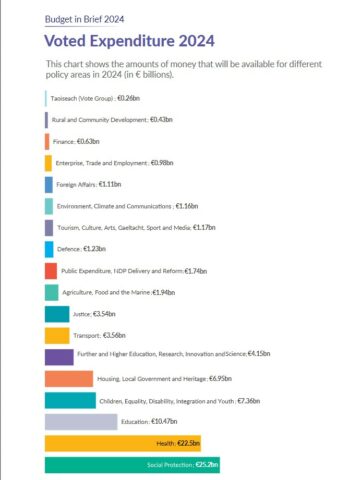
The breakdown of funding provided shows €25.2 billion is budgeted for social protection, while €22.5 billion is earmarked for health.