According to the United States Center for Disease Control (CDC), 33 people were killed in that country in 2022 by dog attacks.
Lest this put you off paying a visit the % chances of being killed by a dog in Amerikay are 0.00001%.
Historical data since statistics on dog bites began to be recorded show an average of around 12 fatalities per year. There were 431 recorded deaths between 1965 and 2001 which works out at an average of 11.6 per year.
So there does appear to have been an increase in both the number of people being bitten, and the number of those bitten who die.
One study shows that the numbers of people killed by an identifiable breed was just 10 in 1979/80 but had risen to 34 in 1989/90.
You will not be surprised, I suppose, to learn this has been attributed to Climate Change.
Interestingly, 1990 was the second worst year since 1950 for murders, and although this fell steadily for around 25 years after 1990 it has been increasing over the past few years.
And fear not, there is a whole new area of “social sciences” which claims to have discovered that “homicide rates are higher when poorer segments of populations are disproportionately influenced by temperature.”
The same study also cites as evidence the fact that “coups and leading rebellions … disproportionately take place in warm weather countries.”
That would be the oul Climate Change then. Marx mistakenly thought he had discovered class struggle as the “key to history” (ancients like Tacitus were way ahead of him, but no matter); for Hitler it was race; others suspect that the Freemasons are being behind everything; astrologists have the planets and star signs; and so on and so forth.
Now we know that they were all in error and that the reason for everything bad is the weather.
Apart from dogs biting people, a cursory surfing of the interweb will also reveal the link between Climate Change and migraine (it causes it), Climate Change and Norwegian casinos (they make it worse), Climate Change and swimming (no more swimming), Climate Change and Shakespeare (The Bard predicted it apparently), Climate Change and slavery (makes people turn others into slaves), Climate Change and dancing (think of the Dancing Priest in Father Ted), Climate Change and Hitler (it’s either worse than Hitler or he caused it, and in any event you can’t go wrong if you mention Hitler.)
The aforementioned link between dog bites and climate change might likewise appear somewhat random, but it has gathered a head of steam of late. In a report in June on the 459 cases of Irish persons who were bitten by the bowlers in 2022, RTÉ referred to a study undertaken at Harvard University which “suggests dogs may be more likely to bite people on hotter, sunnier days and when air pollution levels are higher.”
It doesn’t mention Climate Change, but sure it doesn’t need to.
As a corrective to this, I should perhaps reference another study which concludes that “the rates of death from encounters with animals has remained relatively stable.”
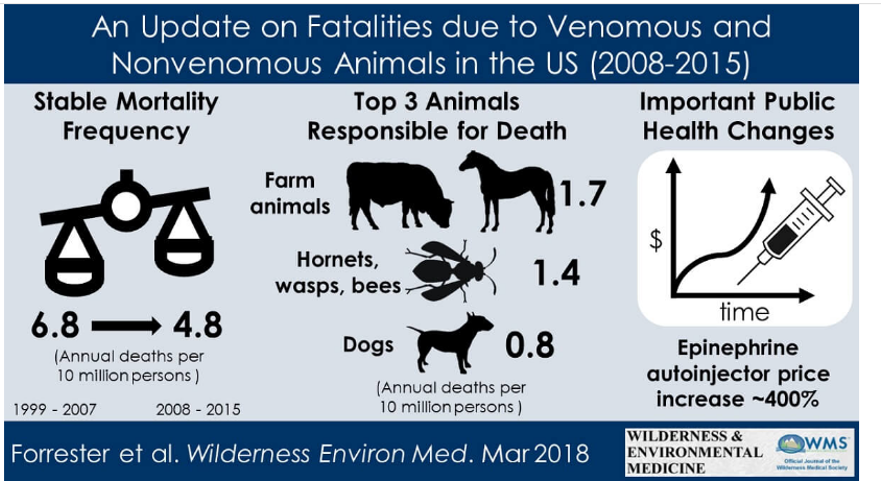
Similarly, in contrast to those anxious to add dog bites to their arsenal of Climate Change alarmism, others have suggested more prosaic reasons to do with the increased popularity of powerful breeds with a greater propensity to bite, American Pit Bull terriers for example, and deficiencies in dog control legislation.
Sri Lanka which is burning and boiling away like nobody’s business appears to confirm this as a programme there linked to vaccination and dog ownership seemingly reduced the number of deaths from dog bites from around 300 in the 1970s to 19 in 2014.
The Harvard Study did find that the number of persons bitten by dogs appears to increase “when the weather is warm,” just as people are likely to be more “cranky” when uncomfortable and that the interaction of people and dogs in such circumstances is a contributory factor if both are in similarly foul humour.
However, the evidence is neither conclusive nor does it place the same weight upon the weather as the media. Indeed, the full study as published concludes that “other factors, such as forced proximity, may be aa greater determinant in dog-on-human aggression,” and that “it is unclear if dog behavior is directly altered by ozone and heat, or, if the observed increase in dog bites is a consequence of altered behavior imposed by the human victim and/or the dogs master, which in many cases are the same individual.”
Not only that but the study by Professor Linnman and others in fact nowhere mentions Climate Change but that was the take chosen by the Indian news site Firstpost who used it as the basis for a piece that deployed a rather loose headline to tangentially link yet another alarmist lecture to the study.
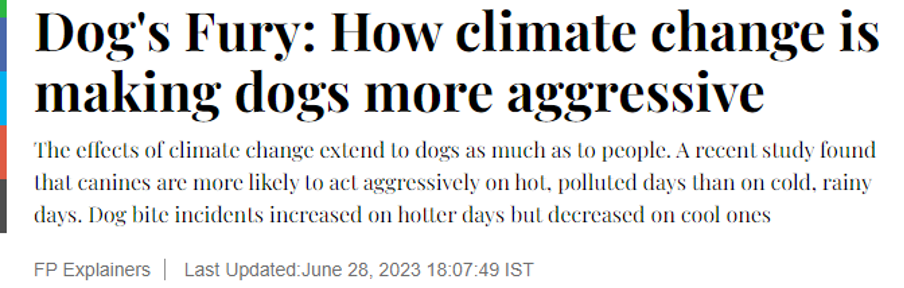
Likewise, Euronews claimed that “Climate change could make dog bites more common” and “turn man’s best friend against us.”
A Zenger News report on the study linked Climate Change to the 10 recorded deaths from dog bites in the UK in 2022, and was able to then list some gruesome reports of dog attacks as proof. The Irish Examiner in January had yet to get with the programme when linking the apparent rise in attacks by dogs to issues of control rather the earth burning.

The linking of dog bites to Climate Change may be yet another example of what statisticians describe as false correlation. A classic example of which is that shark attacks increase as sales of ice cream increase. Another was that skirt lengths in the 1920s were closely correlated with the state of the stock market.
The trick is that you find two unrelated variables that appear to follow similar trajectories and claim that one was responsible for the other. The common connection between ice cream sales and shark attacks was that both increase with warm weather and the number of people on beaches and swimming in the sea. However, ice cream sales do not lead to shark attacks, not do shark attacks make more people buy ice cream.
It is perhaps as logical then to claim that the number of dog attacks leads to an increase in the temperature as it is to claim the opposite. Or that the more slaves there are on the planet then the warmer it will be. There might be a thesis in this yet ..
