The results of Sunday’s Spanish general election might be variously described as a damp squib or as an anti-climax. As the final seat shares were determined, it was apparent that neither of the main blocs led by the centre right and the centre left had secured a majority.
This was due to the fact that while both the Partido Popular (PP) on the centre right, and the Socialist Party (PSOE) on the left had both significantly increased their own vote share, that their main potential allies, Sumar on the far left and the radical conservative Vox, had both failed to win enough seats to create a two party coalition on one or the other side.
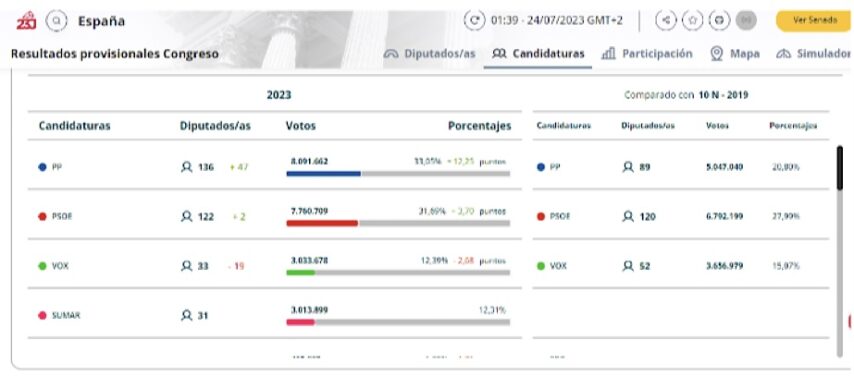
The biggest winner was the Partido Popular (PP) which increased its vote share by 12.2% which means in that they now have 136 seats, a huge jump of 47 from the last general election in 2019. The PSOE likewise grew its vote share by 3.7% and managed to belie predictions of a fall in support by winning an extra two seats.
However, the chance of either of the main parties forming a stable government has been frustrated by the fact that the number of seats won by their main potential ally vote fell. The dog’s dinner of far left, greeny left and Communist left Sumar took 31 seats, seven less than its predecessor Podemos which had won 71 seats in 2016.
The Sumar leader Yolanda Diaz of the Communist Party was Deputy Prime Minister in the outgoing government led by Pedro Sanchez.
Both the main parties will now attempt to persuade sufficient of the smaller groups to support them in forming a government, While the PP and Vox are closest to a majority – requiring just 7 more votes – the ideological complexion of the others favours the left, Besides which, it would appear that Sanchez can continue in government as a caretaker Prime Minister during what is likely to be a protracted process. One that may very well end up in another election.
There was disappointment among the radical right as Vox not only saw its vote share decline, by 2.7% to 12.4%, but more significantly lost 19 of its 52 seats which effectively scuppered the prediction that it would formally enter government alongside the Partido Popular.
It is clear then that the more radical formations on both left and right were squeezed by their larger and more moderate potential allies. The PP also managed to hoover up significant numbers of votes and seats from among the smaller forces on the right and centre.
The reasons why the Vox vote fell remain speculative. Part of it was most likely due to the PP appearing to distance itself from the taint of corruption that had led to its decline and indeed to the split that had led to the creation of Vox. It has also adopted a tougher sounding line on immigration and other issues from Vox.
It might also be argued, however, that Vox in pitching itself to more moderate conservative voters on the economy actually gave them less of a reason to vote for Vox rather than the PP. Unlike much of the European radical right Vox is more conventionally “liberal” on the economy than for example Rassemblment National in France. Sweden Democrats or Law and Justice (PiS) in Poland.
That makes it far less appealing to the working class voters who may agree with it on issues such as immigration, crime and abortion, but which favour the more protectionist and interventionist policies of other European parties of the right.
On Friday, Gript published a piece by Carlos Perona Calvete which details some of the new emphasis of the party, and some of the difficulties which he presciently identified.
While there is much merit in Vox’s support for families and for small business, the perception that it uncritically supports privatisation and lowering corporation tax as an attraction to foreign capital was identified by Calvete as posing difficulties to the extent that “the program does not describe the creation of state companies in strategic sectors, which voters may have expected as a balance to its more liberal elements.”
National sovereignty is incompatible with neoliberal economics. Indeed, it is no coincidence that the sort of open borders and culturally destructive policies favoured by the liberal left and even the far left are completely compatible with the neoliberal economics that have driven the EU’s destruction of national sovereignty across all sectors of life.
The bottom line for big capital is the “free movement of capital and labour.” And that fundamentally requires the undermining of national controls on economic policy and even on control of national borders. And national control of economic policy requires a much greater degree of state intervention than that supported by the centre right which is virtually indistinguishable from the left on every key issue affecting western societies.
So, if there are lessons to be learned from the failure of Vox to increase its support, and indeed caused it to lose some of that support to a party that has been every bit as complicit in creating what has become of Spain as the left, then perhaps it is that they ought not be attempting to outliberal them on the economy.
It will be interesting to see what transpires during the negotiations to form a government, and should that fail and lead to another poll what stance Vox will take in a month or two’s time to regain the ground lost and retake the initiative from the centre right.