It is a perhaps sad, but inevitable, fact of life that methadone clinics are unpopular with locals. Living in a place does not come free of charge, in most instances: Residents invest rent, or mortgages, in acquiring a home. Usually they do so with the intention of raising children, and wish to do so in a safe environment. The purpose of methadone clinics is to provide treatment to heroin addicts, and the nature of heroin addiction is such that those who suffer that affliction tend to be driven to crime to feed their habit. As such, no politician with a brain ever proposes to put a methadone clinic in a leafy residential area. If you put the methadone clinics near respectable people, respectable people will flee to somewhere else.
The map below displays the location of methadone clinics in Dublin. There are nine of them between the canals in the city centre. There are none in Rathgar, Rathmines, Ranelagh, Clonskeagh, or, well, just about any other leafy suburb:
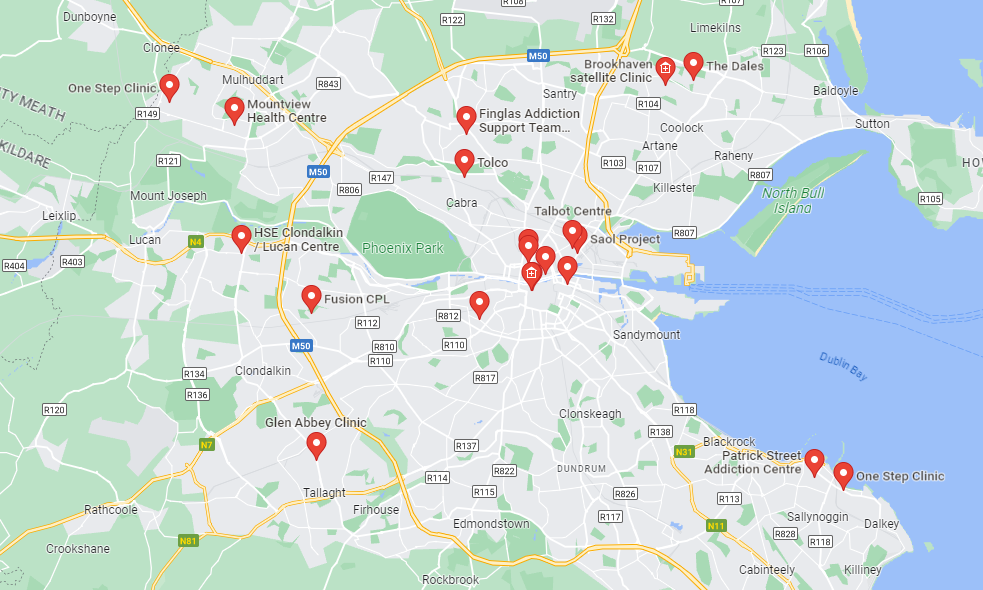
This week it was announced that the state intends to convert an old building on Marlborough Street, just off the main street of the capital, into a residential centre for 1,000 migrants and asylum seekers. Meanwhile, the decline in high street shopping over recent decades has seen much of the former attractions of the city centre – the big stores – increasingly decamping to purpose built suburban shopping centres like those in Dundrum and Liffey Valley. When you move business out of the city centre, and move drug addicts and migrants in, do not be surprised when the overall safety and ambience of the place declines.
Yesterday, it was reported that an American tourist suffered injuries in an assault in the city centre that have left him in a critical condition, fighting for his life, in a Dublin hospital. No arrests have been made, at the time of writing, because the centre of the capital is now so poorly and lightly policed that it is possible for a large group of people to beat another almost to death without a Garda arriving on the scene in time to make a difference.
None of this is accidental: It is the result of decades of awful policy choices.
The contrast with other European capital cities is stark: Paris, for example, is not without its problems but those problems tend to be confined to the banlieus and the slums on the outskirts of the city – they have not been imported to the centre of Paris, which remains one of the most well-policed places in Europe. The same is true of Rome, and London, and Prague, and Warsaw. In Ireland alone has a European country decided to abandon the very centre of its capital city to the kind of social rot that we see daily in the city centre.
That this has consequences should be abundantly clear from the attack on the American tourist: If Dublin attains a reputation internationally as a bit of a dive, then Irish inward tourism will inevitably suffer.
But I think it goes further than that: There is an inexplicable lack of pride in Dublin – this is a rare point of agreement your correspondent has with Una Mullally, who writes often on this topic from her perch in the Irish Times.
The centre of a capital city says a lot about a nation. In the UK, great national events are intrinsically linked to the mall – the great thoroughfare linking Buckingham Palace with Whitehall. It is permanently festooned with union flags, and a heavy police presence. In Paris, the Champs Elysee, bookended by the Arc D’Triomph, is synonymous with France, and is heavily policed for the simple reason that it’s where the tourists go. The same is true of Pennsylvania Avenue in Washington, or Unter den Linden in Berlin.
In those countries, there would never have been a thought about creating a pull factor for drug addicts in the city centre. There is an understanding that the centre of your capital city says something about you as a country, both to those who live there, and those who visit. There is no pretence that those countries do not have problems, but there is an understanding that we can at least keep the centre of our capital cities clean, and beautiful, and attractive.
What does it say about Ireland, and the people who run Ireland, that we cannot?