House prices have seen a drop year-on-year in many counties and in some areas of Dublin, new figures from Daft.ie have shown.
Their price report shows that, on average, prices are 0.5% lower nationally than last year – the first time since mid-2020 that prices have fallen in yearly terms.
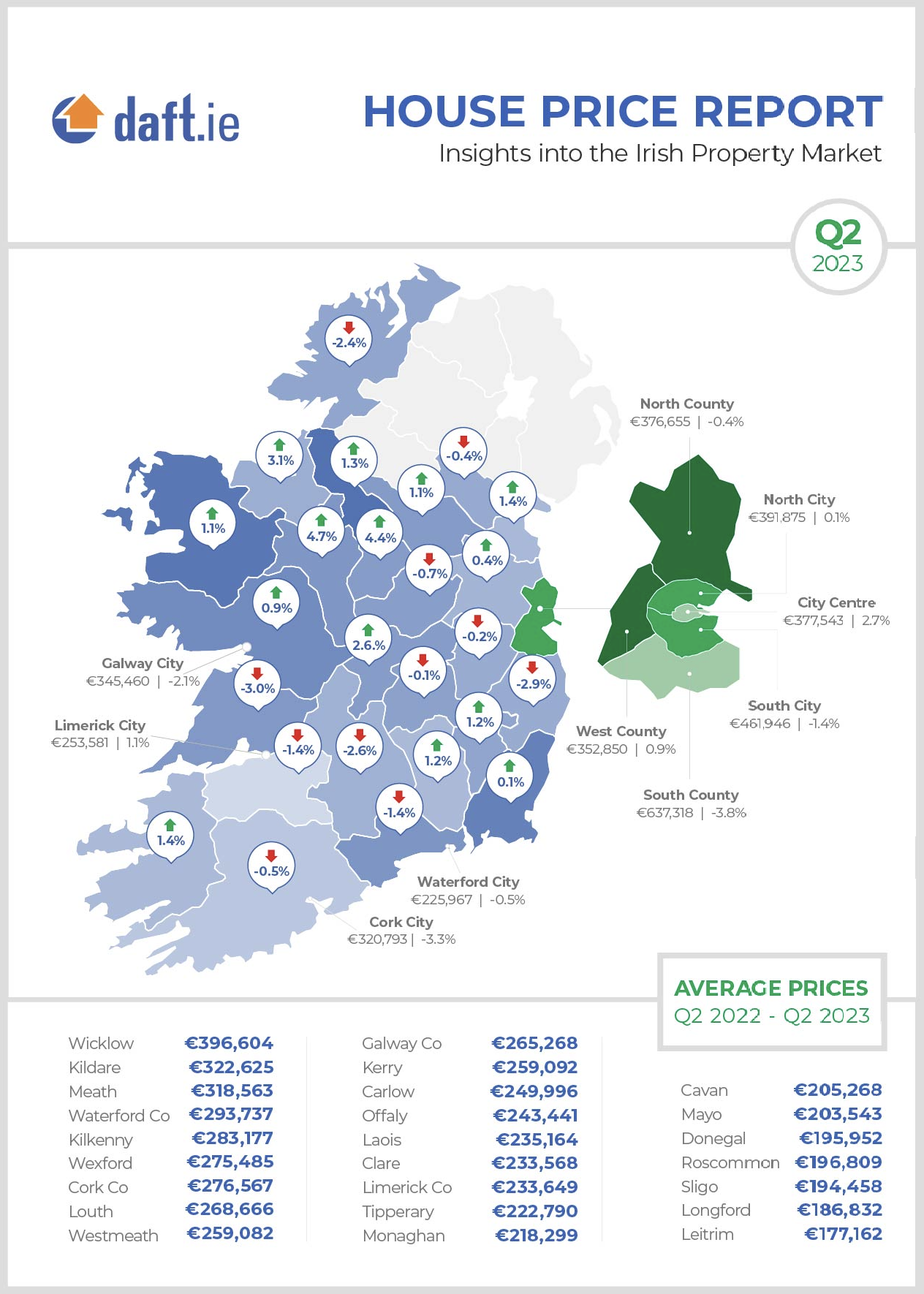
Infographic: Daft.ie
Writing for the Daft report, economist Dr Ronan Lyons said: “So, looking at the second quarter of 2023, are housing prices rising or falling? Without wanting to come off like the classic economist with ‘on the one hand’ and ‘on the other hand’, it really does depend on your perspective.”
“Looking at the second quarter compared to the first, prices rise – and by an average of 2.4% nationally. This is not a trivial increase, almost matching the average quarterly increase in the covid surge between mid-2020 and mid2022. And it is the first time since mid-2022 that prices have increased quarter-on-quarter.”
“So that’s the answer, right? Prices are going up? Not so fast unfortunately. Housing markets exhibit quite a bit of seasonality. For example, across much of the last few years, a pattern emerged where prices typically eased back in the final quarter of the year, which is the quietest for listings, and then increased in the first three months of the new year.”
For that reason, year-on-year comparisons are often more solid – they are also more comparable with other measures of price changes, such as inflation.”
“When we look at what is happening prices year-on-year, the story flips. The quarterly falls in prices – especially in the final quarter of 2022 and first quarter of 2023 – start to add up. At national level, annual inflation is back negative for the first time since mid-2022, albeit only marginally at -0.5%. A year ago it was +9.2%. So compared to a year ago, prices are lower.”
He said that the heat in the market – the typical gap between a dwelling’s listed price on Daft.ie and its ultimate transaction price on the Property Price Register – had cooled “considerably”.
“In Leinster (outside Dublin), Connacht and Ulster, there is now typically no difference between the listed and transacted prices. In Munster and Dublin, there remain premiums above the listed price but they are now quite small (1% in Munster and 2% in Dublin),” the economist wrote.
“In other words, this measure confirms that market conditions have changed considerably over the past twelve months. Whether the latest quarterly figure represents a temporary bounce, after three weak quarters, or a resumption of strong upward pressure, remains to be seen. The labour market is incredibly strong, which translates into strong demand. But with higher interest rates, the gap between underlying demand and effective demand grows. We shall wait and see.”