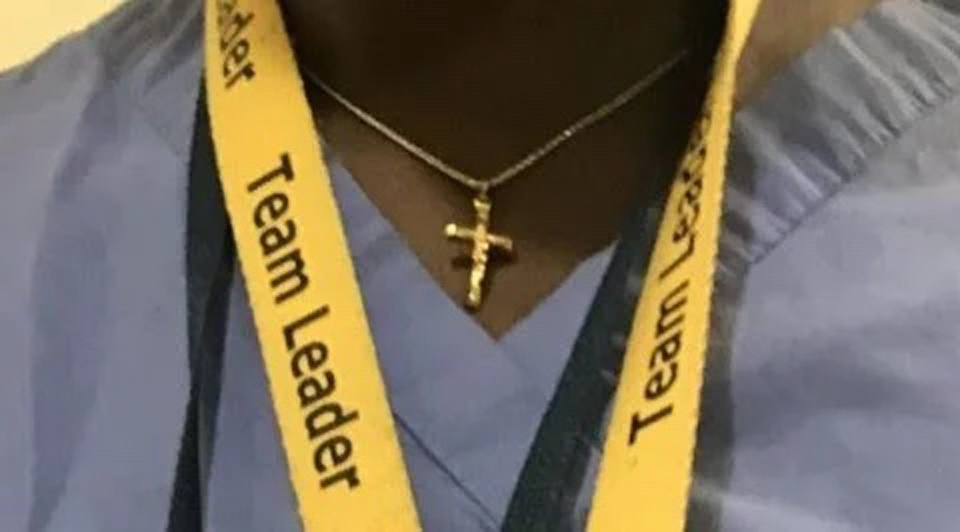
A Christian nurse is suing a London hospital for discrimination claiming she was “bullied out of her job and treated like a criminal” by administrators for wearing a cross around her neck.
Mary Onuoha, 61, an operating theatre specialist at Croydon University Hospital, today told an employment tribunal that she was bullied out of her job for wearing a Christian cross necklace at work.
Mrs Onuoha says she faced a relentless campaign by bosses to make her remove or cover up the gold symbol. She had been a member of staff at the hospital for 19 years after coming to the UK in 1998 and had worn the cross for 40 years as an important symbol of her faith.
The tribunal in south London heard from the nurse’s lawyers that Croydon Health Services NHS Trust violated Onuoha’s right to “manifest her faith” as protected under human rights and equality law.
Mrs Onuoha told the tribunal that she was “treated like a criminal” by her employer for wearing the cross. The case is likely to throw into question the freedom of Christians to display their faith in the workplace, particularly in comparison to members of other faiths.
The nurse says that in her 19 years of working at the hospital, she wore the gold cross around her neck without any complaints or health and safety concerns from colleagues or patients. She claims however, that she was asked to either remove or conceal her cross by hospital administration, a request she refused.
Then, in August 2018, the dispute escalated when hospital bosses ordered her to remove the cross, saying it was a breach of the trust’s Dress code and Uniform Policy and consequently a health risk to Mrs Onuoha and her patients.
Her lawyers will today contend that the dress code was applied inconsistently, with other nurses and members of staff at Croydon University Hospital often wearing various types of jewellery, hijabs, saris, turbans and religious bracelets in wards and theatre without being told to remove them.
Her lawyers claim that Mrs Onuoha was required at all times to wear several lanyards whilst at the same time the trust stated that wearing items around the neck, such as her chain with a cross, posed a “risk of injury or infection”.
Mrs Onuoha claims that on August 21, 2018, she was leading a team working in theatre supporting a patient who was under general anaesthetic.
While the patient was on the surgery table, the nurse’s manager entered theatre and demanded that she remove or conceal her cross immediately.
Mrs Onuoha refused to remove it and was told to leave the theatre to conceal the cross by putting on an extra scrub back to front, on top of the one she was correctly wearing. In response, Mrs Onuoha said she could not leave the patient. To this, her manager said that the junior staff could stay with the patient whilst she removed or concealed her cross.
The 61-year-old nurse, however, again refused to leave the patient. She says that management then returned with another senior staff member, insisting she left to change.
Mrs Onuoha says she was asked what she wanted to do and then, in the end, was allowed to carry on but told that the cross needed to be removed by a specified time later that day. She says that at the same time as the incident occurred, during the same operation, a blue pendant and earrings being worn by the anaesthetist were completely ignored.
According to the lawsuit, this was one of many similar incidents to take place in theatre and wards where Onuoha said she was concerned about the safety of patients.
“I was astonished that senior staff were prepared to potentially endanger a patient’s life in order to intimidate me to remove it,” Onuoha said.
In April 2019 she was issued with a final written warning, but left work due to stress in June 2020 after she was moved to a series of administrative roles. She formally resigned from her role in August 2020.
“This has always been an attack on my faith,” the nurse said, and insisted that the gold symbol was never of detriment to anyone.
“My cross has been with me for 40 years. It is part of me, and my faith, and it has never caused anyone any harm.
“Patients often say to me “I really like your cross”, they always respond to it in a positive way and that gives me joy and makes me feel happy. I am proud to wear it as I know God loves me so much and went through this pain for me.”
The nurse believes a double standard is held when it comes to treatment of her as a Christian compared to those of other faiths.
“At this hospital there are members of staff who go to a mosque four times a day and no one says anything to them. Hindus wear red bracelets on their wrists and female Muslims wear hijabs in theatre.
“Yet my small cross around my neck was deemed so dangerous that I was no longer allowed to do my job.
“From a young age I naturally always wanted to care for people – it was in my blood. All I have ever wanted is to be a nurse and to be true to my faith.
“I am a strong woman, but I have been treated like a criminal. I love my job, but I am not prepared to compromise my faith for it, and neither should other Christian NHS staff in this country,” she said.
Mrs Onuoha is being represented by Christian Legal Centre to challenge Croydon Health Services NHS trust on the grounds of harassment, victimisation, direct and indirect discrimination, and constructive unfair dismissal.
Andrea Williams, its chief executive said: “From the beginning this case has been about one or two members of staff being offended by the cross – the worldwide, recognised and cherished symbol of the Christian faith.
“It is upsetting that an experienced nurse, during a pandemic, has been forced to choose between her faith and the profession she loves.
“Why do some NHS employers feel that the cross is less worthy of protection or display than other religious attire?
“How Mary was treated over a sustained period was appalling and cannot go unchallenged.
“Mary’s whole life has been dedicated to caring for others and her love for Jesus. We are determined to fight for justice.”
Supported by the Christian Legal Centre, Mrs Onuoha will now challenge Croydon Health Services NHS Trust on the grounds of harassment, victimisation, direct and indirect discrimination, and constructive unfair dismissal.