The response to yesterday’s article on housing allocations to persons who had been in IPAS accommodation was interesting. Apart from the evidence provided by the De Paul documents there is a perception that the main Approved Housing Bodies are allocating the bulk of their housing to persons with ‘leave to remain.’
There is also a belief that a considerable proportion of local authority housing is being distributed in a similar way. There is no means to confirm or dispute those perceptions, and further queries I have made remain without a response.
The AHBs emphasise their working closely with IPAS and the local authorities and data from the Housing Agency shows that persons who have been through the International Protection system comprise a significant proportion of those who are on local authority housing lists.
If the De Paul statistics are a reflection of the overall picture with regard to social housing allocation through the local authorities, then it might be a reasonable assumption that a considerable proportion are indeed allocated to persons who have been in the asylum system.
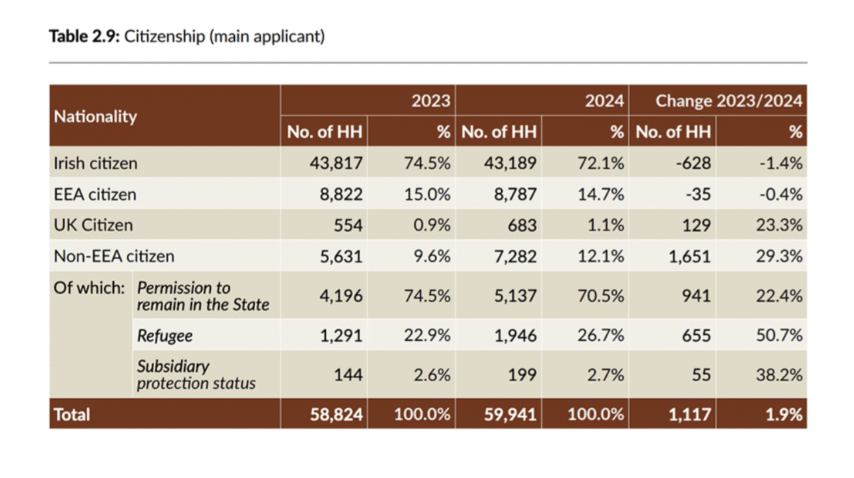
The tables show that overall, 28% of the heads of households on local authority housing lists in 2024 – the last year for which this information is available -were of non-Irish nationality. Given the gap between citizenship and foreign birth the proportion of heads of households born overseas is likely to be close to one-third.
The most interesting statistic is the fact that all of the 7,282 heads of households who were of other than Irish nationality in 2024 were persons who had been through the asylum system; 70% with leave to remain rather than having been granted refugee status. That accounted for 17% of the number of heads of households on the local authority housing waiting lists.
I contacted the housing department in Dublin City Council regarding the numbers of persons who had been allocated social housing and how many had been assisted in that by one of the Approved Housing Bodies. I received no reply before publication.
While it is difficult, as we have reported over the past number of days, to obtain specific information on the housing of people who are or who have been in accommodation under the responsibility of the International Protection Accommodation Services (IPAS) it is not impossible.
The State and the Approved Housing Bodies, who have mostly taken on the task of providing persons who have been given ‘leave to remain,’ are reluctant to impart any details. However, an examination of the available information does provide a considerable insight into what is going on.
Unfortunately, we still have no means of determining where the many thousands who are still awaiting a decision on their application but who are not in direct IPAS accommodation are living. As noted, the numbers in IPAS accommodation were virtually unchanged at the end of 2025 despite the arrival of more than 13,000 new applicants.
As Niamh Uí Bhriain has observed, that is simply not explicable unless there are somewhere in the region of 20,000 applicants who have not been granted leave to remain who are in private accommodation. Yet all of those responsible for accommodating applicants deny that they are facilitating this.
The Department of Justice informed me last night that “IPAS Accommodation is the only accommodation offered to applicants and the State does not accommodate applicants in other settings.”
The only recognition that people might be in private accommodation is where the Department notes that “Applicants may also independently arrange their own accommodation while their application is being considered and some applicants do not take up offers of accommodation from IPAS.”
They may, but any person who has applied and is still within the system and who stays in private accommodation will not be entitled to expenses, to social welfare benefits or to any rent allowances or other housing assistance.
The only legitimate means to access such accommodation would be through the goodwill of family or friends given that the person has no income, or if they are holders of a Labour Market Access permission which applicants for asylum may apply for five months after registering their application.
I have asked the Department of Justice how many people are currently eligible to work with a LMA permission. I received no response. In the absence of more recent statistics the only figure we have dates to 2021 by which time there were more than 6,000 permissions.
The Central Statistics Office (CSO) published a report in August 2025 which showed that 77% of new applicants for the Daily Expense Allowance (DEA) were economically active, ie. in some form of employment, in 2024. In order to qualify for the DEA you have to be living in IPAS accommodation which would suggest that the vast majority of those with permission to work are not in private accommodation.
Which is presumably what prompted recent suggestions by Government ministers that such people might be required to pay rent while still in IPAS accommodation. Which of course promoted a predictable response from the NGOs and others.
There is no reason why they ought not pay for their accommodation if they are working. It also implies that the cohort of people in the system who are entitled to work are not living in privately rented accommodation.
Ironically, Mike Allen of Focus, told the Irish Times on January 7 that the solution to persons with the right to remain being “forced out” of IPAS centres might indeed be to charge them a rent. Focus was one of the main supporters of the abolition of direct provision but it would appear that they only wish to replace one form of dependency on the State with another.
Even where persons granted asylum and leave to remain are surely no more entitled to any assistance that is not available to any other person in paid employment. Nor ought they be entitled to special consideration when it comes to the allocation of scarce social housing.