One thing that has clearly not been solved in 2022 is the housing crisis. Indeed, the last week of the Dáil session this week will see a motion of no confidence in the Minister for Housing from People Before Profit.
The motion cites the low level of houses built by local authorities, the numbers of people in emergency housing, and the failure to basically seize other people’s property, as contributory factors. Their reference to the rapidly increasing number of people claiming asylum without ever acknowledging that this is also a contributory factor is so infantile as to require no more than to point it out.
Maynooth Professor Rory Hearne even wrote a piece at the start of the year for the Irish Examiner in which he cited emigration as a possible consequence of the lack of housing, but failed to refer at all to the elephant in the room.
It is also interesting that while the far left and Sinn Féin point to the failure to meet the demand for new housing units, both are in thrall to the climate extremist view that new builds should be limited as part of the Irish people’s contribution to saving polar bears, who appear to be thriving regardless. As pointed out here previously by Ben Scallan, the Sinn Féin spokesperson on housing and possible future housing minister, Eoin Ó Broin, is supportive of the Irish Green Building Council that wants to limit new builds to 20,000. The IGBC also wants people to live in apartments of limited floor space rather than in proper homes.
Given that the current official target, as set by Darragh O’Brien in 2021 is 33,000 per year, and that this will fall short by at least 5,000 in this year, the left clearly has no better alternative other than some plan to take houses off other people.
Now, while you may be certain that there are people who in PBP would be at least notionally up for that – whatever about ever being able to carry it out – the Shinners in their new soft liberal mode have no such intentions.
Which leaves us still with the conundrum of where to find the land and the means to build enough houses that will satisfy an existing and accumulating demand that is actually accelerating due to unplanned and unregulated mass immigration way beyond not only the official targets but what is actually required.
The latter, as we have looked at before is hugely dependent on the level of likely immigration over the next 20 or 30 years and beyond. We have previously looked at estimates from the ESRI and Davy’s which have variously estimated the annual demand at between 35,000 (Bergin and Garcia-Rodriguez) to 200,000 or over 60,000 per annum (Davy’s), or even 400,000 between now and 2030.
Bear in mind too that the both Davy’s and Bergin/Garcia Rodriguez were basing their estimates on the likely increase in population largely driven by immigration on evidence available to them BEFORE the arrival of tens of thousands of people from Ukraine, and prior to the massive increase in numbers travelling here, most of whom are coming from countries deemed by the United Nations to be safe.
The latest statistics from the Central Statistics Office published last week show that the numbers of planning permissions granted for new houses and apartments fell by 41% between the third quarter of 2021 and the third quarter of this year.
Overall, the numbers of planning permissions granted to the end of September was down by almost 3,000 on 2021 which will almost certainly mean that the number of new builds completed in 2023 will be even lower than the estimated 28,000 for 2022.
To add to that, construction in November slowed for the second consecutive month and there have been reports of labour shortages in the housing sector which is partly due to the numbers of people working on other construction projects such as commercial property and infrastructure.
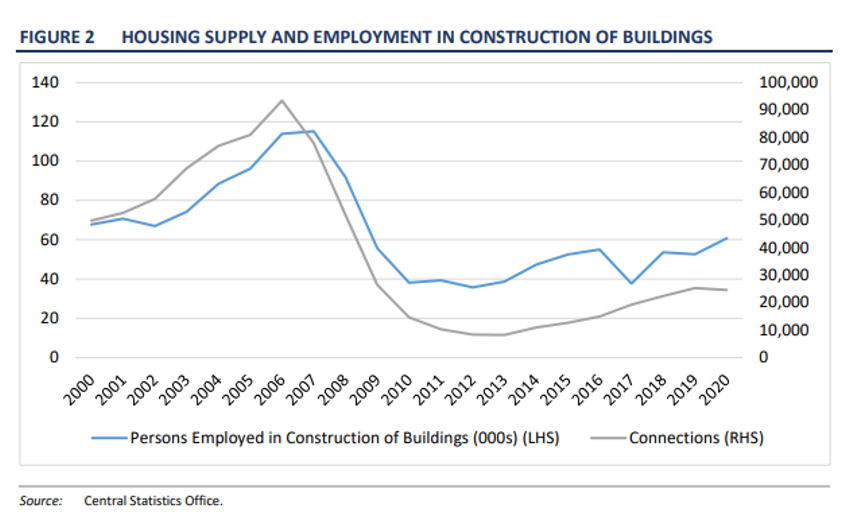
Increasing future housing supply: What are the implications for the Irish economy? (esri.ie)
The failure of supply to match demand has also led to pressures on rent, particularly given the large proportion of new builds being bought by institutional developers with the aim of placing them on the rental market. Interestingly, the Selectra housing site conducted an analysis of the housing marker which showed that mortgages were within the reach of people on average monthly incomes but that the average monthly rental of €1,447 here is way beyond the capacity of such earners if the amount of disposable income devoted to rent remains under the 55% maximum recommended by the Housing Agency.
Also last week, the ESRI published another report on Increasing Future Housing Supply which focuses on factors such as labour supply, and which reads slightly anachronistically given that they refer to the Covid panic as having been a limiting factor in inward migration and the consequences that apparently had on the numbers available to work in construction (p8.)
The report also refers, contradictorily to my mind, to both high housing costs being an inhibitory factor for migrants, but also that “it is also true that increased migration will lead to higher levels of demand for housing and hence will put further upward pressure on house prices in the short term.” (p12.) Oh, and not to mention that housing conditions for immigrants are “sub-optimal.”
Maybe it’s just me, but are they not missing the bleeding obvious here? They point to the elephant in the room, but just as people are focusing on that, they throw in some gratuitous reference to the mouse sitting out in the back garden minding his own business.
And just to remind us that all of these reports, for all their undoubted statistical veracity and the research capabilities of the authors, are hog-tied by external ideological constraints, they conclude:
Finally, it is imperative that any policy measures introduced to stimulate activity in the housing market must be consistent and coherent with those necessary to achieve the targets set out in the Government’s Action Plan on Climate Change
No wonder the Irish state cannot even begin to form an idea of how to cope with the main issues facing it at the present time. Those inside and outside of the official tent are equally as bereft of ideas – or rather sane plausible, nationally centred ones – as each other.