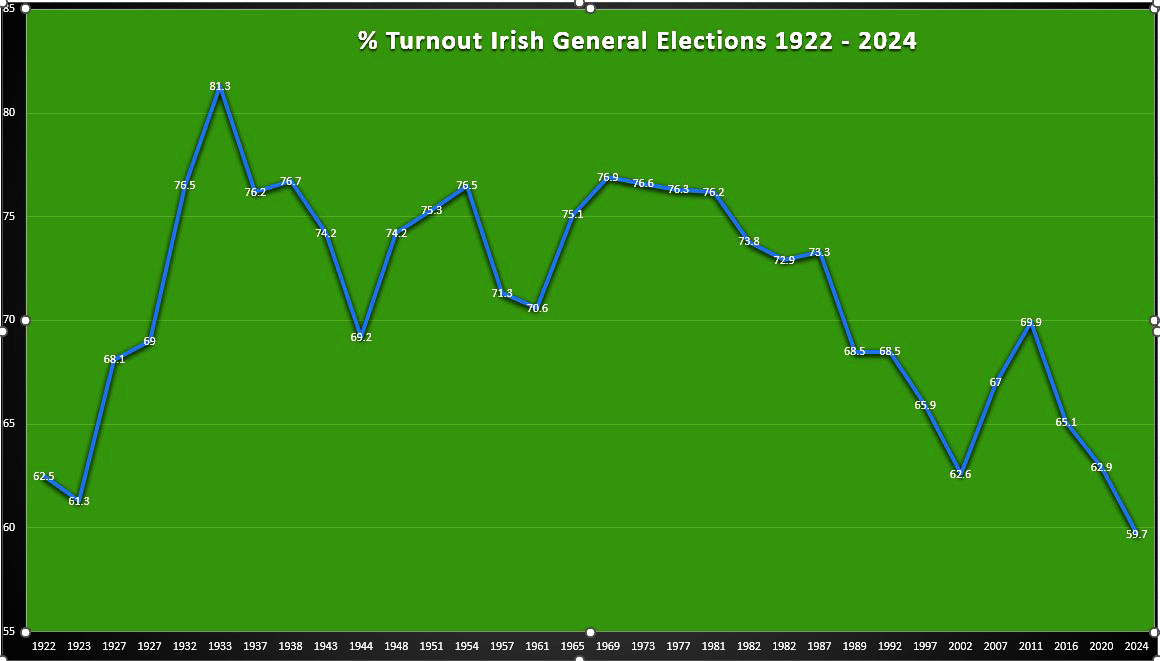
One of the stand out numbers from the recent general election was the one for voter turnout. At 59.7%, the November 2024 general election had the dubious distinction of setting a record for the lowest turnout in a general election in the history of the state.
In fact, you have to go back to the turbulent days of the birth of the Irish state to find similar voter turnout rates. The general election of June 1922 had a voter turnout of 62.5% – that election took place a week before the Civil War started. The general election of August 1923 had an even lower turnout rate at 61.3% which was hardly surprising considering the upheaval associated with a civil war.
By way of comparison, the turnout for the 2020 general election was equally unimpressive at 62.9%. In fact, voter turnout has been falling consistently over the last two decades. What the figures really show is that participative democracy – as measured by voter turnout – is not in a good place in the modern liberal marvel that is 21st century Ireland.
And yes, everybody is aware of the ragged state of Ireland’s electoral register. However, that does not fully explain the trend of falling voting rates. Throughout most of the 20th century, voter turnout rates in Ireland consistently hit the mid seventies – the 2024 general election saw them dip below 60% for the first time continuing a trend that has now been evident since the turn of the century.
So what has gone wrong with Irish democracy? In a word, it could be that the state has meddled too much with what is a very simple idea of facilitating people in voting for a candidate or party of their choice from which a government is then elected.
Remember how state funding of political parties was supposed to fix the old problem of brown envelope donations from people hoping to influence electoral outcomes? Anyone who thinks that tax payer funding of political parties fixed that problem and the broader issue of supporting the democratic process is naive in the extreme.
One of the unintended side effects of that has been the strengthening of the party HQ over its own grassroots. There was a time when the party HQ relied on their local cumann members to do everything from fund raising via church gate collections to putting up election posters. Thanks to state funding, many of the larger parties such as Fianna Fáil and Fine Gael no longer need local cumann activists to the extent they once did.
This is clearly now shown in the annual Árd Fheis. This was frequently a testy affair for most party leaderships – think of that infamous 1971 Fianna Fáil Árd Fheis when Kevin Boland along with a section of the delegates took on the Jack Lynch leadership over its policy on Northern Ireland. Whatever else, at least it showed that there was a party grassroots with actual political opinions that they saw as important. The same can hardly be said for Fianna Fáil in 2025.
Such raucous scenes have now been largely replaced by more dignified scenes of delegates – on expenses – clapping enthusiastically for whatever the leader of the party is for these days. Nowadays, the Árd Fheis is less about policy making and more about carefully orchestrated PR photo ops. State funding of political parties has been crucial in tipping the balance of power away from grassroots political activism in favour of the party HQ and the bigger the party the greater the power imbalance these days.
The other significant state – or more correctly NGO – intervention in elections involves gender quotas. Making state funding conditional on reaching gender quotas for the selection of candidates may have sounded like an enlightened thing but it has had mixed outcomes.
In the recent election, parties were required to nominate 40% female candidates in order qualify for funding. This was up from the previous figure of 30%. No one will be too surprised to learn that both Fianna Fáil and Fine Gael both managed to reach the magic figure of 40% in the recent election. Indeed, there is a suspicion that if that same number was 60% both parties would also manage to reach that quota by adding a sufficient number of female candidates. Invariably, not alone are many of these candidates of poorer quality but they are also less likely to be elected.
Gender quotas, as they now operate, not only devalue the role of women in politics but also devalue politics and democracy itself. However, don’t expect any party leader to call out a taxpayer funded cash cow which strengthens their hand over their own party grassroots.
The winners in all of this have been the party leaders and by that same token, Fine Gael have now emerged as modern Ireland’s ultimate political insiders. The question these days is not what Fine Gael has to do to win an election but rather what they have to do to actually be removed from power.
The 2024 general election saw Fine Gael complete a hat trick of disastrous election results. In the 2016 general election, the party lost 10% of their vote and 26 Dáil seats. In the 2020 general election, they lost a further 15 seats on a 20.9% share of the vote making it the party’s fourth worst ever electoral performance. In the recent 2024 election they even managed to beat that woeful performance with a 20.8% share of the vote making it the third worst general election performance in the history of the party.
However, the significant take away here is that despite Fine Gael’s electoral carnage the party has still managed to cling on to power. In fact, the party is now on course for an unprecedented 19 years of being in power. Not bad, you have to admit, for a party that has now been crashing and burning at the polls for the last decade.
If you’re wondering why voter turnout in Irish general elections is falling then perhaps it’s time to consider how, in modern Ireland, the basic cause and effect associated with voting is being rapidly removed. Why is anyone surprised that voter turnout is falling when it is apparent that a party that has clearly been rejected in the last three general elections continues to stay on in power?
The Ireland that progressives have built over the last two decades has been presented to the rest of the world as some progressive marvel. However, it would appear that increasingly it is one where the very idea of democracy itself has been hollowed out. The state and its allied NGOs have been central to this.
The poor state of Ireland’s electoral register may well be a factor in the country’s declining voter participation rates. But let’s not pretend that there is not a bigger story at play in those same declining voter turnout rates.