When Kate and Joe Reagan moved their young family to Ireland from the United States in 2016, it felt like a dream had been accomplished.
The young couple had long been attracted to Ireland, eventually taking the leap of faith and driven by a natural sense of adventure, uprooting their lives in Portland, Maine, to settle in County Carlow. Joe, who had spent a stint studying at NUI Maynooth, tells me that himself and his wife, Kate, moved with the intention of settling permanently and buying a home in a country they still hold fond memories of. But the property market at the time had different ideas.
“We had two kids when we moved to Ireland, and our wife was pregnant with our third child who was born a few months after we arrived in Ireland. Both my son and my daughter were born in Waterford. It was a huge move at the time. Our eldest child was three and our youngest at the time was just a year and a half. For our children, they see themselves as Irish because basically, they don’t even remember being in the States, really,” Joe says, explaining their decision to move trans-atlantic.
“I was in my early thirties and my wife, Kate, was in her late twenties at the time. We were always interested in moving outside of the US. Legally, we were able to work in Ireland or in fact anywhere in the EU, so we utilised that to be able to move to Ireland and my wife got a job transfer with her company. I was the same.
“We lived in Carlow town. We just loved Ireland whenever we visited – the people, the culture, the beauty of the country – and we just made it happen, making the leap from the States. I suppose it was our dream to get over there and get out of the States. In America, there is also a very intense work culture, and in Ireland, we liked the fact that things were more relaxed and there was more of a work-life balance and a sense of freedom in a way,” he says.
“I had studied in Ireland. I was at NUI in Maynooth back in 2004, and I loved my time there. I also did a lot of volunteer work in college. There are obviously a lot of Catholic priests and I made great friendships and connections in the faith circles while studying, going abroad to the missions with them and things like that.
“I ended up doing missionary work with quite a few Irish priests in South Africa. I suppose I had a lot of cultural and first-hand experience with Irish people abroad as well. We initially moved to Tullow and then to Carlow town in 2018. This was all, of course, before Brexit came into effect.
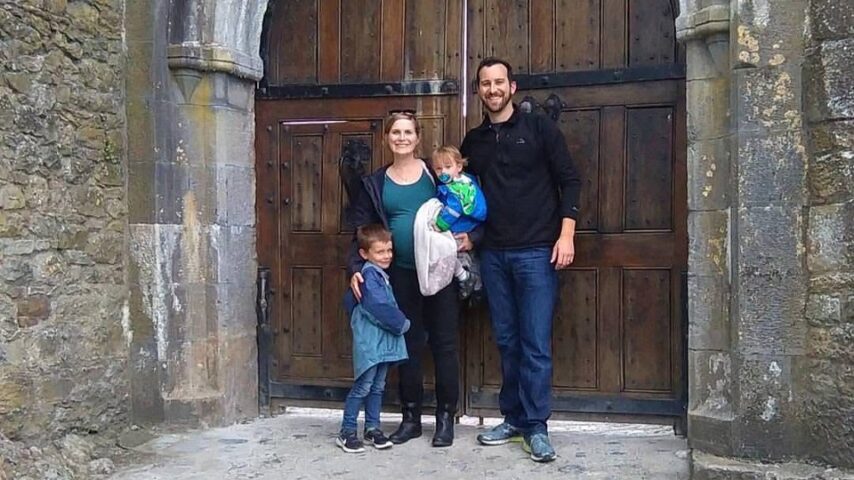
‘THERE WAS SO MUCH WE LOVED ABOUT IRELAND’
“There was so much that we liked – that we loved – about Ireland. We threw ourselves into everything locally. The kids were involved in all kinds of sports, from the GAA, which they loved, to football and a local basketball team, Old Leighlin, in Carlow. We would do the park runs on the weekends and we were involved in the community. We loved the people and the attitude to love.
“We had plenty of great friends that we still keep in touch with. Everyone was so friendly and there was that community aspect there where you could pop in and have a few pints with the lads and listen to a bit of music. My wife enjoyed those things as well.”
‘OWNING A HOUSE WAS OFF THE TABLE’
As for our kids, they were so involved of course, in school in Ireland and there were so many events and they had loads of fun and friends. They were probably the most upset with us when we left. Because for them, Ireland was home and it was all they knew. We were there for eight years.”
While the family quickly got used to calling Ireland home, the constantly changing loan rules and housing crisis made their goal of buying a house feel like an uphill battle. They gave up on their aspiration, and initial expectation, of becoming homeowners – and resigned to renting.
“We were renting like so many people, for the whole time we were there. Like most people we had the intention of buying a home and staying in Ireland permanently, but unfortunately for us, that just wasn’t attainable. It always felt like that from the start, really, with how expensive everything was. It was hard because a we were quite early in our careers. Looking back, it always seemed like the goalposts were moving in terms of loan approvals.
“The fact we had four children, which is a big family these days, didn’t really help. It always felt like every time we were going to get there, something changed, and financially, things were just very tight. We eventually resigned ourselves to renting because by that stage getting a house felt like it was off the table,” Joe tells me.
However, as the eerie gloom of the initial lockdown descended upon Covid – turning into repeated lockdowns – the Reagans started looking into buying a home in Italy, spurred on by glass-half-full thinking that this way, they at least owned something and could go somewhere warm on holidays.
“When we arrived in 2016, there were still some opportunities to buy in Ireland, but we hadn’t established ourselves yet, which would have needed to get the opportunity to buy. Things were getting harder, and I suppose that around the time when we had resigned ourselves to renting, we started dreaming of going to foreign places or owning property somewhere. We had some savings and it was around the time of Covid that we realised, when we began looking into it, that there were actually houses you could buy abroad for €20,000 to €30,000, and they’re liveable.
“In many of them, you don’t even need to do much work, so we thought, why don’t we do that? That way, at least we’ll own something with the money we would have put towards a deposit – because we’re not getting on the property ladder in Ireland.”
They settled on the rugged region of Abruzzo – famed for its beautiful scenery and mountains which are still home to wolves and bears. Many sleepy country towns in Italy’s greenest region – about a three-and-a-half hour drive from Rome – remained largely unknown to tourists until the noughties.
“The idea of putting the money down, owning something and having a house – even just a holiday home we could go to for the summertime – that sounded fantastic. So that became our goal, and we eventually purchased a house in Abruzzo in 2023,” says Joe happily.
While it was intended as a holiday escape, things shifted quickly for the family – their children had long settled into schools and were happy with life in Ireland – when their landlord informed them that he would have to increase their rent. Because they were not living in a rent pressure zone. Joe recalls how he and Kate had just returned from a three-day trip to Italy where they had finalised the sale of their holiday home to learn their rent in Ireland was going to have to increase.
“A friend had watched our kids while we were abroad, and we had a text from our landlord asking us to meet up,” says Joe.
“Essentially, he said that he needed to increase our rent. It’s hard when you’re trying to keep things ticking over and you get that news. We just thought, what do we do? It was a situation where we owned a house and suddenly, it just didn’t seem like a great deal for us. It didn’t make sense to us. Our rent was increasing at the time to a point that was unattainable for us.”
“Having our four kids and looking at my electricity bill and groceries bills going up and up every month, you start to ask, how are we surviving?”
Joe says they had to make a clear decision – to pay a rent they could barely afford in a country facing a housing crisis – or move into their own home in Italy with no mortgage. While they could look for another property, there was a shortage of houses in the area and the rent was not significantly cheaper elsewhere. So, they bid farewell to Ireland, the place their children and themselves had known as home for eight years.
Kate was working a remote job at a time when remote working was becoming more commonplace in the aftermath of Covid lockdowns, helping to give the family flexibility to move elsewhere.
‘IRELAND WILL ALWAYS BE OUR HOME. WE HOPE TO RETURN ONE DAY’
“Because my wife was lucky enough to be able to work remotely, and I was happy to change jobs and do a bit of remote work too – I work in sales – we began to wonder if we could make the leap to Italy.
“We had four children and life was expensive enough as it was – so we started to consider the possibility of what life would look like being rent and mortgage-free, having bought the house in Italy for €24,000. Even with our friends in Ireland, we could see so many instances of landlords selling up and people no longer having anywhere to live, but struggling to find a new place. The stress that many people are going through to buy homes in Ireland or even find somewhere to rent is very tough.”
While Joe had some family connections in Ireland, his wife, Kate, had cousins in Abruzzo which gave them a link to the region.
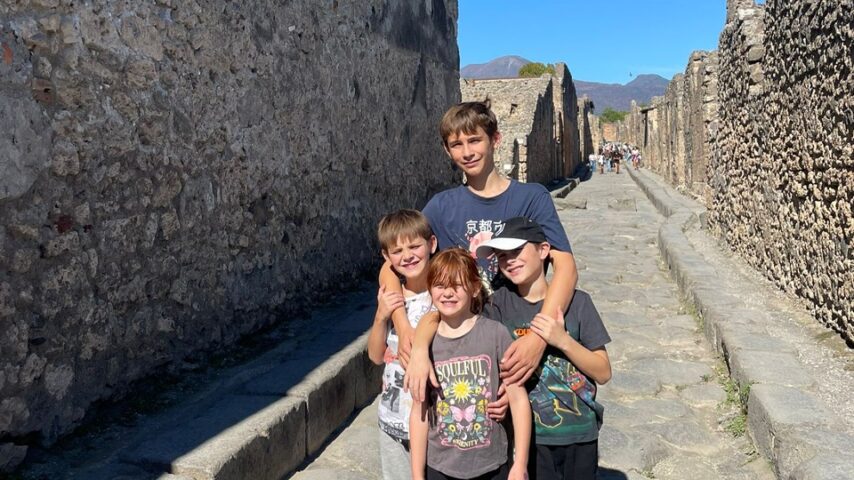
“I have to say though, Ireland will always be our home, and we hope to return one day,” says Joe, whose children – Mairéad, Kieran, Declan and Brendan (aged 9, 10, 11 and 13), all have Irish names.
So, how is life in Italy? Joe describes it as “polar opposite” to Ireland, with both places having different advantages and disadvantages.
The scenery, food, prices and culture beat today’s Ireland, says Joe, whereas Italy being laden with more bureaucracy is frustrating.
“The Italian bureaucracy is definitely famous for a reason, with regards to visas and documentation and getting that all worked out. In Ireland, it’s much more laid back. The weather is obviously beautiful and it’s a big mood booster – though we do miss the brighter and longer evenings in Ireland, and of course in Italy, it gets so hot in the summer where there are days you just need to jump in a pool. I think one difference is that in Italy, we have found the cost of living to be less and the kind of lifestyle we have here means we seem to be able to live well on less.”
“Obviously, the language barrier was a big thing at the start, especially when you have to get your kids enrolled in the local school. However, we were quickly fully immersed into Italian life, and within a year our kids were speaking Italian. It’s amazing how quickly they picked it up, and there’s a big benefit of course to having two languages.
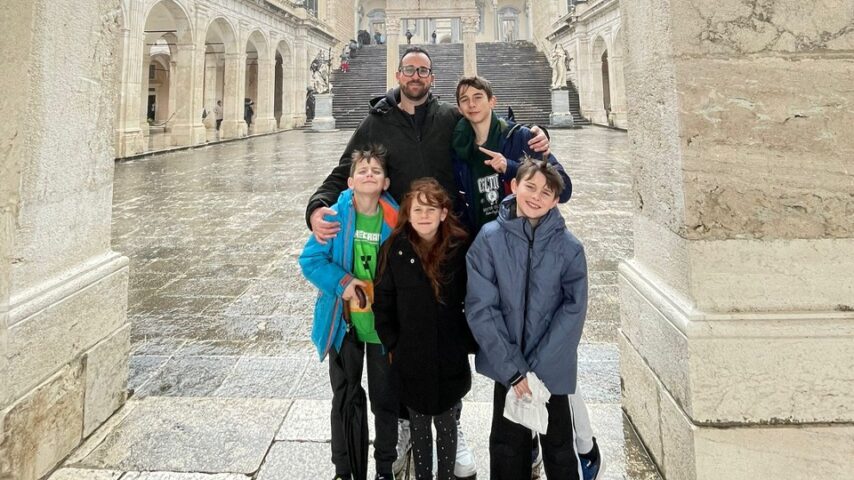
“As adults, I have to say we’ve been a bit slower learning it, but we did everything we could, including doing classes of course. Sometimes, when we didn’t understand as much as we should, I would lean on my eldest son – who’s now a teenager – and who was so good with the language so quickly, which he sometimes resented,” laughs Joe. “He’s been very helpful with the translation.”
“Yes, we had a great community in Ireland,’ adds Joe. “But it took us years to break that barrier and to peel the layers back and become friends with people. Whereas in Italy, it was quicker to make those connections and slot into the community.
MELONI’S TAX BREAKS FOR WORKING MUMS
“On the other side of that,” adds Joe. “A lot of Italian towns now have such an older population and they’re actually facing a shortage of kids. Schools are closing and some of the communities are shrinking because of the falling population. So I have to say, as a family coming in with four kids, it definitely felt positive and that we were making a small difference. People were curious, like, ‘Who are these Americans?’ They actually called us Irish at first because we had an Irish mini van.”
One unique advantage Joe points to are Italy’s tax breaks for working mothers – capped at €3,000 a year. It’s not a secret that Europe as a whole is in the grip of a birth rate crisis. While opponents will argue that ‘bribing’ women to have more babies doesn’t work – it has helped Joe’s family. Italy’s government, led by Prime Minister Giorgia Meloni, introduced significant tax breaks and incentives for working mothers in the 2024 budget to address the Italian birth rate – which is one of the lowest in the world.
Such measures have been designed to encourage women to remain in the workforce after having children, and have been supported in the context of supporting families.
“People like to criticise Meloni as this Trumpian figure, but the policies she is encouraging are pro-family, and they are helping people like us,” says Joe. “Whereas there’s a flat tax rate in Ireland, my wife enjoys a tax break of a few thousand euros yearly, which obviously adds up, and makes a difference.”
Many locals seem to approve of Meloni, who has injected the country with a fresh sense of national pride.
The most understandably common question Joe gets asked is, ‘What’s the catch?’
“Our home is in Celenza sul Trigno, which is a small town of about 800 people. But it’s not in the middle of nowhere or anything like that – there are also bigger towns and cities near us, with say 20,000 or 40,000 people. It’s small but it has everything we want. The bigger towns nearby would have the restaurants and shops and amenities but where we live, we have the basics, which is all we really need. Our kids go to the local school here, but my eldest will be starting secondary school next year so he will have to take a 30-minute bus to school.
“Also, because the house was so affordable and we don’t pay a mortgage, we’ve had the money to decorate and do what we want with it. We recently had our kitchen done up, at a few thousand euros – a fraction of what many people in Ireland pay for a kitchen renovation, which can go into the tens of thousands.”
“In terms of the question, ‘Is there a catch?’ we get that all the time. Of course we do,” admits Joe. “But there isn’t a significant one. Of course, there are challenges that come with packing your life up in a suitcase and having your kids grow up between different countries.
“They have accents that I suppose don’t fully belong anywhere, but there are also benefits – they’ve learned to be adaptable at a young age. It’s not all romantic. There are lonely times and moments of doubt. Living abroad strips away comfort, undoubtedly, but it also strips away excuses, and that has been good for us.”