Swiss Olympian athlete Sarah Atcho has told fans she has developed pericarditis from taking a Pfizer booster vaccine for COVID. Pericarditis is an inflammation of the pericardium (the thin membrane around the heart) which causes chest pain.
Atcho vented her frustration in a statement posted to social media, writing that: “I have to admit that I am upset at the situation because we don’t talk enough about side effects.”
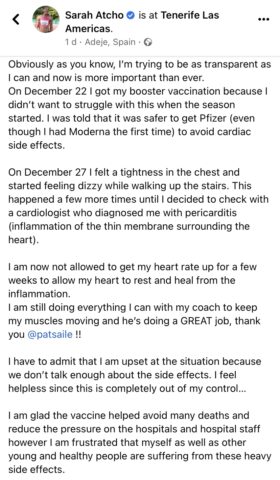
The talented sprinter also wrote that, while she was “glad the vaccine helped avoid many deaths and reduce the pressure on hospitals and hospital staff,” she was “frustrated that myself as well as other young and healthy people are suffering from these heavy side effects”.
Atcho said that she was trying to be “transparent” as an athlete, which she believes “is now more important than ever”. She revealed that she got her Pfizer booster vaccination on 22nd of December – and was advised to get the Pfizer booster specifically to “avoid cardiac side effects”.
“On December 22 I got my booster vaccination because I didn’t want to struggle with this when the season started. I was told that it was safer to get Pfizer (even though I had Moderna the first time) to avoid cardiac side effects.”
She continued in the statement: “On December 27 I felt a tightness in my chest and started feeling dizzy while walking up the stairs. This happened a few more times until I decided to check with a cardiologist who diagnosed me with pericarditis (inflammation of the thin membrane surrounding the heart).
“I am now not allowed to get my heart rate up for a few weeks to allow my heart to rest and heal from the inflammation. I am still doing everything I can with my great coach to keep my muscles moving and he’s doing a GREAT job, thank you @patsaile !!”
Atcho said she was upset at the situation and stressed that the potential side effects of COVID vaccines are not talked about.
“I have to admit that I am upset at the situation because we don’t talk enough about the side effects. I feel helpless since this is completely out of my control… I am glad the vaccine helped avoid many deaths and reduce pressure on the hospitals and hospital staff however I am frustrated that myself as well as other young and healthy people are suffering these heavy side effects. I hope you understand why it is important for me to share, I’ll keep you guys updated on the process.”
She ended the statement by telling social media users: “Let me know if you’re experiencing the same, let’s help each other!”
Under the post, which has been shared almost 1,000 times on Facebook, people thanked Atcho for her “honesty” and wished her a swift recovery.
“Thank you for your honesty and courage to speak out. I pray that you will recover completely and that by sharing your story, you may help someone else” one person on the comments penned.
Another commenter told the sprinter: “I’m glad you’re speaking out on this. Your questions are valid. I wish more young healthy athletes would speak out as well. Prayers that you will have a speedy and full recovery.”
It comes as World number 1 tennis player and top athlete, Novak Djokovic, was deported from Australia because he said his Covid recovery should exempt him from a vaccine. The controversy has been described as a witch-hunt, with Serbian President Aleksandar Vucic sharply criticising the Australian authorities for their “mistreatment” of Serbian Djokovic, saying they “humiliated themselves” in persisting with a push to deport the tennis champion.
The Novak controversy has refocused attention on the world ranked No. 25, Jeremy Chardy, who says he has had a series of problems after taking the vaccine and that he feels his tennis career is now over, as he is unable to train and play.
On the HSE’s website, the risk of rare myocarditis and pericarditis is acknowledged in relation to the Pfizer jab.
“Very rarely, people may develop myocarditis and pericarditis after getting the Pfizer/BioNtech vaccine. Myocarditis and pericarditis are inflammatory heart conditions. The risk of these very rare conditions is higher in young men,” the HSE states.
“These conditions are more likely to occur after the second dose, and mostly happen within 14 days of getting the vaccine.
The HSE cite two European studies “which have estimated the risk of myocarditis, after the second dose of the vaccine as:
- one additional case for every 38,000 men aged 12 to 29 (within 7 days)
- one additional case for every 17,500 men aged 16 to 24(within 28 days).”
The HSE adds that: “We do not yet know the risk of myocarditis or other rare side effects after a booster dose.”