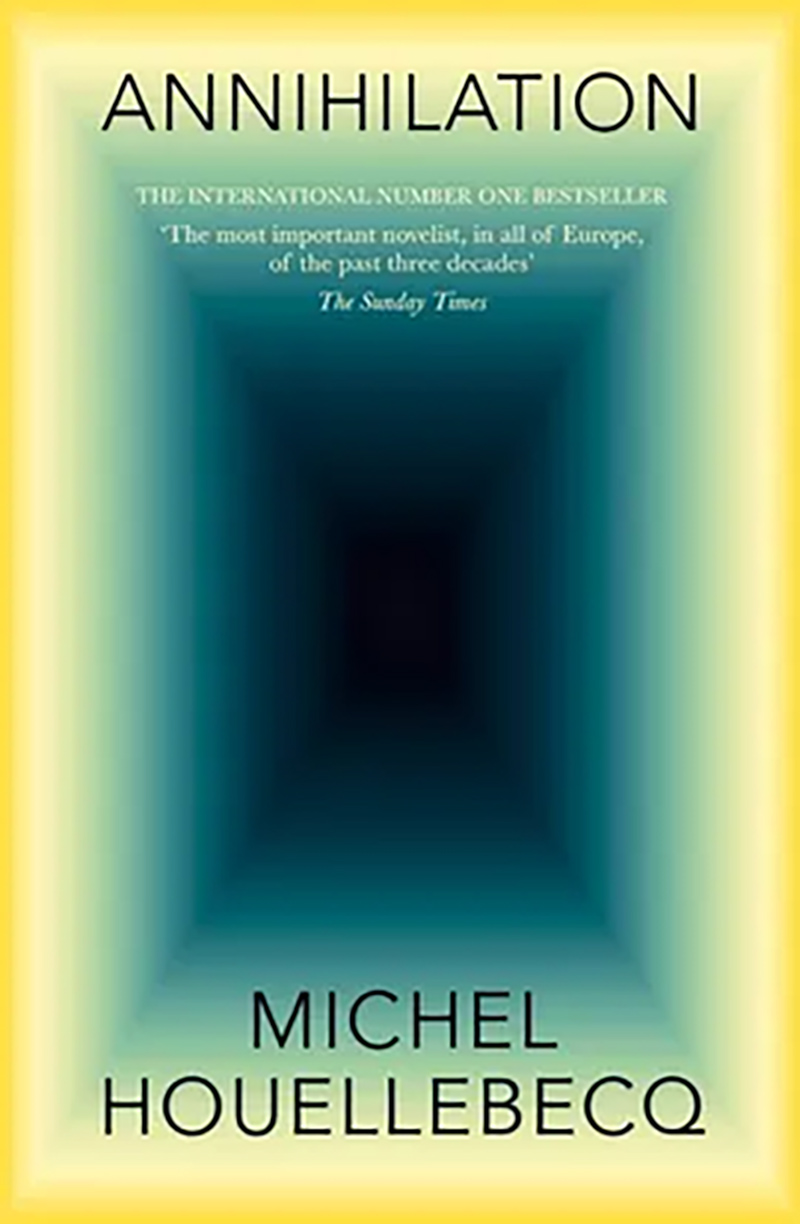
Is this how Taylor Swift fans feel while waiting for tickets for their idol’s upcoming concert? French novelist, Michel Houellebecq, has a new novel out this week, Annihilation. Or, more correctly, Houellebecq has an English-language translation of his 2022 novel in French, Anéantin, being published this week.
The French-language version has been well reviewed by this stage – in English too – though this reader has done his level best not to read them. Not speaking French – beyond being able to say the Hail Mary and ask for a baguette at the campsite – I am one of the many readers (of English) who has had to have waited patiently for the work to arrive in this most global of languages.
That has not bothered me; the opposite in fact. As an Irish speaker, I have taken perverse pleasure in knowing that someone, somewhere, has written a book, another book, of importance in a language that is not English. That, of course, is a well-established practice for Houellebecq by this stage. His 1998 novel, Atomised, in English, was certainly the one that brought him global fame, or infamy, depending on your tastes. Submission in 2015 and Serotonin in 2019 ensured that he became one of those writers who won recognition from a global, English-language, audience and became a must-read author.
It must be quite an odd experience for Houellebecq; writing in his native French, ploughing and planting that unique furrow, publishing in that language, waiting for the reviews and then starting the whole process over again in a second language, English. Usually, there was only a wait of a few months between the French and the English-language versions of his novels.
That has not been the case this time, with two years lapsing between the two texts. The poet Paul Murray, O.P., – no relation – has a lovely line in his poem, The Art of Poetry, about “the slow wheel of language” turning. This has certainly been a slow turn of the wheel, from French to English, but one which has given us all time to reflect on the intimate nature of language and its importance to culture, French and European.
The Irish for language is, of course, teanga, which can also mean “tongue” and that is a very, very intimate word; we see immediately the connection between voice, expression and physical being in a “tongue”. It is good to be reminded that English is not the only language in the world. Unfortunately, we are bad at learning other people’s languages because, well, eventually, they learn English which is the language we use to rule the economic world – or so the government would have us believe.
In that regard, Houellebecq has reminded us that Europe can, just about, still produce works of fiction, in a language other than English, and works that demand a world-wide readership. This writer has some half-forgotten German as his third language; fragments of Heinrich Böll and others that are still held within the memory and spark the imagination. They are important for reminding me, as a casual reader if nothing else, that Europe is more than just the English language and that native languages – French, Breton, Welsh, German, Catalan – all live within the continent’s borders, reminding us of other histories and producing literature that informs our, European, imagination and sensibility.
(Böll, like Houellebecq, also spent some time living in Ireland, providing a cosy, sentimental, connection, which we can all enjoy.)
Of course, a visit to the local bookshop will have a table full of Irish writers, of English, vying for the reader’s attention. Had I the money, the time, the energy, the inclination, I would buy more of them and more often. Alas, few of them have the appeal of Houellebecq for this casual reader. Houellebecq has name recognition and literary pull that many other professional writers must envy.
I am waiting in anticipation for Houellebecq’s novel, counting down the days, and will shell out hard-earned cash for the hardback copy, something I rarely do. I will read the new novel straight away; I will, temporarily, abandon Netflix and YouTube for this book. I will set time aside to read; I will want to read it. I will read Houellebecq for the pleasure, provocation and insight because he is Houellebecq and I will learn something or feel something more after reading him than I did before.
I am a Swiftie, a total middle-aged Swiftie!