The Journal’s ‘Morning Lead’ today brought attention to the fact that last month the US government decided to brand November 2023’s Dublin riot as an instance of “White-Identity Terrorism” (WIT).
That categorisation was contained in the US Department of State’s annual Country Reports on Terrorism for 2023. Alongside the inclusion of such organisations as the Continuity IRA and the New IRA and their assorted activities – regular appearances in reports such as these – Ireland was notably listed as one of the six countries affected by WIT or “Racially or Ethnically Motivated Violent Extremism” (REMVE) in 2023.
This was news to me, which was surprising as someone who of necessity reads the news somewhat forensically.
WIT/REMVE are described in the report as “a growing and transnational threat to the United States and our allies,” and developments on this front are summed up as follows:
“Violent white supremacist, anti-government, accelerationist, and like-minded individuals promoted violent extremist narratives, recruited new adherents; raised funds, and shared tactical training – including weapon-making instructions – both online and in-person. Many REMVE attacks are inspired by transnational REMVE movements with adherents around the world who connect online. Attacks often are carried out by individuals who are part of anonymous online communities but lack formal ties to traditionally organized groups.
“REMVE actors are increasingly adept at exploiting social media platforms, online gaming platforms, gaming-adjacent platforms, smaller websites with targeted audiences, and encrypted chat applications. They use these means to recruit new followers, plan and rally ideological support, and disseminate materials that contribute to radicalization and mobilization to violence.”
What has this to do with Ireland? Well, the report tells us:
“In November, Irish white supremacists and ultranationalists online spread disinformation regarding the nationality of a stabbing suspect arrested after stabbing two adults and three children. This anti-immigrant disinformation led to three days of white supremacist rioting in Dublin, in[j]uring police and bystanders.”
There is almost too much wrong with this brief summary of the Dublin rioting to address. As is often the case, disinformation on the part of the US Department of State gets the official thumbs-up (and reported enthusiastically by The Journal, one of our esteemed national fact-checkers), while supposed “anti-immigrant disinformation” gets the imperial thumbs-down.
We’ll start at the beginning I suppose. If “disinformation” regarding the nationality of the stabbing suspect emerged immediately following the incident, most of it was incorrect only in terms of which nationality they attributed to then-50-year-old Riad Bouchaker from Algeria. The rush to remind us that he’s apparently a naturalised Irish citizen who’s lived in Ireland for two decades or so doesn’t change the fact that he’s not of Irish ethnicity.
Whether you find that fact distasteful or not doesn’t matter here. To describe the perpetrator as an immigrant was not “disinformation” then and remains an accurate description now. That that revelation lit a fire under people’s feet amid an ongoing national immigration argument should have come as a surprise to no one.
Indeed, the way the summary is composed would lead one to believe that “Irish white supremacists and ultranationalists” fabricated an inflammatory story and in so doing sparked “three days of white supremacist rioting in Dublin”.
In reality, and as mentioned, 50-year-old Algerian man Riad Bouchaker stands charged with the attempted murder of the children that November evening, an event that sparked an initial – peaceful, if agitated – protest, which was followed as numbers grew by a single evening – not three days – of rioting. Intense as the situation was, it was brought under control in a single night, and those who participated in it are still being brought to justice.
Meanwhile, Riad Bouchaker appears to have dropped off the radar altogether, with updates on his case essentially nonexistent.
But for our present purposes we return to the so-called “white supremacist rioting”. While politicians and police figures were quick to describe the unrest initially as “far-right” hooliganism driven by hatred and a “manipulative element” – all of which are very much implied by the US report – the picture has changed almost entirely since those first heated hours and days.
As our own staff present on the ground attested to in their accounts and reporting, the rioting wasn’t carried out by any organised ideological movement so much as by lawless youths taking advantage of the bacchanalian atmosphere that follows in the footsteps of mass unrest.
That perspective received some ironclad confirmation late last year when gardaí decided to release 99 CCTV images of those caught on camera during the riots, in an effort to identify those who continued to evade the gardaí’s reach.

Turns out the “white supremacist” movement in Ireland has unusual bedfellows, as many of those captured on camera appeared to either be immigrants or of diverse ethnicity themselves. John Mooney in the Sunday Times, upon the release of the pictures, admitted that that the photos showed “white, black and Asian rioters ‘answered a call for mayhem’” – revealing that “diverse ethnicities were involved in last year’s Dublin disorder, complicating the case against the far-right”.
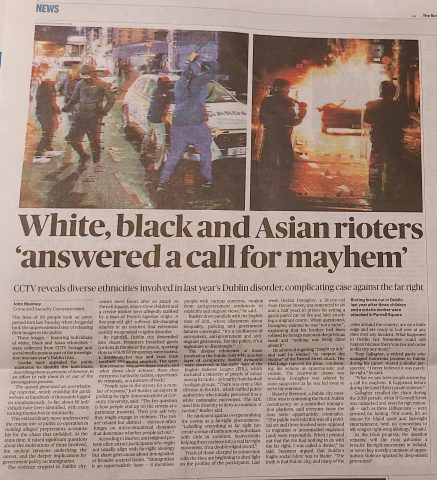
Not long before those images were released, Gardaí admitted that most of the participants in the Dublin rioting were “opportunistic” vandals and looters.
“A lot of the individuals that we’re now looking for are not necessarily connected with any hate elements—they’re dealing with looting, criminal damage, and issues around that,” a Garda spokesman told reporters last November.
All in all, the idea that the Dublin rioting of November 2023 was organised and conducted by Irish white supremacists and ultranationalists is itself flat out disinformation, or misinformation at the very least. If that couldn’t be said in the immediate aftermath of the incident (and it could be with reasonable certainty), it most certainly can be now in light of garda statements and developments.
The US Department of State should, but won’t, amend its report to either remove this inclusion or provide much-needed context that essentially dilutes its case into non-existence.
Similarly, for an outlet that so prides itself on its fact-checking credentials, The Journal should know much better than to uncritically amplify patently false narratives. To do so so openly suggests a less than objective stance on Irish social affairs.