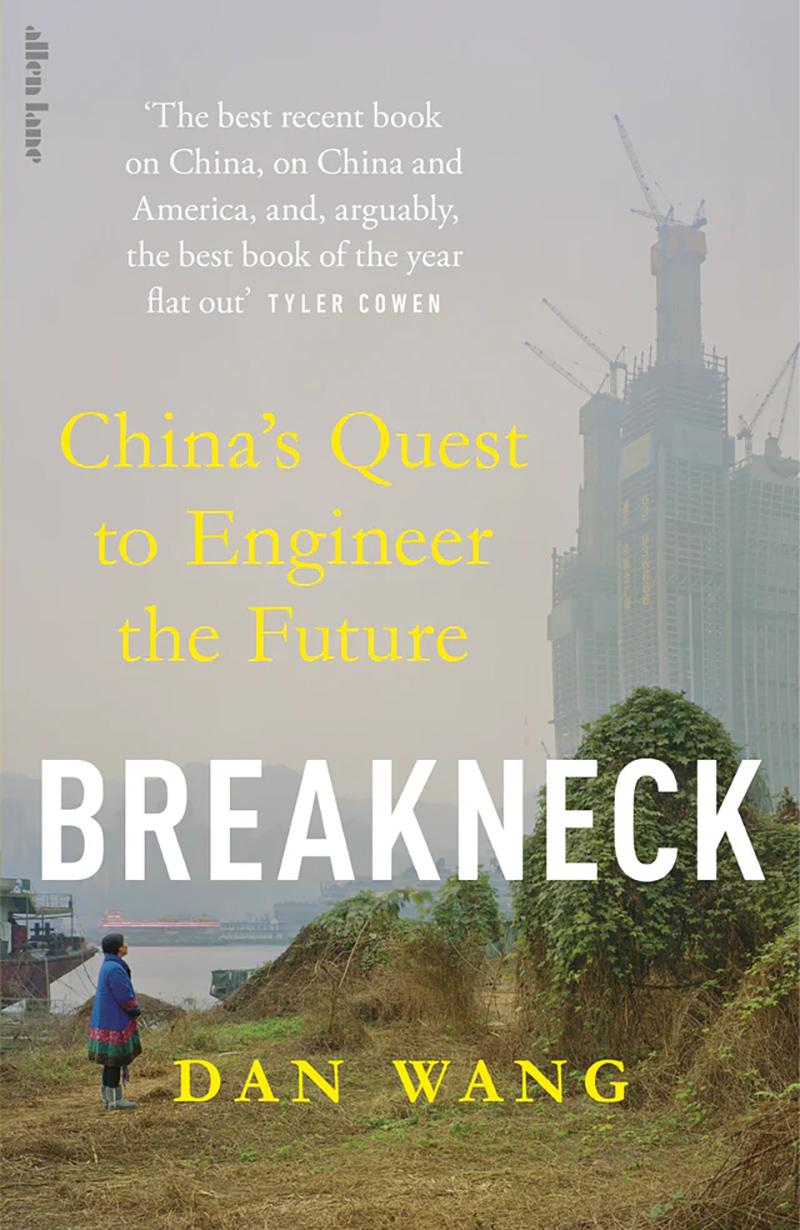
Two of the most discussed books of 2025 have been ‘Abundance’ (written by the American journalists Ezra Klein and Derek Thompson) and the technology specialist Dan Wang’s ‘Breakneck: China’s Quest to Engineer the Future.’
The former is about American domestic affairs: in particular, the need for Democrats to tone down their regulatory zeal and embrace a politics of productivity and abundance.
The latter is about the two global superpowers and what Wang sees as the striking contrast between their socio-economic models: America as a nation governed by lawyers addicted to obstruction, and China as a nation governed by engineers addicted to construction.
Klein and Thompson’s book is interesting, but Wang’s is far more deserving of study.
The contest for global supremacy between America and China will, after all, define the coming decades.
The thread that links the two books together is this distinction between those who can build and those who cannot.
This has global relevance, especially in the post-industrial societies of the West where the creative instinct has been sapped by a toxic mix of over-regulation, climate catastrophism and educational degeneration (all three of which are obviously in evidence here in Ireland).
Klein and Thompson’s thesis is a simple one. “Scarcity is a choice,” they write, before arguing that “we need to build and invent more of what we need.”
They hit out against liberal NIMBY objectors who make it impossible to build nuclear power plants or even green energy projects. They also zero in on the zoning policies of Democrat-governed cities which have made it impossible for low-income people to live in affluent areas where social liberals cover their lawns with signs bearing progressive slogans.
America has reached a turning point here, as demonstrated by Trump’s significantly increased vote tallies across major cities in 2024.
Whereas California used to represent the bright future of America, the authors concede that poor governance there has now become one of the best arguments in support of the Republican Party.
They also see the political reality that many on the Left continue to avoid: the population growth of pro-growth Red States and the decline of the Blue State model will likely tighten the GOP’s hold on the three branches of government.
One important shift that Klein and Thompson note is the rise of the ‘de-growth’ movement, which has coincided with an explosion in the size of the regulatory state to the point that major infrastructural developments are prohibitively expensive and painfully slow.
De-growth advocates are not focused on reducing the impact of human activity on the environment. Instead, they seek to prevent there being any impact at all. One way of accomplishing this is to deliberately increase energy costs through carbon taxes or other punitive measures.
As the authors show, there is a clear link between high energy prices and support for anti-establishment parties internationally, and yet still these efforts continue.
Wang, on the other hand, tells a rather different story in a very different way.
The contrast between his birthplace of China and his homeplace in America makes for a striking story, and Wang is the ideal storyteller.
He is comfortable in both countries, admires both and sees the flaws in both. The recent accomplishments of the ‘engineering state’ his family left behind are incredible.
“Since 1980, after Deng’s reforms began, China has built an expanse of highways equal to twice the length of the US systems, a high-speed rail network 20 times more extensive than Japan’s and almost as much solar and wind power capacity as the rest of the world put together,” he writes.
Chinese Communist Party officials are obsessed with building things and so are the Chinese manufacturers who employ 100 million Chinese workers (eight times the size of America’s manufacturing force).
When a public policy problem emerges in China, their solution is to build. If houses are in the way, their residents are forcibly moved before the bulldozers commence their work. If more energy is needed to fuel the economy, power plants are constructed swiftly. If rare earth elements are detected, they are mined.
Wang explains that China still does not invent all that much, but it has a genius for taking the technology which has been invented by American researchers and developing it to the maximum degree possible.
One example he cites is nuclear power. The first nuclear power plant was built in America in 1957. The first Chinese nuclear power plant was built in 1991. By 2025, China had equalled America’s number of nuclear facilities, and while America is only building one new nuclear plant, China is building 31.
The dramatic decrease in the cost of solar energy globally has also been driven by Chinese mass production of techniques first developed in America and Germany, and the ‘Abundance’ authors also point to this as an example of how their country is falling behind.
Even if China cannot come up with the original idea, it has the numbers, the will and the growing skills in advanced manufacturing to exploit the accomplishments of others.
Both ‘Abundance’ and ‘Breakneck’ refer to the farcical example of the California High-Speed Rail project designed to link Los Angeles with San Francisco.
In 2008, this plan was approved by Californian voters, and in the same year China began building a high-speed railway between Beijing and Shanghai which was about the same length as the LA-San Fran project.
“China opened the Beijing-Shanghai line in 2011 at a cost of $36 billion,” Wang writes. “In its first decade of operation, it completed 1.35 billion passenger trips. California has built, 17 years after the ballot proposition, a small stretch of rail to connect two cities in the Central Valley, neither of which are close to San Francisco or Los Angeles. The latest estimate for California’s rail line is $128 billion.”
These comparisons may seem academic to some. Yet the risk of military conflict between China and America remains very real.
Russia’s brutal war against Ukraine has shown that mass production still counts. If China ever chooses to challenge America in Taiwan or elsewhere, its ability to produce vastly more drones, ships and military munitions than the US will count massively.
One statistic Wang cites stands out like no other: in 2022, China had almost 1,800 ships under construction, and America had just five. In a naval war, this will be key.
‘Abundance’ includes a striking quote by the businessman John Arnold: “America has the ability to invent. China has the ability to build. The first country that can figure out how to do both will be the superpower.”
Chinese manufacturing has also undergone a revolution in quality as well as quantity in recent times.
America urgently needs to address these stark realities, and the degree to which Donald Trump succeeds in rebuilding a manufacturing base will be key to judging the consequentiality of his presidency.
Wang’s most chilling insight is that the “fundamental tenet of the engineering state is to look at people as aggregates, not individuals.”
The two most appalling examples of where this can lead are outlined in one chapter on the extreme Covid lockdown pursued in China, and another chapter which examines the ‘One Child Policy.’
In keeping with the essential characteristics of the engineering state, the One Child Policy was designed by a missile scientist and embraced by the CCP leadership on grounds of efficiency.
Wang describes what followed in grisly detail: the forced sterilisations and abortions, the pregnant women dragged in front of mass rallies and harangued, and the particularly horrific episodes when local officials fell behind their sterilisation and abortion quotas and adopted drastic measures to catch up.
In the post-Christian West, abortion has been justified on the grounds of choice and female empowerment, but without the direction of an authoritarian state, the slaughter has never reached the scale seen in China, where more than 320 million abortions were performed in just 35 years.
The One Child Policy’s legacy is seen in the country’s growing demographic crisis, not to mention the broken bodies and broken hearts of so many Chinese women, particularly in rural China which bore the brunt of it. When the engineering state fails, it fails catastrophically and monstrously.
Wang’s appeal to readers is similar to that of Klein and Thompson, in that he too believes that America needs to once again learn how to build.
There is more hope of this than there is any realistic hope that the Chinese authorities will embrace a greater pluralism and respect for individual rights.
What all this means for America is obvious, but what it means for Ireland needs to be considered too.
Ireland’s economic model is to some extent parasitical. Ireland’s tech sector produces far less innovation than the tech sector of Israel with its ‘Start-up Nation’ mentality, let alone Silicon Valley.
It is not just new products where we fail to build. Our infrastructure is noticeably poorer than peer competitors, and the inability to complete major infrastructural works in a timely and cost-efficient manner is no longer even a cause of actual scandal.
Irish universities increasingly churn out graduates with few real skills, and the increase in the number of young people going on to third-level education has coincided with growing labour shortages, which have in turn made large-scale immigration more necessary.
A small cohort of affluent people in the professional, legal and NGO worlds prosper today, but the country as a whole does not.
Half-measures are no longer an option. The free world will not stay free or prosperous for long if major changes are not made.
Ireland should go further than any Red State has gone by ripping apart the regulatory state, curtailing the economic opportunities for lawyers and fundamentally changing the education system in a way that incentivises apprenticeships.
Far fewer people should be going to college, and those who do should be expected to pay back what the state spent on their education in the form of a progressive graduate tax.
In energy policy, the fundamental question needs to be ‘what technology can deliver the most energy most affordably?’ When the question is answered, a policy of developing that energy source should be pursued vigorously.
Like in America, we should ask ourselves why there are so few scientists and engineers in Irish politics, and we should do much more to elevate the standing of the STEM subjects from primary school upwards.
We need to take a sledgehammer to the status quo and build a better future, brick-by-brick.
Breakneck
Author:
Type: Hardback
ISBN: 9780241729175
Date: 26th August, 2025
Publisher: Allen Lane
Available at Dubray Books