The last few days have seen the newspapers full of the unspeakably tragic case of Sara Sharif, a “cheerful little soul” who was killed at just ten years old at the hands of her own father and his wife. It’s one of those stories you do your best to avoid reading.
Sara, born to a Polish mother and Pakistani father, lived in Woking, Surrey, with her father Urfan Sharif and his new wife Beinash, who was 13 years his junior, after his first marriage fell apart and the courts granted him custody of Sara – despite his history of allegations of physical and domestic abuse. Both Sharif and Sara’s stepmother have been found guilty of her murder.
Sara’s teachers have tearfully remembered the child as a chatterbox, an “often sassy” little girl who would “sing to anyone who would listen” and was always smiling. She confidently told her headteacher that she wanted to sing when she grew up and that one day, she would go on the X Factor.
“That really is what everyone remembers about Sara – the constant song, constant singing, constant dancing,” her former teacher said. “We’ll always remember her as that really confident, very smiley, full of energy and life, little girl. She was an absolute chatterbox.”
“She was often called a mother hen. She would love to look after all the little children on their playground.”
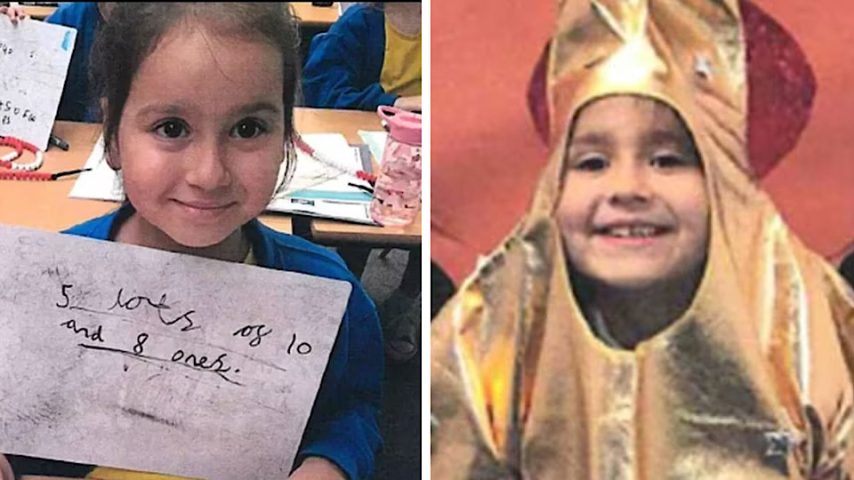
But at home, behind closed doors, who was looking after little Sara? It turns out that the child, born into problematic circumstances and deemed to be at risk by social services before she was born, was being subjected to the most brutal abuse and harrowing violence. She lived a painful existence, subjected to torture, but somehow, she managed to sing and smile and dream.
When Sara died after being beaten to death, her little body was battered, bitten, and had multiple broken bones. She had puncture wounds, an iron burn, and scalding on her feet from water.
Sara was found lifeless on a bunk bed in one of the bedrooms in the house just an hour outside London after her family fled to Pakistan on a flight, with Urfan Sharif leaving a hand-written note for authorities.
“I beat her up. It wasn’t my intention to kill her but I beat her up too much. She was naughty over the last week and I was giving her punishment to sort her out,” he told police in a frenzied phone call altering them to Sara’s body in the early hours of August 10th, 2023. He had beaten his ten-year-old daughter with a metallic rod and a cricket bat. Her body had 71 external injuries and 25 fractures.
Highlighting the sheer horror of the case, Libby Clark of the Crown Prosecution Service said: “These must be the worst injuries that I have come across. The number of them, the nature of them, and the suffering, is like nothing I’ve seen before.”
The child’s old headteacher, Jacquie Chambers, speaking to channel four news, said it was hard to put the tragedy or its scale into words. “I don’t think I’ve ever felt such sadness, and I say that on behalf of all the staff and the community.”
Sara was killed by those who were supposed to protect and love her most. While the case, above all else, is evidence of the existence of absolute, horrifying evil in our world, there were a litany of institutional failings that enabled it to take place.
How could a man who had been accused of domestic violence and coercive control, by multiple women, have been deemed suitable to be a parent? It is understood that Sara’s mother, a Polish woman called Olga Domin, who has suspected learning difficulties, had lost custody of Sara because after a child protection plan was put in place amid concerns that Sara was at harm from both Domin and Sharif. As a small child, Sara spent some time in foster care, and multiple red flags were raised. All of this is extremely important. Neighbours reported hearing screaming from the house for two years, yet social services did not intervene.
But equally, there are fundamental elements of the case which has gripped Britain that are being played down, or worse, completely ignored, seemingly because they are not as socially or politically acceptable to discuss.
One of them being why Urfan Sharif was ever in Britain to begin with. It has now come to light that he exploited EU rules so he could stay in the UK. Sharif moved to the UK in 2003 from Jhelum in Pakistan on a student visa to study business management in London. However, as reported by The Telegraph, fast-forward six years and he had secured part-time work as a taxi driver and had entered into a sham marriage with Sara’s polish mother, an EU citizen, so that he could stay in Britain. He had a history of exploiting vulnerable women.
He disappeared into the system. He did not have to leave when his visa was up, like many others who come to the UK with no intention of leaving. It was Jeremy Kyle, in a blistering segment on Talk TV, who summarised the case best in a display of rightful rage. A short clip of the segment has garnered over one million views on X.
“They won’t talk about how EU laws allowed that piece of rubbish to stay in my country,” Kyle said vehemently. “They won’t talk about how social services have more than dropped the ball, they’ve allowed a child to be killed. They won’t face prosecution as they should do.”
“I don’t care if I get sacked for saying this,” an exasperated and understandably emotional Kyle said. “He married a Polish girl in a sham marriage and ended up in a half a million pound house.”
It is all well and good to talk about the systematic failures of social services and the British State and what needs to change. But Jeremy Kyle of all people is one of the few media figures with some kind of influence to ask how on earth this murdering coward was allowed to stay in Britain. How he was allowed to slip quietly under the radar and commit such atrocities.
“Are we seeing a situation where social services are also infiltrated with the woke left?” a guest on the programme asked Kyle. “Where they just give the benefit of the doubt. This is what happens when you give the benefit of the doubt. People like Sara die.” The portion of the programme can be viewed in full here:
This is another absolutely crucial point. Is it the case that those in charge of the system for protecting children would rather risk complete tragedy than, God forbid, appear racist? Or worse still, Islamaphobic? Such questions deserve to be platformed. It would not be unheard of in Britain. Rochester is the prime example of how horrendous abuse was not investigated properly because police, council bosses and social workers feared they would be deemed racist or Islamaphobic due to who the perpetrators were – namely Pakistani men.
The shattering trial at the Old Bailey last week heard that Sara had begun wearing a hijab to hide bruises on her face. In addition, there is that one haunting picture of Sara heavily made up with enough makeup for someone twice her age. As it turns out, her stepmother would apply the heavy makeup and eyeshadow to hide bruising. Sara had been subjected to at least two years of abuse, with neighbours having reported hearing “gut-wrenching screams” from the house.
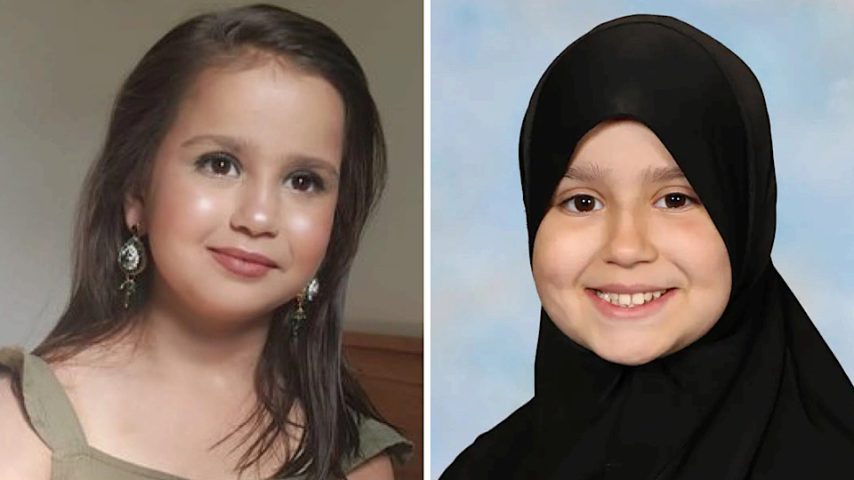
Why weren’t questions asked when little Sara suddenly started wearing the hijab to school? An MP in Sara’s town has rightfully called for a probe into whether teachers may have been too afraid to question why she had begun wearing the garment after being seen with bruises.
Teachers were concerned when Sara gave different accounts of how the visible injuries were caused. The noting of the bruising triggered Sara’s father to withdraw her from school shortly thereafter in April 2023, making the excuse that he was choosing to homeschool her. From there, the abuse intensified.
We know that the race card was played by Sara’s monster of a father, who had complained during the school year that Sara’s hijab had been “pulled down by another child.” He said he was worried the incident was “racist,” The Times reports.
A neighbour told the court that Sara’s parents told her their daughter was being bullied at school for wearing a hijab and she was being homeschooled because of that.
“Every single time I saw her she wore a hijab — she was the only member of the family who wore that,” the neighbour told the trial.
Sara, when asked at one point, when she returned to school to begin year 5, about bruises seen on her chin and cheek and eyelid, started to try to hide her face, “pulling up her headscarf.” It was noted that the Muslim child’s headscarf was “quite low and almost covering her forehead.” It was also reported that Sara’s stepmother was seen at school swearing at two younger children in Punjabi and Urdu two or three times a month, including shouting bitch and whore.
It is clear, from the details laid out in court, that there was at least some level of social isolation in the case of the family, who held cultural and religious practices that could rightfully be described as regressive and contrary to British and Western values. But is it possible that the authorities feared to pry further, especially when Sharif had already alleged racism.
The kind of cultural segregation which underlines the heartbreaking case of Sara Sharif is common-place in the UK, but so ingrained that even a case as gut-wrenching as this may not be enough to result in an adequate debate. But it is a reminder that we must ask questions about the deeply harmful attitudes and beliefs that are being imported and allowed to take root in the UK while polite Britains look the other way.
All of this is of course not to say that all Muslims are dangerous or evil, like Sharif and Beinash Batool. The couple were not religiously observant but used the weight of Islam to help hide the suffering of an innocent child. Their cunning prediction that Westerners are petrified of appearing racist or Islamaphobic was, in the end, correct. How many chances to save Sara were missed because of this?
The only hope now, in the depth of such a tragedy, is that we will start to ask the real questions and to condemn evil and its enabling factors, whether to do so is politically correct or not. We must get below surface level. There must not be another Sara. May her gentle soul rest in peace.