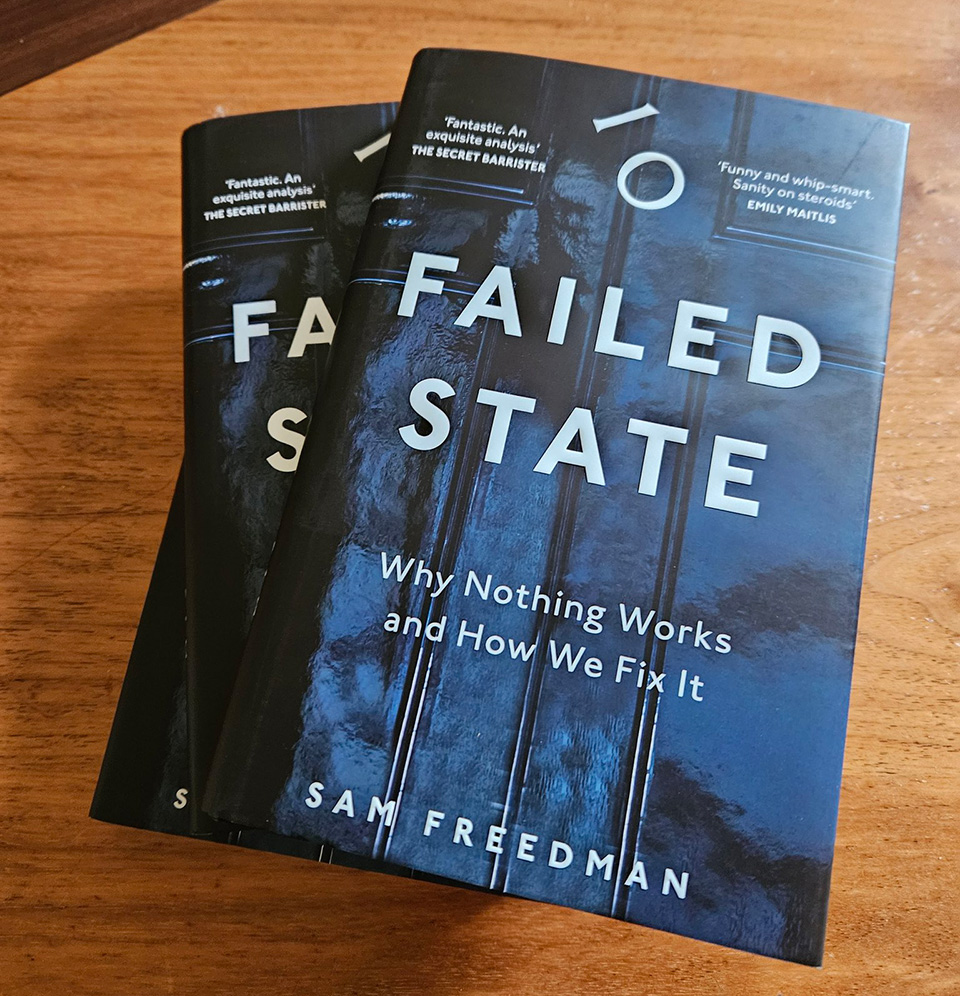
Sam Freedman is a former advisor to the Conservative education secretary Michael Gove who now works for the Institute for Government think tank.
His 2024 book, ‘Failed State: Why Nothing Works and How We Fix It,’ focuses on the severe difficulties which have befallen the UK, which is struggling with persistently large budget deficits and stagnant growth.
Though he worked for a former Tory minister, Freedman’s account is not a partisan one, and it is clear that he regards the May/Johnson/Truss/Sunak era as being quite disastrous.
However, he believes that this is not a problem of individual personalities. Instead, he thinks that Britain is facing a crisis cycle akin to the trade union militancy and economic malaise of the 1970s, with this situation being “a crisis of governance.”
Freedman argues that three trends have contributed to the inability of the British state to function properly.
Firstly, there is the problem of the growth of the state and its sprawling regulatory apparatus, with the result that government “is simply trying to do far too much through institutions like Number 10 Downing Street and the Treasury.”
Secondly, Freedman contends that the executive branch of government has grown much stronger relative to the legislative branch, with MPs having an ever-smaller say when it comes to shaping legislation.
Thirdly, he writes that “the pace of politics has gone into overdrive” due to the rise of the 24/7 news cycle.
“We have seen power over everything captured by a handful of people who can’t cope with what they’ve taken on, while at the same time scrutiny has been deteriorating and the incentives for those people have been skewed ever more towards communications rather than policy,” he writes.
The author’s case is a persuasive and constructive argument, with all three sections of the book including suggestions for tackling the three key problems.
Best of all, the great majority of what he says has relevance to recent trends impacting Irish politics.
Margaret Thatcher rolled back the frontiers of the British state by privatising many industries, but this added a layer of complexity to British governance given the rise of outsourcing, and the need for state bodies to regulate this.
More seriously, Thatcher deliberately weakened local government in order to suppress opposition from entities such as the Greater London Council.
Just as is the case in Ireland, weak local government makes every local issue a national one, thus overloading the administrative centre.
As the power of the PM has grown and the role of the MP has diminished, office holders have come to rely on a comparatively new species: the Special Adviser, or SPAD.
Freedman points out that political advisors barely appeared in the comedy series ‘Yes Minister,’ where the core interpersonal dynamic lay between the elected politicians and career civil servants. A modern version of the show would clearly look very different in the post Tony Blair/Alastair Campbell era.
Now, absurdly well-paid ex-journalists and other unelected anoraks swagger through Whitehall and Leinster House acting as if they are the people’s government.
As Freedman recounts, they can have incredible authority, as in the example cited here of a 25-year-old Tory SPAD covering departments with a combined annual budget of around £500 million.
If the SPADs had actual policy expertise – scientific, technological or otherwise – this system may be defensible.
Generally though, their role is heavily focused on media work; at the time the book came out, there were 25 SPADs in Number Ten working on politics and media, compared to just 12 focused on policy.
This might not be a problem if the heavy-lifting on policy was being carried out by MPs. Unfortunately, though the workload of the average MP has increased, the actual power of the Commons has declined.
Freedman’s analysis of the media environment is particularly striking. He quotes a former senior aide to David Cameron who describes the ground floor of 10 Downing Street as consisting of “the Cabinet Room, the Prime Minister’s office and an enormous comms operation.”
In a never ending news cycle, short-termism shapes political decision-making, with announcements being made in order to secure coverage rather than to advance any clear long-term agenda. Another aspect of this is the rise of “performative legislation” – where politicians aim to signal they are doing something about an apparent problem that voters care about.
When it comes to serious matters such as the country’s budget, every effort is made to maximise the news value of each component of the government’s plans.
As in Ireland, the annual budget is preceded by an annual statement several months earlier, which essentially makes the overall plans obvious, but still allows for the orgy of carefully-planned leaks in advance of budget day.
Freedman makes an intriguing suggestion about abolishing the annual budget entirely, which would horrify headline hungry politicians and SPADs alike.
Much of the author’s UK-specific policy recommendations have relevance here also. His call for expanded powers for local authorities certainly does, as the dominance of Dublin over the nation writ large is arguably even greater than what London possesses.
Improving the committee system in parliament is another no-brainer, if only as a means of getting backbench politicians to focus on something other than becoming ministers.
What is most deserving of the Irish reader’s attention is the description of how Liz Truss managed to become PM in spite of her complete lack of ministerial achievements and the personal defects which soon became painfully visible while in office.
Freedman quotes Rory Stewart’s memoir which states that Truss’s promotions stemmed from the perception that she was a strong media performer. When her party colleague Stewart watched her interviews closely, he noticed that she rarely made any attempt to actually answer questions, instead sticking rigidly to Tory speaking points and attack lines.
Rather than focus on public policy, Freedman notes that Minister Truss cultivated her relations with the Tory press, becoming “known as one of the most inveterate leakers in cabinet,” and profiting accordingly.
Here in Ireland, we have a surprisingly specimen in the shape of our Tánaiste Simon Harris.
Like Truss, he too has risen by befriending journalists (surrounding himself with ex-journalist SPADs) and focusing relentlessly on growing his social media accounts (263,000 followers on Twitter, 145,000 on TikTok). He too has been accused of leaking to the press in order to advance himself.
When discussing Simon Harris, many in the Irish commentariat will also note his abilities as a media performer.
True, he can recite figures and messaging points and feign an emotional connection – though not in the town of Kanturk strangely – but for all the times Harris has spoken, has he truly said anything?
A children’s hospital costing three and a half times its budget and missing its completion target by at least five years is as good an example of state failure as anything else, and should be viewed as such.
For the moment, Ireland’s economic position continues to shield Harris and others from the consequences of their actions. In the longer-term, whatever is unsustainable cannot last.
Whether storm clouds appear over us or not, like Britain, Ireland needs a more devolved structure of governance, a more functional parliament and a new set of ethical guidelines which break the power of the SPAD by closing the revolving doors between politics, public affairs and journalism.