This is a fascinating subject matter. The author is not alone in the feeling that there is an increase in what he calls ‘bullsh*t jobs’ in the western world, the type of jobs that feel pointless and of no real value to wider society and the economy.
For most, this feeling comes from a sense of growing bureaucratisation, administration and what some would describe as managerialism. It is a something I feel myself even if in theory, I work in what should be a meaningful sector.
Following processes and procedures, increasing compliance requirements, the need for paperwork (or more recently complex interconnected digital systems that absorb more time than the actual work you are employed to carry out), are a reality in just about every sector and area of work.
The reasons for this are probably quite complex. But the reasons are not so for David Graeber. Spoiler alert: just as you get to the end of the book, Graeber admits to being an anarchist and anti-statist. His solution to the rise of BS work is simply universal basic income. Then everyone will have the time to do whatever they want, particularly to become, like Graeber, political activists who can advocate for political change.
If the reader, like myself, was anticipating an analysis of the rise of managerialism and the increasing bureaucratisation of the working world, the rise in compliance requirements and all that, the reader will be disappointed. If you are looking for analysis – some rigour maybe – you will not find that in “Bullshit Jobs”.
This is a grievance book. At different stages, the rise on BS work is blamed on the elite, the patriarchy, capitalism, right-wingism, conservatism, theology, religion – going back to Saint Augustine and at one stage, poor old Adam himself. The thesis is that because 40% of those who filled a survey feel their work is pointless, that if it were not for the ‘elite’ creating meaningless jobs we could all be working four-hour days and have more time to be like the author.
The narrative generated belongs to the author, but his data-set is a series of anecdotes that he has sourced, he admits, through responses to his Twitter account (‘a population more likely to be artsy and more politically engaged’ because they follow the author?) and an article written in 2013 on the same subject. If nothing else, the book is an attempt to stretch out that original essay through padding with the stories of disaffected workers who are not, or were not, happy with their jobs and who seem to have a chip on their shoulders at their bosses or former employees.
A substantial number of these seemed to have had multiple, or many, BS jobs. Some also found university BS. And everything else that made demands on their time. One such example is Eric, whose work was so BS that it made him get drunk all the time during work and then to slack off to go get high at different types of parties. Work was what made him do it. Padraigh, another, was upset because work meant he was not able ‘to paint, to follow my creative impulses’ because of work, while he was much more focused when he wasn’t employed ‘but that didn’t pay’.
And all this is the fault of everyone else. The low-paid and the artsy intellectuals are the angels, while everyone else in society are demons. Sometimes low-paid administrators (and administrative assistants) are demons as well: pushing their paperwork and making life miserable for the real blue-collar workers who are the salt of the earth doing real, meaningful work.
Yet the author undermines his blue-collar sympathies when he admits that a universal basic income will free up people from the drudge work to do something more worthwhile, like installing solar panels, restoring antique furniture or translating Mayan hieroglyphics. Nor will conservative voters be able to overcome the structural inequalities that prevent them from becoming human rights lawyers. They cannot even imagine such a life.
When pressed for solutions, the author, as he has been to any of the critiques of his point of view in preparing this book after the 2013 essay, is dismissive. This isn’t a book about solutions. It is a book about a problem. He doesn’t want to be drawn into policy positions – not only because he doesn’t have any, but also because policy implies an elite policymaking machine which he, as an anarchist, fundamentally doesn’t agree with.
The author seems to be of the view that someone, upstairs, maybe a Bilderburg group or some other secret society (he doesn’t say, just ‘they’), came together and decided to create all these meaningless jobs to quell the masses, and that all is needed is for ‘us’ to decide to stop the need for BS jobs. He doesn’t quite suggest how, since he recognises that only those with meaningful jobs – the farmer, the garbage collector – can bring society to a halt by stopping what they do, but that those with the BS jobs would not be missed at all if the downed tools.
Coming to the end of the book, comparing and contrasting work to sadomasochism (without the ability to call ‘orange’ to your boss), the author draws on French philosopher, Michel Foucault, whose BDSM, apparently was liberating and reflective of his writing about power. The author never mentioned the philosopher’s apologies for child abuse or relations with Tunisian boys, which is not an unfamiliar blind spot of most grievance writers who see all the world to be at fault.
Resentful of all perceived bogeymen, yet like Foucault, the author seems to have navigated this unfair world to have accessed a book deal to write all about it. The injustice of it all.
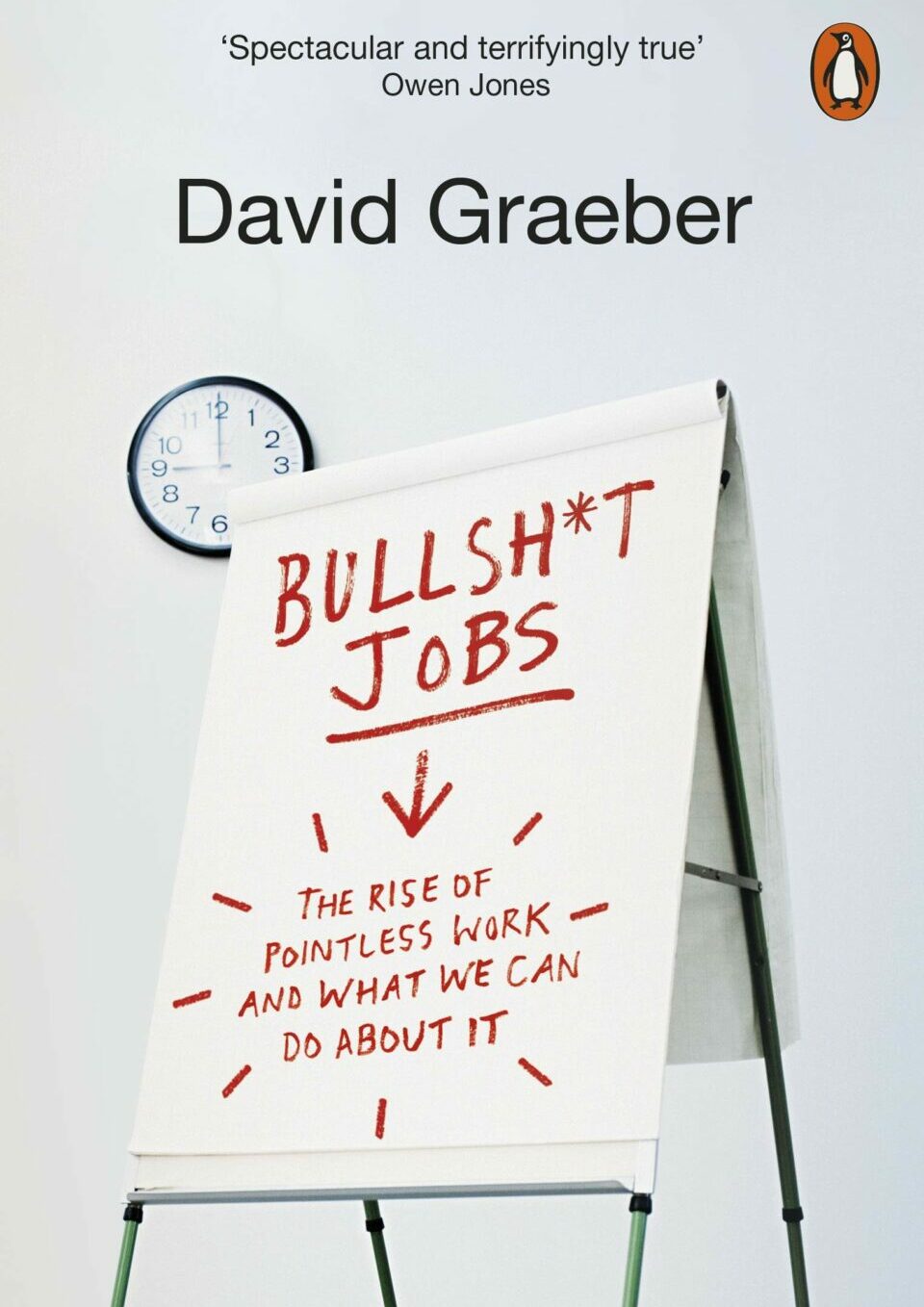
- Publisher : Penguin; 1st edition (7 Feb. 2019)
- Language : English
- Paperback : 368 pages
- ISBN-10 : 0141983477
- ISBN-13 : 978-0141983479
- Dimensions : 12.9 x 2.1 x 19.8 cm
Dualta Roughneen