In his introduction to the book, Kuper goes to some length to explain what this book is not. He thought it wasn’t many things: its not his personal revenge on Oxford; it isn’t a name-dropping memoir; nor a twee Oxford tale of witticisms nor another biography of Boris Johnson. In fairness, he is right. Unfortunately, it is also not a book about how a tiny cast of Oxford Tories took over the UK.
It is a book about Oxford Tories who did take over the UK. But Kuper makes no effort to create the causal link that he includes in his title. This is a major disappointment. The expectation would be that there was going to be some insights into Oxford life that Kuper, given that he was in the place when many of the ‘tiny caste’ were there as well, would shed some light on.
Maybe there were some secret societies? Some backscratching? Some hi-jinx and japes that we hadn’t heard about before? None of the above. There wasn’t even a connection between the Oxford Tories being in Oxford and then getting to the higher echelons of politics. Kuper is unable to shed any light on what the magic dust of Oxford might be. He cannot even explain why some from public schools and some from private schools and even some from Eton, do well or do badly after leaving Oxford.
You might have expected some tales of how the political connections established in Oxford helped David Cameron, Boris Johnson and Jacob Rees-Moggs climb the greasy poll to the top of society. There are none. We know that they went to Oxford. They left Oxford. They didn’t even go directly into politics. They found other jobs. They even got sacked from other jobs. Then they made their way back into politics.
No causal link.
We learn that Jacob Rees-Mogg dressed like a man three times his age in university. Essentially how he dresses now. We don’t learn anything about pig-gate and David Cameron. We learn that Cameron dressed well too. And talked very smoothly. We learn that Boris was a bit of a bumbler.
We don’t actually learn anything new.
It is hard to understand what the point of the book is. In fairness to Kuper, he knows that there is an audience who would like to read about some salacious tale of upper class twits climbing the ladder to power through some back-channel dealings – or by at least creating the impression that there is some such story there. Unfortunately there isn’t.
It would be better as a biography of Kuper’s time in Oxford – or even his time breathing the same air if not quite rubbing shoulders with the future leaders of the UK. Parcelling the tale as something else is misleading.
Even in the final chapter, Kuper looks at ‘What is to be done’ about the problems he thinks he has identified. Yet, he hasn’t identified any problems in the lead up to this climax. He isn’t happy that there have been so many Prime Ministers that went to Oxford, but it becomes clear that the main problem is that Boris, Rees-Moggs and a few of their allies were leading figures in convincing the UK electorate to leave the EU. David Cameron, though a Remainer, rubber stamped the referendum that led to it, so he neatly falls into the pile as well.
He wants Oxford to reform itself. To be fairer. Less elitist. To be more like Germany and Holland. But then doesn’t every quite explain how. Or why. It is just a case of ‘I don’t like it. I don’t like Boris. I don’t like Brexit. Change it.’
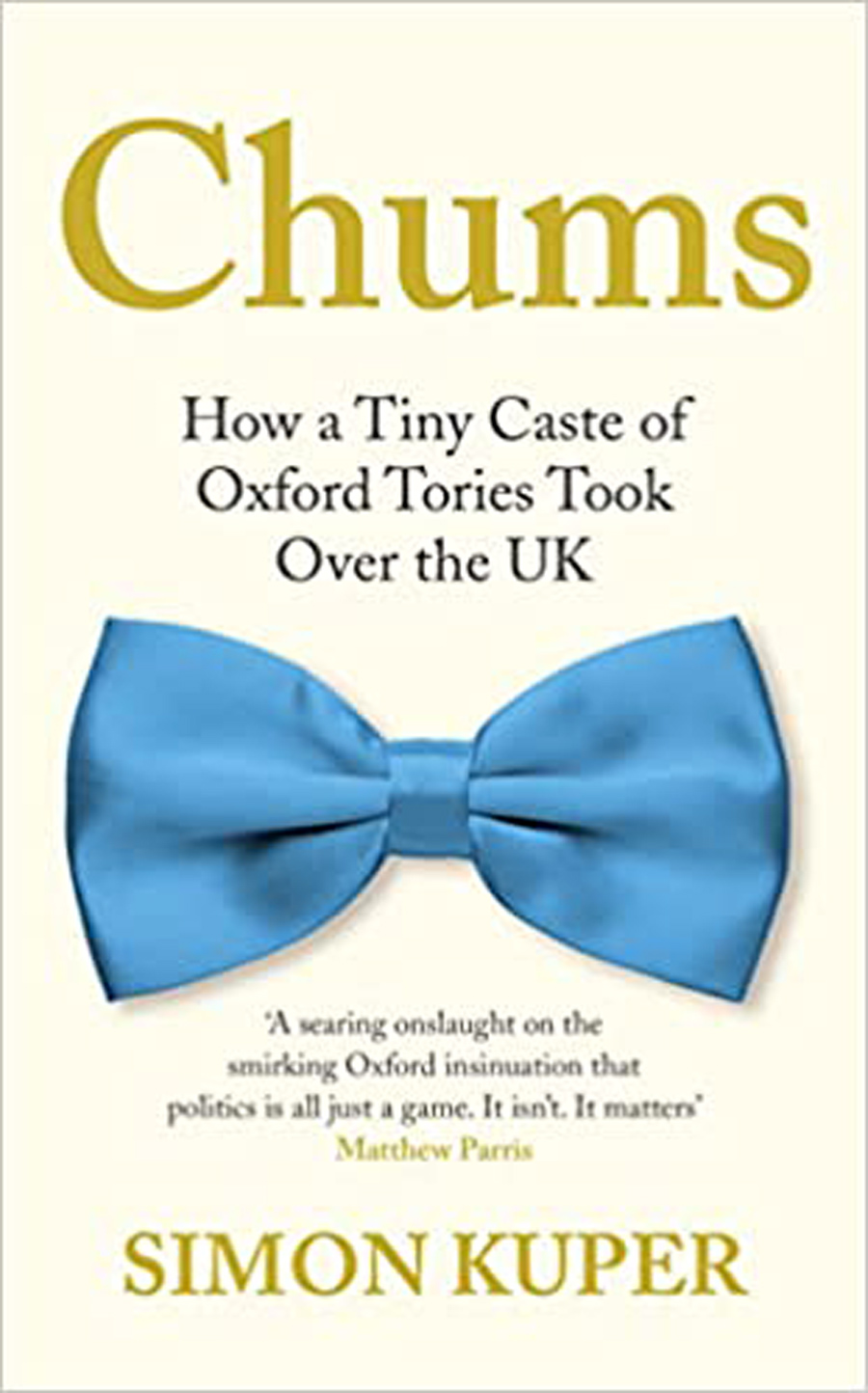
Chums: How a Tiny Caste of Oxford Tories Took Over the UK
- Author : Simon Kupter
- Publisher : Profile Books; Main edition (28 April 2022)
- Language : English
- Hardcover : 240 pages
- ISBN-10 : 1788167384
- ISBN-13 : 978-1788167383
- Dimensions : 14.2 x 2.79 x 22 cm
Dualta Roughneen