Before the general election, Fianna Fáil and Fine Gael made conflicting promises about whether they would introduce updated hate speech laws if re-elected to government.
The website WhichCandidate.ie, run by the University of Limerick, is an online tool that helps Irish voters find political candidates aligned with their views by comparing their answers on key issues with candidates’ positions.
In the recent 2024 general election, one of the questions was “New laws on hate speech should be introduced to protect vulnerable communities.”
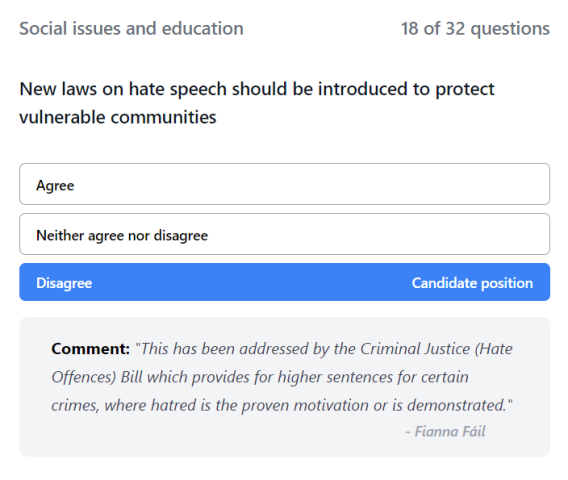
For this question, Fianna Fáil leader Micheál Martin answered “Disagree”, explaining that new hate speech laws were not needed in his party’s view.
“This has been addressed by the Criminal Justice (Hate Offences) Bill which provides for higher sentences for certain crimes, where hatred is the proven motivation or is demonstrated,” he wrote.
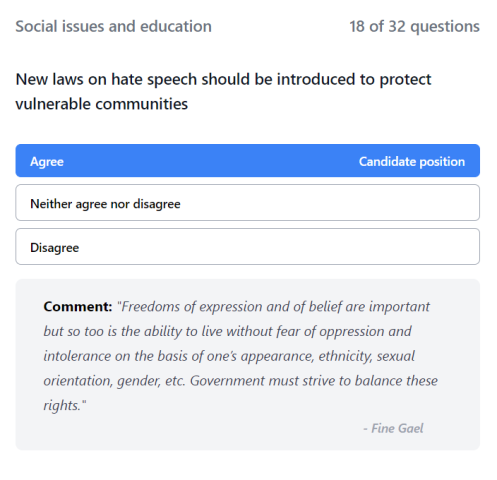
Meanwhile, Fine Gael leader Simon Harris answered “Agree” to the same question.
“Freedoms of expression and of belief are important, but so too is the ability to live without fear of oppression and intolerance on the basis of one’s appearance, ethnicity, sexual orientation, gender, etc.,” he said.
“Government must strive to balance these rights.”
Fianna Fáil and Fine Gael are poised to lead the formation of the next government, with projections suggesting they will collectively secure around 86 seats in the 34th Dáil, which is just short of an overall majority. Fianna Fáil is likely to have 48 TDs, potentially outpacing Fine Gael by 10 seats.
Moreover, over half of Fine Gael’s TDs will be newcomers to Leinster House, following the retirement of 18 outgoing members.
As the conditions of the coming coalition are hammered out, it remains to be seen what form a programme for government may take.