I was only at Mass this Easter Monday morning for about 10 minutes when the texts started coming through, all in their many variations conveying the fact that Pope Francis had died. Sure enough, at the end of the prayers of the faithful, the priest, into whose ear the deacon had whispered, added a prayer for the Pope’s final rest, which set off a cascade of shocked glances around the church for those not being harassed at the hip by their mobile companions.
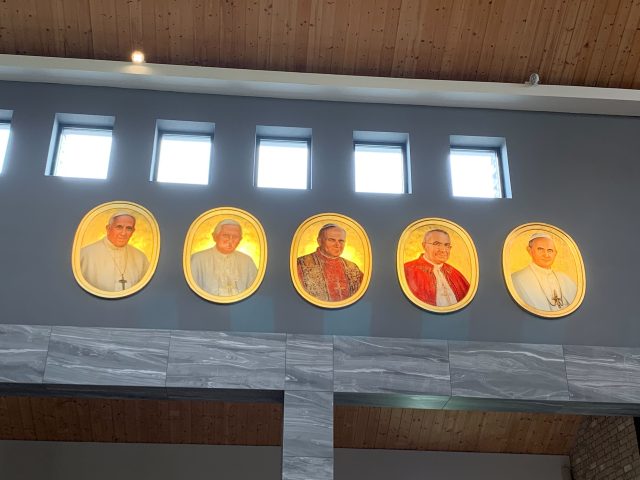
It was surreal sitting there for the rest of Mass looking up at the images of the past five popes, Francis included, that adorned the wall overhead. It occurred to me that they’d have to add another frame in short order. But then, everything about a papal death is surreal. How could it be otherwise? There have only been 266 of them throughout the Church’s 2000-year history, stretching all the way back to Saint Peter himself. You’re likely to experience only a handful of them in a lifetime.
The papacy is an utterly unique institution, which is something that can be readily admitted whether you’re of the faith or not. That is why it attracts the attention of not only the Catholic press, but the secular too, whenever a pope says anything notable.
But also, of course, when he dies.
All other coverage took a backseat on most rolling news channels that I checked after Mass and throughout the day, with images from churches and holy sites around the world instead being broadcast alongside input from Church experts, and as usual, non-experts alike. I expect that fascination to continue for some weeks as Pope Francis is laid to rest and his successor is chosen and profiled.
As much as I, and many other catholics, find the office, the history and the intricacies of the papacy to be of great interest, what appeals to the mass audience is undoubtedly something much simpler – which isn’t to say that this isn’t something that appeals to we catholics, too. It is the elevation of one man’s life and his relationship with God above the masses in some sense, making him, standing alone at the head of the Church on earth, representative of every man as he stands before God in this life.
In a world where, despite the fact that the number of practicing catholics in recent decades has plummeted, the number of people who’ll tell you they believe in God in some shape or form, or who describe themselves as “spiritual, but not religious” remains high, you might say that the population was primed for a pope like Francis, who from the beginning expressed the desire to lead a ministry of the margins over the centre, of mercy over moralising, and one during which the Church would be marketed as a “field hospital” for an ailing world rather than as the Bulwark of Truth.
Was he entirely successful in that endeavour? I do not mean to speak ill of the man, of whom I grew deeply fond, when I hazard to answer: in some ways, yes, and in other ways, no, not at all. It was, as probably all papacies must be, a mixed bag. And because of that, Pope Francis gave me, and likely many others, too, an important life lesson: in our dealings with one another, we have to learn to take the good with the not-so-good, the successes with the failures, the ups with the downs.
It is something that can only be truly grasped over time, in our relationships, and curiously enough the Pope-everyone else in the Church-relationship is a good one for learning it.
Contra my colleague John McGuirk’s position as stated earlier, I do have something of an understanding of what it means to have a relationship with the Pope, despite not having known him personally. For some years now, through my work with The Irish Catholic newspaper and personally, I’ve followed his sayings and his doings. I’ve pondered his writings. I’ve prayed for him and for his intentions, as per the Catholic practice.
The briefest engagement with any sort of Catholic media space in recent years would have been enough to inform you that some people loved what Pope Francis was doing, while others hated it. Some thought he could do no wrong, others that he could do no right. While I never fully fitted into the latter category, I certainly fell on the more critical end of the spectrum early on, and only over time did this soften. My views and positions on things didn’t change (which I’d like to imagine are good and orthodox), but my understanding of how to be an edifying and supportive presence in both the Church and more generally did.
I still think, to cite some specific examples, that the Synod of recent years championed by Pope Francis was largely a waste of time and effort, a process the vast majority of Catholics, practicing and otherwise, didn’t engage with and remain clueless as to the outcome of. I think that, in light of the Church’s own teaching, the ‘same-sex unions blessing debacle’ of late 2023/early 2024 should have and could have been avoided.
But as so many of us are inclined to forget: it’s hard to be the Pope. To harken back to an earlier paragraph, he stands as the “vicar of Christ”, as the visible head of the Church on earth. And from that daunting position he’s expected to engage with the same broken and messy world as the rest of us. Naturally, the blemishes that result from that engagement are going to stand out on the pristine papal regalia.
But as I learned: they shouldn’t, and thankfully that is a lesson I can apply fruitfully to the rest of my relationships. Francis did very much good, for which he could be lauded, and where it was perceived that he made mistakes, he could be prayed for.
He denounced things that remain radically unpopular to denounce, repeatedly: abortion, gender ideology, the breakdown of the family and more. He provided moral and intellectual stimulus for those both within and without the Church (his apostolic letters on the different centenaries of Dante Alighieri and Blaise Pascal stood out for many). And perhaps most importantly for catholics: he “finished the race”, “he kept the faith”.
After weathering a difficult few years health-wise, and especially a final slog towards the end, all under the most intense public scrutiny, this 88 year old man pulled himself together every morning to go forth and do his duty, right to the end.
“Brothers and sisters, this is the greatest hope of our life: we can live this poor, fragile and wounded existence clinging to Christ, because he has conquered death, he conquers our darkness and he will conquer the shadows of the world, to make us live with him in joy, forever. This is the goal towards which we press on, as the Apostle Paul says, forgetting what lies behind and straining forward to what lies ahead. Like Mary Magdalene, Peter and John, we hasten to meet Christ,” he said in his final homily, the day before he died.
Similarly, his final tweet read “Christ is risen! These words capture the entire meaning of our existence, for we were not made for death but for life”.
Danish philosopher Søren Kierkegaard wrote that the saint is the person “who wills the one thing” – by which he meant the Good, which for him was God’s will.
It’s not for me to speculate about whether Pope Francis or anyone else is a saint or not, but in the end, his life ultimately spoke of “the one thing”, and a great many people, as today’s outpouring showed, are the better for it.