A mother of seven has spoken of being forced to leave her Dublin home with her young family – even though her husband is working full-time – and a subsequent battle with homelessness due to what she says is a lack of support for large families from institutions and the State.
Diana Grzimo, 39, and her husband, Igor, 42, both originally from Latvia, came to Ireland in 2005. The couple came in search of a better life, driven by Ireland’s “deep community values” and shared Catholic heritage at the time, along with what she describes as an “enduring belief in Ireland as a nation that supports family and dignity.”
Upon arriving in Ireland, Diana was able to secure work within days, and before her children were born, she worked as a personal assistant, while her husband also quickly found a job in construction. When her children were small, Diana earned two degrees, one in Business and Law (Ba Hons) and a second in Counselling and Psychotherapy (Level 7) as well as a Professional Certificate in Immigration Law and Practice.
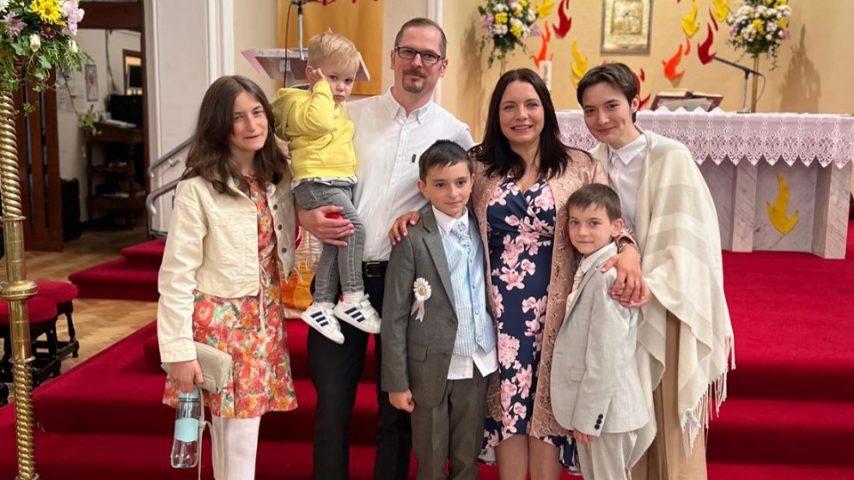
Igor worked in construction for years, and now works full-time as a joiner for a shop-fitting company in Dublin, where he has worked for nearly a decade. Having established themselves, the couple were able to raise seven small children whilst contributing through work, education, and forms of volunteering.
“In 2019 I worked as an Immigration Law consultant and legal / medical / public interpreter,” Diana says. “My work did not improve the situation but made it worse, as my salary just replaced FIS and our medical cards were taken away. We were not getting any housing supports.
“I had to give up my work. For over ten years I have been a volunteer. I volunteered for different organisations in the past and from 2020 I have been a trustee and administrative manager (volunteer) for a local small charity with a big demand,” Diana added.
However, 20 years after moving to Ireland, Ms Grzimo, a naturalised Irish citizen, says that the family is being torn apart by a system that “does not see them or support them.” Ms Grzimo’s husband remains working in full-time employment and the family lives on one income. However, being a big family on one income has left it “impossible” to qualify for a mortgage or a loan.
Following 17 years spent in their rented home in Dublin, the family were issued a termination notice over “overcrowding” as it was deemed that their house was too small to accommodate their large family. (Diana does not blame the landlord and says it was most likely for health and safety or for insurance reasons.)
“This is the system that penalises and ignores,” she said. The agent agreed to keep Igor and at least one of the couple’s older children in the home, which the family appreciate. They have since tried to rent a bigger house, however they have not been able to find anywhere suitable for a family of seven children. The family also tried obtaining a mortgage, which was unsuccessful (may be add that large families on an average income can’t access a mortgage in Ireland.
“We always worked towards the mortgage, but still did not access it,” Diana says.
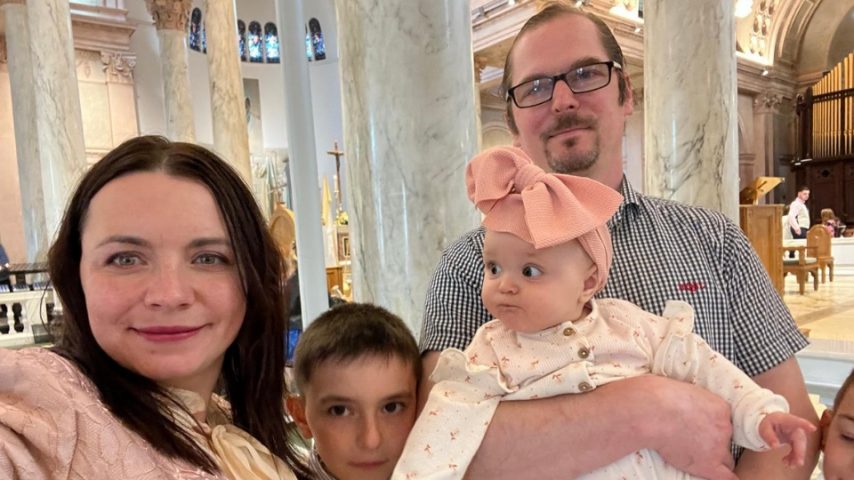
In July, Ms Grzimo and five of her children (those under 18) became officially homeless and were placed in emergency accommodation in a hotel. Her 18 year-old daughter, who is a student, was separated from the family, which her mother has described as “traumatic for the entire family.” Her husband Igor, along with the couple’s eldest daughters, aged 15 and 19, meanwhile, remain in the house they rented for 17 years.
During a call with the council, the family was informed that if they presented as homeless together, they might be turned away if no suitably large room was available on that day. They were also advised that the family could be separated, and that their then 18 year old daughter, a full-time university student, could be considered an adult and referred to a single women’s homeless hostel. Fearing the trauma of such a separation and wanting to protect their daughter, Diana says her family felt they had no alternative but to separate voluntarily. This decision, made out of necessity, reduced the level of “overcrowding” and temporarily invalidated the notice of termination.
In the following weeks, the couple’s 15-year-old daughter, who was experiencing panic attacks and increasing anxiety, left the hotel and joined her father and sister.
“The notice received was over overcrowding, which even the Council itself agreed with back in 2016 when they asked us to find a bigger house under the RAS scheme or they will stop the payments due to not suitable accommodation,” Ms Grzimo explained. “We could not find any landlord who would accept the RAS and stayed in the house until 2025. As per contract – 5 bed-spaces allowed. The Threshold validated the Notice and the Council was notified about the notice and validation, but fully ignored the situation. Note: SDCC still found a reason to cancel all housing supports in early 2017.”
At present, Ms Grzimo and four of her children are staying in one overcrowded hotel room, with many other families sharing similar conditions.
“The notice received was over overcrowding, which even the Council itself agreed with back in 2016 when they asked us to find a bigger house under the RAS scheme or they will stop the payments due to not suitable accommodation,” Diana explained. “We could not find any landlord who would accept the RAS and stayed in the house until 2025. Note: SDCC still found a reason to cancel our application and all housing supports in early 2017. We simply got penalised for working and having children.”
‘EVERY HOUR AWAY FROM MY FAMILY IS AGONY’
“Our application in 2017 was cancelled on the predicted income which also included a short term Back to Work dividend. It is not calculated towards the threshold now, but it was calculated in our case to inflate the income. The actual income earned that year was below the threshold. This is still ignored. We managed to get back on the social housing list only in 2021 with the support of the Community Law and Mediation Centre,” Ms Grzimo told Gript.
She has now asked the government to get involved in the family’s situation and “help resolve it immediately.”
“Every hour in this prison away from my family is an agony. Only in a safe and long-term home can our family reunite and begin to heal. We are accountable, responsible, and hard-working parents who do our best to raise healthy and responsible children, yet we have been left alone and completely neglected,” Ms Grzimo said.
‘NO FAMILY SHOULD BE FORCED INTO SEPARATION’
“No family should be forced into separation in order to survive. Stop penalising large working families. If the government is not willing to support large families, then at least remove the obstacles for parents to provide for their families without risking becoming homeless – review the policies and study the impact of the Working Family Payment on access to social housing supports. Banks do not consider this payment as income, yet it often pushes families above the inadequate threshold for housing supports,” she told Gript.
“We are completely stuck. Work and parenthood should never be penalised. We are bringing up Ireland’s future tax payers. Our family already pays taxes.”
NO LARGE HOMES FOR RENT
The family have not been able to access suitable social housing because there are no homes big enough to accommodate nine people, and they have been told that the waiting list can be between 10 to 15 years long for a four-bedroom house.
Ms Grzimo says that the family were told by social officers to leave Dublin and move to the countryside or elsewhere. She says that no private landlord wanted to accept seven children, that no bank would lend to a large family, no social housing was available, and no support was offered.
The European Large Families Confederation (ELFAC) has highlighted the Grzimo family’s case, calling on the Government, along with South Dublin City Council and the European Commission to immediately intervene to reunite and properly house the family. The organisation, based in Barcelona, Spain, has called for large families to be recognised as a distinct group “requiring tailored housing policy.” It says there should be an end to “discriminatory” thresholds that “penalise” families for work or short-term income bumps. The group also says that national and local housing strategies should be developed to reflect demographic realities – pointing out that Ireland has the highest proportion of large families in the EU (20.6%).
Despite this, it says that there is no dedicated large family association, no housing policies specific to their needs, and no safeguards to prevent what is currently happening to the family.
“We have known for years that we were at risk of homelessness, and now we are homeless. I am in a hotel with five of our children, while our husband is staying elsewhere with our two eldest children. It is such a difficult situation for us all,” the mother of seven told Gript.
Diana says that restrictions mean that she cannot have visitors to the hotel where she is staying with the younger children, leaving her isolated and anxious. The single hotel room has three metal bunk beds; the mother says that the difficult, cramped living conditions have left her children with stress, isolation, and disruption to their education. She says she misses being able to cook the children proper meals.
“Breaking up a family like ours is something which was entirely avoidable, but it is happening because our housing needs have been ignored. We feel that we have been neglected by the South Dublin City council, and we have all suffered physically and mentally from the ongoing situation.”
“We know of another family in Wexford with six children who have also been separated and are in the exact same position. This shouldn’t happen to large families.”
The family say they would be happy to live in a smaller house than they are deemed to require, but regulations do not allow this.
“We are exhausted mentally, physically, and emotionally. The social housing income threshold for large working families is completely inadequate in today’s cost-of-living crisis. Landlords reject large families, and banks don’t lend to us (our financial history is clear, this, again, is due to the number of dependent children and one income). Please note that banks do not count Working Family Payment as an income, but this payment often brings families over the threshold for social housing supports. The most vulnerable families are pushed into poverty.”
“We have tried so many times to apply for a mortgage, but we are not eligible,” Diana added. “The banks will not lend us money, and they won’t even start a mortgage application once they hear that we have one income, yet so many kids.”
“We’ve been searching for somewhere to rent for over two years, but if you have a large family, there’s just nothing available. A waiting list for a larger home would leave us waiting for 8 to 10 years. We don’t want a new house. We simply need somewhere to live. Things are impossible. We want to live as a family and build our future together, but right now we are separated. To us, it seems like discrimination. We have always worked and contributed, and now there is nothing for us.
“Every day we remain in this hotel, my children and I suffer more. The government must act right now, our children deserve a safe home, not a life in limbo,” says the mother.
Commenting on the case, Raul Sanchez, secretary general of ELFAC, said: “Housing is not a luxury, but a human right. Social institutions need to ensure that all families, regardless of size and composition, are able to live in a home that meets their needs, and that their children are able to grow up in a warm, safe environment, knowing that they are protected and cared for.”
In a letter addressed to the Minister for Children Norma Foley, which has not yet been answered, the (ELFAC) wrote:
”Diana and Igor’s story is not unique; it highlights a systemic issue impacting many large families across Ireland and Europe. In an era marked by declining birth rates, large families are subjected to punishment and discrimination for “having too many children”. It is increasingly apparent that having a large family is perceived as a luxury that only the wealthiest can afford.”
“Large families are not a problem for society, they are a solution: to selfishness, loneliness and demographic challenges. The strong network of relationships fostered within a large family extends to the wider community, building resilient social bonds and enhancing community cohesion.
“I firmly believe that there must be a solution for Diana and her family, allowing them to stay together in their local area of Firhouse/Ballycullen in South Dublin, where they have built strong community ties over 17 years. And so I am asking for your help.”
South Dublin City Council have been contacted for comment.