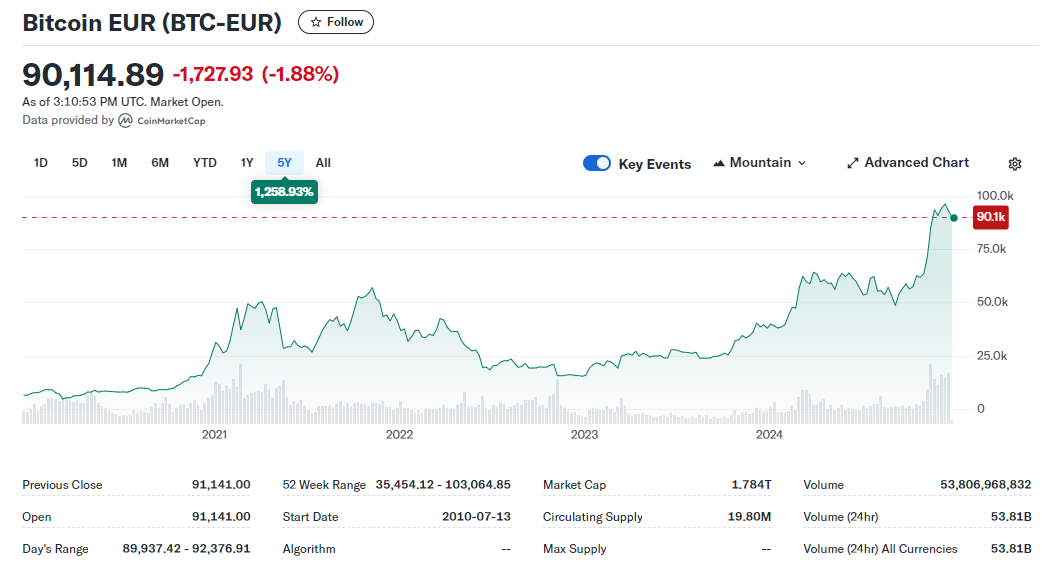
Bitcoin’s price set another new high last week – surging to more than €100,000 for the first time before retracing. The world’s largest cryptocurrency now has a market capitalisation just shy of €2 trillion. For context, the base money supply of the euro is €4.7 trillion, and Ireland’s entire real estate market has been valued at approximately €1.39 trillion. Over the 16 years of Bitcoin’s existence, conventional wisdom has generally held that it is merely another speculative bubble of no value, albeit one that clearly has more staying power than tulips. Despite a series of striking signs that attitudes towards Bitcoin are changing elsewhere, especially in the US, Ireland has witnessed no serious discussion of the possibility that what was once considered fringe internet money could prove to be highly consequential.
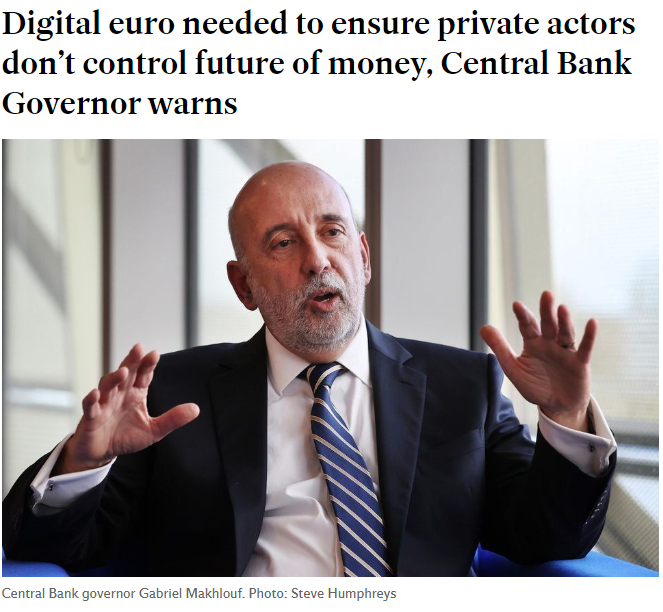
Institutional trust has been a widely discussed topic in recent times. Public confidence is particularly crucial in organisations responsible for monetary policy—which in Ireland’s case is outsourced to the European Central Bank (ECB). Money is how we value our working time and save the fruits of our labour, so getting it right is no mere academic exercise.
The ECB failed to predict the inflation that followed years of easy money policies during the Covid-19 pandemic, and later overestimated how quickly it would recede. Quantitative easing, undertaken in the name of financial stability, benefitted certain segments of society at others’ expense. The price increases which were squarely blamed on exogenous factors have yet to revert to baseline levels – which one would logically expect if they bore no relation to monetary policy as we are assured. During this period, the ECB had the excess institutional brainpower to run a remarkable series of what can only be described as ‘hit pieces’ on Bitcoin – something rarely encountered with other assets or currencies.
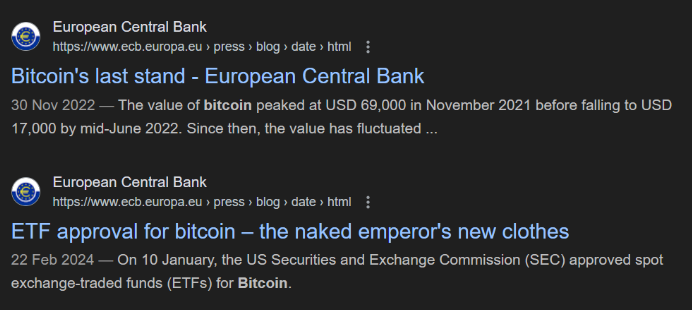
These pieces were published on the ECB’s official blog, with a caveat that they represent the views of their authors. Similar views have been publicly ventilated by the ECB’s president Christine Lagarde – “my very humble assessment is that it is worth nothing”. When ‘Bitcoin’s Last Stand’ was published on 30 November 2022, Bitcoin’s price was approximately €16,000, close to its lowest point since 2021. Ironically, this preceded a rally of over 500%. Not quite the “artificially induced last gasp before the road to irrelevance” that the authors predicted. A comprehensive response to the ECB’s more recent piece – focussing on the authors’ seeming inability to make any logical distinction between Bitcoin and ‘crypto’ generally – can be found here.
There are many legitimate discussions to be had concerning Bitcoin: Does it currently qualify as money and has this changed directionally over its lifetime? Is its volatility likely to reduce with time if it continues to grow? Does it have the capacity to scale meaningfully? Can it remain decentralised and secure in the long term? What are the environmental impacts of mining, and could it add to the capacity of our grid? Rather than engaging with these issues earnestly, we have encountered mostly hand-waving dismissal from those who should be thinking deeply about them. Despite many authoritative pronouncements from economists and bankers, thus far the market has clearly determined that Bitcoin does have value, which has generally increased over time.
A continuation of this trend could be highly consequential, and although the case will not be set out here, it is at the very least a credible proposition that we are witnessing the emergence of a new form of base money that will be widely used in the future. Although our institutions must admittedly strike a delicate balance in their messaging around something that is widely perceived as having the potential to separate money and state; given the high stakes and distinct direction of travel, taxpayers deserve more than the blatant ideological opposition so far witnessed from those tasked with safeguarding our financial interests. While consumer protection is a laudable aim, an exclusive focus on risk aversion may end up draining the economic baby with the bathwater.
Ireland’s domestic information environment is little better. David McWilliams recently told Pat Kenny on Newstalk that Bitcoin was like Esperanto – the proposed universal language that never caught on – fascinating to those who use it, but of little consequence to anybody else. The fact that it never fails to come up when he is being interviewed about money might be a subtle hint that the analogy is less than perfect. We have also previously responded to David’s remarks on Bitcoin, given his extensive audience – which can be accessed here. If Bitcoin is what its proponents claim, we may already be in the midst of a digital gold rush.
In the nineteenth century, many people may not have fully appreciated that the populations of Victoria in Australia, or California in the US were building generational regional prosperity by extracting the world’s (then) most important form of money from the ground – but the benefits which accrued as a result are felt to this day. What would it do to trust in our institutions if we missed the modern, digital, and more accessible equivalent, because our own public servants, bankers, journalists and academics told us we simply shouldn’t take it seriously?
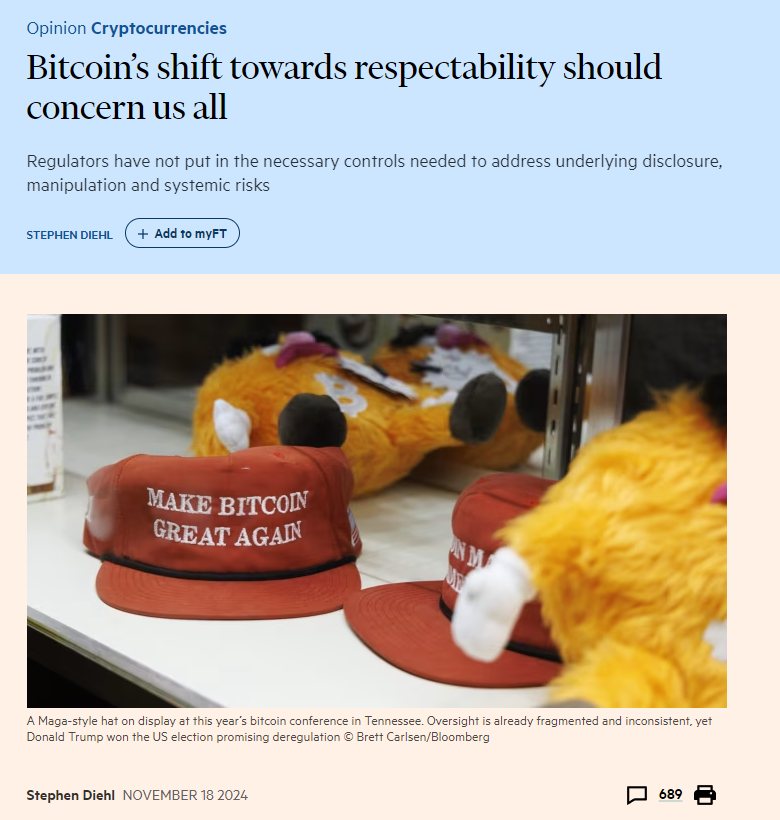
Complacency was not necessarily critical while it was ubiquitous; however, the recent change in sentiment from the incoming US administration should rouse us to the potentially momentous implications of a monetary shift. Donald Trump determined that it was worth his time to attend a Bitcoin conference in Nashville while on the campaign trail in July, promising a more friendly regulatory environment and stating his intention to create a ‘national bitcoin stockpile’.
All indications so far are that these are not empty words, and he has now made a series of appointments which are noteworthy. The incoming Commerce Secretary, Howard Lutnick – who may be familiar for his critical comments on Ireland’s role in offshoring American companies – is vocally pro-Bitcoin and is the founder of the large investment bank Cantor Fitgerald which provides bitcoin-backed lending. Similarly, a proposal for a strategic bitcoin reserve – in the form of a bill in the US Senate – has been discussed by the incoming Treasury Secretary, Scott Bessent. The Chair of the US Federal Reserve recently likened Bitcoin to gold, and when making the latest interest rate announcement last week, was asked whether there would be a value to the US government holding a reserve of bitcoin.
Whether or not any such reserve materialises, the institutional attitude in the US towards Bitcoin has undoubtedly changed, and where money flows, narratives and regulations are likely to follow. The spot Bitcoin ETFs which were approved earlier this year have been some of the most successful ETFs in history, already surpassing the total assets under management in US gold ETFs – over $128 billion. Larry Fink, the head of the world’s largest asset manager Blackrock, previously called Bitcoin an “index of money laundering” in 2017. Blackrock is now producing videos to educate its clients about the benefits of Bitcoin and the tone has changed: “We believe Bitcoin’s long-term adoption trajectory will be primarily driven by its fundamental use case as a global monetary alternative amid monetary and geopolitical uncertainty.”
Bitcoin has made its way into passive indexes, public and private pension funds, and onto the balance sheets of dozens of public companies. America’s oldest bank has now been approved to custody Bitcoin on behalf of its clients. Last Monday, an ex-finance minister Christian Linder accused the German government of missing out on the economic opportunities offered by Bitcoin and failing to integrate it with the country’s financial strategy. The following day, a French MEP openly called for a bitcoin reserve in the European Parliament. These are now far from isolated remarks and appear set to intensify in frequency and sincerity.
“We’re gonna do something great with crypto because we don’t want China, or anybody else … but others are embracing it, and we want to be ahead” – Donald Trump
An imminent US strategic bitcoin reserve is far from guaranteed, and even some of Bitcoin’s supporters contest the wisdom of such a move given the potential political and market signals it could send. If, however, it does eventuate, the obvious prisoner’s dilemma it presents could signal the start of a strategic race to accumulate a new global reserve asset, with countries scrambling to ensure they are not left behind. The US may not even be the first significant player to act, and the game theory of geopolitical competition makes significant nation state adoption unlikely to be an orderly and collaborative affair. While this entire concept might seem far-fetched to many, it undoubtedly sounds less like fiction than it would have in the past.
While the Irish state may be caught flat footed on the current trajectory, earlier this year the ownership rate of cryptocurrencies in Ireland was estimated at a significant 13%. Given Bitcoin’s longevity and greater than 70% market share dominance, it is likely that somewhere in the region of half a million people in the country own some – in spite of the prevailing messaging and disincentives to ownership, such as tax status. The legitimate interests of this cohort of voters have yet to be tangibly represented by politicians.
In contrast to Ireland’s 33% capital gains tax rate, which is one of the highest in the Western world, several European countries – namely Germany, Belgium, Switzerland, Luxembourg and Portugal – impose no capital gains tax on digital assets held for at least a year. Our approach is unlikely to attract or retain capital and investment – especially given that Bitcoin is a uniquely portable bearer asset which can easily flow to where it is treated best.
A continuation of Bitcoin’s growing global relevance as a digital, decentralised, and fixed supply money is not contingent on the actions of nation states and asset managers, or the realisation of strategic reserves; however, the rapid evolution of these narratives highlights how ill-prepared we appear to be on this side of the Atlantic for what may be ahead. Dismissing Bitcoin’s recent performance as a Trump-related phenomenon risks overlooking the broader trend and could see Ireland, and Europe more generally, miss the opportunity to capitalise on what may be the most significant monetary shift since the end of the Gold Standard.
The Author, Richard O’Hagan, is a member of Bitcoin Network Ireland, which is a non-profit organisation with the aim of educating people about the benefits of Bitcoin adoption in Ireland and advocating for sensible government policy in this sphere.