For Portarlington Independent candidate Elaine Mullally, running in the upcoming general election in the three-seater constituency of Laois was a decision which seemed obvious.
“I felt as if there was no alternative,” she tells Gript. “Everyone was saying things like, ‘Well, sure, who would you vote for?’ I felt that if I decided to run, at least I’m giving people the choice. People here can reason: “Here is a reputable business person who is well known and well respected, so let’s give her a go.”
Deeply disillusioned with the current political system, the Laois business woman says she is far from the only one “fed up” with the way “the country is being run at present and the unbelievable wastage of money.”
Mullally, the owner of a children’s indoor soft play area which has hosted birthday parties and other events for kids for the last 16 years, says there were a couple of key motivating factors behind her decision to throw her hat in the ring as an Independent.
“It feels as though there is no one being held accountable for anything at the moment. I have two daughters who are 20 and 21, and there’s very little to keep them here. My eldest will finish her law degree next year, and there’s no housing for them; the cost of living is so high.
“There’s just so little; it’s even become difficult for parents to put their kids through college because the college places were so scarce, and whatever was there was so expensive. My girls were a main motivating factor for me.”
Mullally was previously associated with Independent Ireland as one of its founding members. However, she quit the party founded by TDs Michael Collins and Richard O’Donoghue in July, saying that she came to the difficult decision as she said it no longer aligned with her values and principles. Her stepping away came just over a week after the party joined the European Democrats grouping in the European Parliament.
There are challenges involved with not being in a political party, though, Mullally admits.
“Obviously, there’s no party machine behind you, so you don’t have that drive, that force, to put foot soldiers on the ground. So I’ve had to do that myself – which I did quite successfully.
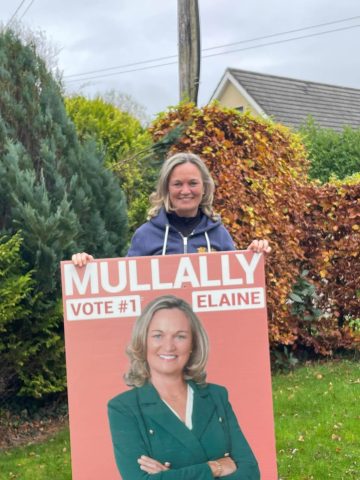
“I held seven public meetings across Laois in the main towns, and from those meetings, I was able to hear what people wanted me to represent them on. But also it was an opportunity for people to step forward and say, ‘Well, I’m willing to help you if you’re going to champion this cause,’ so I’ve had a team of 45 built from that.
“The second issue or the second challenge is that there is kind of an apathy out there. Voters are deeply disillusioned.
“The biggest complaint I heard on the doors was, ‘I’m not voting for anybody, because I just don’t trust any of ye,’ and ‘I don’t think anything’s going to change.’ So there’s that nearly loss of hope. We have spent nearly eleven weeks on doors, so we are talking to people and explaining to them why they should vote.
“Thirdly, I would highlight the challenge of how in my view, there is a big amount of Independents running who are not genuine. They’re not authentic, or 100 per cent independent. We know there’s been a big swing towards Independent candidates, because after 2020, Sinn Fein were seen as the up and coming, rising party, who were going to stand up for everything.
“And they didn’t. So now people are going to vote Independent. But the problem I am having is that there are some candidates, who are presenting themselves as independent, but they are not independent. It’s my view that if you’ve sat with a party at any point in history, you cannot call yourself completely independent.
“I am completely independent, because I will not align with any party. I am not saying I wouldn’t work with another party, but I wouldn’t align myself, because I didn’t come from a party stock – and I hope people do their research and work that out before Friday,” she says.
However, Mullally says the benefits that come with being an Independent voice outweigh the drawbacks.
“I hope that within my constituency, people can see that I want to represent their voice – and that’s something I really feel I’ll have the freedom to do as an Independent. I’m not going to be told, whipped or led in another direction. I am not going to tell people ‘I’m going to represent your voice,’ and then get into the Dail and say, ‘Oh sorry, I can’t actually speak about that. I’m not allowed to talk about that topic.’
“Or if a vote comes up and it’s very important for people on the ground, such as the No/No referendum, and I’m not allowed to vote against that if it was a public vote. Being an Independent gives me the freedom to express the views of people and what they want. But I also have the courage to do that – which I know is lacking.”
But what has the response been like on the doors for Mullally?
“The whole county has been amazing, but Portarlington blew me away because it’s my home town. When I arrived here last week after ten weeks of canvassing, there was an amazing response, because people see the benefits of having someone in their own locality representing them, and Portarlington really hasn’t had that, to be honest. I’m born, bred and have lived in Portarlington my whole life. I’ve worked in Portlaoise for a number of years,” she says.
The Dáil hopeful would love to become the first woman elected to the sole constituency of Laois (Carol Nolan has been a TD for the Laois-Offaly constituency since the 2016 general election, and and previously from 2016 to 2020 for the Offaly constituency).
“My roots are here, and people have said to me, ‘It would be great to have one of our own.’ Also, it’s been a three horse race for all of time in Laois. There’s never been a female TD for Laois. So people have said, ‘Wouldn’t it be great to have one of our own and a female elected here. Why not? Why not put you there?’
“What are the big issues that have come up over and over again on the doors?” Mullally is asked.
She says firstly, the lack of support for parents of children with autism and special needs. And secondly, immigration. These two issues, she says, stand out above the rest.
“The biggest issue throughout the campaign and something which came up at the public meetings was the prevalence and the lack of support for families who are dealing with autism and special needs. It’s absolutely disgraceful how little support these families are getting. And teachers as well,” Mullally said ahead of a meeting at the Colby School in Portlaoise.
“I have a meeting later with the principal there, who has invited me in to have a chat regarding the shortage of occupational speech therapists. And this is across the board, not just in Laois. I want to concentrate on Laois initially, and do what I can.”
There’s also St Francis School in Portlaoise, she says, which has been cut to three classes recently.
“There’s a lot of battling on the ground for our children, which shouldn’t be happening at the moment. And particularly families who are trying to cope with this. We are seeing that for many families, the diagnosis isn’t timely. And when the diagnosis is finally made, they don’t know where to go.
“They don’t know what supports are available. The school places are extremely tight, and I have to say this was the biggest issue so far at the public meetings. When I got out on the doors, this became even more obvious, because if I wasn’t talking to a parent of a child with special needs, I was talking to a grandparent, or an aunt or an uncle. It’s an issue that the larger parties are only just starting to pick up on now.
“It leads you to question, if they’ve been in power all this time, who were they listening to for the last five years? They weren’t listening to the people. They couldn’t have been.”
The second biggest topic that has raised its head at the doors in Laois is immigration, Mullally says, as she appeals for a “grown up” conversation on the topic which continues to be a big issue in the polls.
“The issue of immigration has finally made it to the mainstream media with the debate on RTE this week. But it’s been coming up for me for the last couple of months, and people are very unhappy with the way the government handled it, and how they have tried to shut people down and exclude them from debates and discussions. Why can’t we have an open, adult, grown up conversation about how badly, if at all managed, the immigration system is in this country?”
Those areas are followed by housing, the cost of living, and mental health.
“Mental health is huge. We have a huge problem with mental health in this country,” she adds.
‘GOVT SPENDING TAXPAYER MONEY LIKE IT’S MONOPOLY’
When asked about the unique skill set she can bring to the Dáil, Mullally agrees Irish politics could indeed benefit more business people like herself.
“I’m a small but successful business owner. I know that if I overspend in one area of my business, then something else is going to suffer severely, so you have to run it extremely well. I believe the country should be run like my business,” she opines.
“As a business person, you learn to get good at weighing up all situations before you make a decision in relation to something that could affect the stability of the business. And again, looking at the country as a whole, why isn’t there more housing? Why isn’t the infrastructure better from a health perspective and an education perspective? It’s because somebody didn’t look at the bigger picture.
“The country is not being run as a whole unit. It has been segmented out so badly that there’s nobody taking responsibility for what’s wrong. I think being a business owner, you have a whole different outlook on money, for a start. I have a private business, which is one thing, but if you’re in government and you’re handling finances, it’s other people’s money, so there should be an even greater level of accountability, not less. Yet we’ve seen this government spending taxpayer cash like it’s monopoly.”
Mullally says those on the doors are indeed annoyed with how their money is being spent at present by those in power. “They are not listening to people,” she believes.
SQUEEZED MIDDLE CAN’T QUALIFY FOR A MORTGAGE
On housing, she says many people now fit into the “squeezed middle,” particularly young professionals, who are not earning enough to buy a home, but are earning too much to qualify for government assistance and schemes.
“There is a frustration because I am meeting many families on the doors who have one, two or three adult children living with them who are often in their early thirties. They have said to me, ‘My son is not earning enough to qualify for a mortgage, but he’s earning too much to qualify for any of the schemes like HAP.
“So what is happening is that the squeezed middle are not getting on the property ladder at all. They are living at home with their parents, and they don’t want that. People are thinking, ‘My child who is in a good job and working hard can’t afford a house – and here our government is blowing €330,000 on a bike shed, or outting €9 million towards phone pouches.
“Why aren’t they putting it into the things that people want?’ There is a justifiable anger out there, because nobody from the government is coming out and saying, ‘We made a mistake.’
“WHAT IS A WOMAN?”
The Portarlington woman also says that the government’s approach to SPHE has come up at the doors, and that the government’s ‘wokeism’ on issues including gender has been in the spotlight. She even says that during the campaign run, she has opened doors to be asked bluntly, ‘What is a woman?’ – a question people see some politicians in the Dail unable to answer.
“The majority of people are not very happy with the Department of Education on this. They feel it is overstepping the mark when it comes to education, which they increasingly feel should focus on practical skills and mathematics and reading and writing. Many people seem to agree this is emotionally and agenda driven, and that the government is trying to impress upon young brains – parents are not happy over this.”
“I know this is funny, but I’ve knocked on a door only to be asked, ‘What is a woman?’ I have replied, “An adult human female,” and voters have responded to that simply by saying, “You’ve got my vote. Now off you go,” Mullally laughs.
“That’s their question. That’s their line in the sand. And it is a case of “Well, if you can’t define a woman, then what are you doing trying to take a Dáil seat?”