Collectif Némésis, France.
There’s a strange irony in a feminist feeling unsafe to meet in Marseilles, famously one of France’s most open cities, as a result of threats from left wing activists. Nina, a spokeswoman for the French feminist group Collectif Némésis, grew up in a poorer area of north Marseille with her grandmother. They were two of the few ethnically French residents in the suburb. “We could see the effects of uncontrolled migration,” she said. “A really beautiful city has become really horrible.”
Historically one of France’s greatest melting pots, the Provençal capital has seen a dramatic change in the character of inward migration since the 1960s, which is having a profound effect on the culture of the city. “You have to change the way you dress, where you travel in the city—you even need to remember to carry pepper spray in your bag. Mass migration brought human trafficking, drugs, and prostitution to Marseille. The problem is that this drove many decent people away, so increasingly only the dangerous ones remain. The police don’t have the resources to deal with it; there are parts of the city they can’t even enter,” Nina says.
In France, it is illegal to collect data related to race and ethnicity, however, Nina pointed out that those without French citizenship made up 9% of the population, but 29% of the prison population, 15% of domestic violence cases and 63% of sexual assaults on public transport in the Île-de-France region. “Data from other European countries would suggest that this would be higher if we had the full data”. The effect that this was having on women in her city drove Nina to join Collectif Nemesis, a group founded in 2019 to address the impact that mass migration was having on women. The group has grown dramatically and operates in France, Spain, Italy and Switzerland.
“Feminism is a great thing. We didn’t have the right to vote, to divorce, to have a bank account but modern feminists have to understand they need to apply those foundational principles to the modern context. Left wing feminists played a very important role 30 years ago, but today they are useless, they refuse to realise that their feminism must evolve as the situation evolves”.
“The left have had a monopoly on feminism, yet women have never been in such danger in France,” Nina claims. She says the Left’s embrace of other causes has de-centred women’s issues in mainstream feminism. “Feminism is erased by other causes, if you’re a feminist you can’t be pro-Islam when it treats women as if they are inferior. Yet the left says you can’t be a feminist if you’re not anti-racist or pro-Islam. They don’t want to see the problem, they become extremely violent because they can’t admit they’ve failed”.
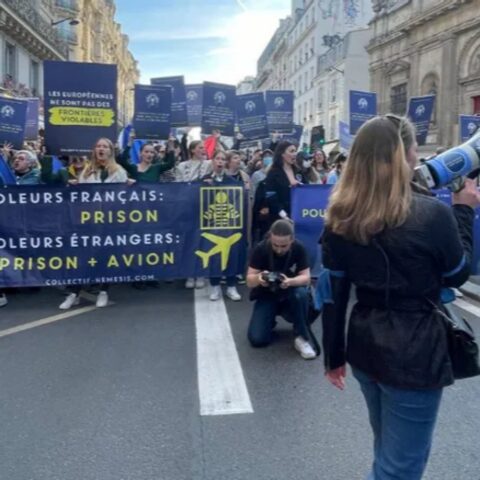
Nina moved to Aix-En-Provence for college, the week before we met, she attended a court case for her local Imam. The Imam had claimed that women have half the brain of a man. “There were ANTIFA activists there from all over the region. During the court case they attacked us verbally, they even grabbed us in front of the police and judge, both men and women. Sometimes women can be more violent.”
The Imam, who openly claimed to be a salafist, was issued with a fine, but Nina pointed out that this won’t have an impact on what he preaches. “Many of these radical groups receive support from the Islamic Brotherhood, who is financed by islamic countries like Saudi Arabia and Turkey. They seek to take strategic positions of power in French society, and they are growing. They have completely captured the Left”.
“The muslim community represents a large pool of votes, the left can now not gain power without appealing to them, which means making concessions to their ideology. Aix-En-Provence is now the only city in the south of France that doesn’t have a security problem, but I am worried that if the left gain power here, what happened in Marseilles, will happen in Aix.”
“A left wing mayor could undermine the police, they want to create banlieues in the city centre and increase transportation to the banlieues on the outskirts. The goal is to mix the populations. Of course, it is good to mix populations, but we don’t live in a Disney movie and it is the women of Aix-En-Provence that will pay the price for this.”
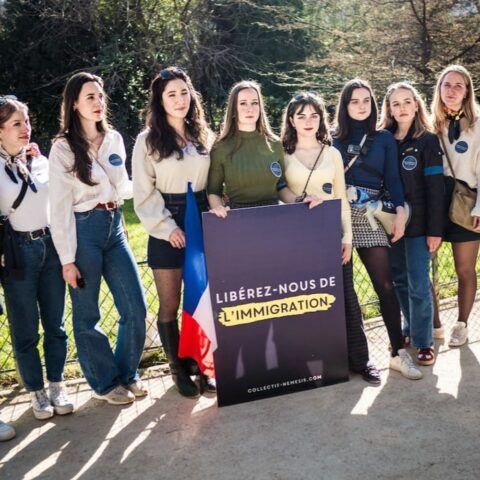
Collectif Nemesis recently drew national attention at the opening of the Christmas markets in Strasbourg, where they unfurled a banner from a building that read “6,482 rapes or attempted rapes by foreigners in 2024: Santa, re-migrate these rapists for me” The group is now at risk of legal charges for allegedly endangering public safety. Nina pointed out the two-tiered approach from France’s legal system in its approach to groups like Nemesis in comparison to other activist groups.
“We are pursued almost like a terrorist organisation” Nina argues that there has been a breakdown in the political neutrality of the French judiciary. “Judges form syndicates that then become political.”
She points to the 2013 Affaire du Mur des cons, where the magistrates’ union created a noticeboard called the “Wall of Jerks,” which displayed images of people they claimed to be “jerks.” Those featured included right-wing politicians, intellectuals, and journalists, as well as the parents of victims, including fathers of young girls who had been raped and murdered by repeat offenders.” The syndicate was not dissolved,” she says.
“Judges use culture as an excuse to give lighter sentences to those with migrant backgrounds. The Right is criticised for focusing on migrant crime rates, but if we deported migrant offenders, native offenders could be punished more severely. Many of France’s prisons are now at 200% capacity, meaning that some offenders serve their sentence out of prison, which is leading to high rates of recidivism. If we deported the 29% of prisoners who are non-nationals, we could punish French offenders more severely.”
Nina argues that the rising rate of offences that are being carried out against women in France needs to be looked at within the context of the cultures the French state is importing. “If you take men from foreign cultures who do not view women as equal, who do not understand we have an equal right to work, to talk, to have a job, they will not treat us as such. We are not meat, we are not animals”.

“They are hostile to integration, they want us to apologise. They want to come to France for the money, for jobs and security, but they do not want to be French. They want the advantages of France but not the duties of it. We are proud of the heritage our ancestors gave us. Having French citizenship alone, does not make you French. Being loyal to France, learning the language, contributing to our society does. Migrants must prove they deserve to be French.”
Nina argues that this point is causing a growing generational gap between young French people and the May ‘68 generation. The new generation grew up with terrorism, so they are ready to act, the problem lies with the older generation.”
“The Bataclan traumatised a generation. Last year I took my little brother to Disneyland, he looked at me and said ‘if someone comes at us with a weapon, we’re all dead” Visiting Disneyland the first feeling he had was terror”
Recently, France has experienced a wave of migrant violence against women and children. Claire Geronimi, a 28-year-old Parisian was raped in her apartment building by Jordy Goukara, a homeless migrant from the Central African Republic with multiple prior convictions and three unenforced deportation orders; after publicly testifying about the attack and criticizing France’s migration policies and judicial leniency for stating that her attacker “should not have been on French territory,” she faced intense backlash, including accusations of racism, as well as silence or rejection from mainstream media, left-wing feminists, and organizations like the Fondation des Femmes, experiencing what she called a “double punishment.”
Collectif Nemesis was the only women’s rights organisation to support Geromini.
Geromini’s case came against a slew of other similar cases such as Philippine Le Noir de Carlan, a 19-year-old university student, who was raped and murdered, in Paris’s Bois de Boulogne, her body partially buried the next day; the prime suspect, a 22-year-old Moroccan migrant named Taha Oualidat previously convicted of rape and had likewise had an unenforced deportation order.
Lola Daviet, a 12-year-old schoolgirl, was lured into her building’s apartment in Paris’s 19th arrondissement, where she was raped, tortured, and killed by Dahbia Benkired, a 24-year-old Algerian woman also under an unenforced deportation order, whose body was found mutilated in a trunk.
When asked if she was optimistic about the future, Nina replied “There has been progress, in six years, we’ve gone from 10 activists to over 500, across five different countries. Many groups have formed based on our example. This is a sign that people are waking up but I don’t know, it’s almost too late for us already, and we are trying to rectify the situation, but it’s very complicated. There has been progress. I’m hopeful but I don’t want to be disappointed. Irish women need to understand that if they don’t act now, they will suffer the same problem we are experiencing today.”
Women’s Safety Initiative, England
Eloise Schultz is a member of the Women’s Safety Initiative, a group inspired by Collectif Nemesis in Britain to advocate for victims and survivors, as well as critique the impact that mass migration is having on women and girls across Britain.
“Women are disproportionately affected by many of society’s problems, particularly in relation to safety and women’s rights. When we look at issues such as grooming gangs, the primary targets have overwhelmingly been women and girls.
“While men are often victims of violence such as stabbings, women are, by nature, more vulnerable in many everyday contexts. If we examine the countries where women are most unsafe and have the fewest rights, we also find that many asylum seekers originate from these same places. Given the cultural contexts in which women’s rights and respect for women are limited, it is reasonable to have concerns about the potential impact on women’s safety here.”
Her group has received backlash from other feminist groups. “People that would consider themselves to be feminists take issue with us but when we were taking some of our promotional photos with signs saying that one in four sex crimes were committed by foreign nationals, we had women coming up saying thank you,” she says.
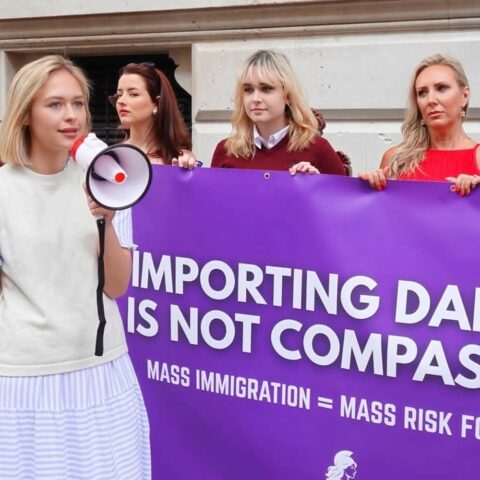
Schultz says that she can understand the fear from other feminist groups to speak out about this issue ““They try to keep themselves to be seen as acceptable, they have a fear they won’t make progress for women’s rights if they’re not behaving themselves. If they start rocking the boat, the valid points they’re making might get ignored”.
Schultz’ sees her patriotism and feminism as intertwined “Feminism is a big part of our history and our culture, I think even outside of politics, even just in the day to day, how British men would treat women, being gentlemanly and treating women with respect has been part of British culture and that’s something I’m proud of and something I don’t want to be taken away”.
In Britain, foreign nationals are 71% more likely to be convicted of a sex crime compared to Britons. Schultz points out the behaviour of those from different cultures is having a chilling effect on British girls. “Women and girls have had to change our behaviour. You have to be on your guard. I always look for the shoes – when I see standard issue shoes, I know I need to be careful”.
The WSI have pointed out the disparity in sentencing in British law for offenders with a migrant and native background. Migrants can receive lighter sentences because judicial discretion often treats factors like no UK criminal record, cultural dislocation, or migration-related vulnerability as mitigating. This is reinforced by the Equality Act 2010, which encourages courts to consider the impact of sentencing on disadvantaged groups. Judges may keep sentences below 12 months to avoid automatic deportation, a consideration that does not apply to White British offenders.
Schultz argued that this was allowed to happen because of a disregard among the British political class for the most vulnerable groups in society, such as women and the working class. “I think certain groups are targeted because they are more vulnerable, while the establishment largely ignores working-class white people. When I was in Rochdale, I learned that there was a city council member who was abusing young boys in the foster care system. The care workers knew about it, and the council was aware as well, yet all they did was speculate on which boy would be next. This shows a clear contempt from the authorities toward working-class people.”
Schultz is optimistic that the conversation around migration is beginning to open up. “I get rare but awful DMs saying they hope I’m infertile, but broadly the reception has been good. It’s too obvious now for it to be dismissed, it’s just undeniable at this point, they can’t tell you you’re wrong,” she says.
“This shift in narrative is a positive sign, as it reflects a change in public mood. Politicians are responding to what people want to hear, but it doesn’t necessarily inspire confidence that policy will change quickly. It says more about the country’s mood than about their true intentions.”
Schultz pointed out that women across Europe are facing the same problems with regards to mass migration and expressed her hope that Irish feminists can be inspired by the work of other European feminists and the Irish tradition in their activism in this area. “Make that element of patriotism and being proud of your history apart of your activism,” she says.
Women’s Coalition on Immigration, Dublin
As in France, the Irish state does not collect data on crime disaggregated by national origin. However, one study from 2009 by the Rape Crisis Network Ireland suggests that Ireland’s experience mirrors that of continental Europe. The study found that non-nationals were more likely to be suspects in rape offence cases than their Irish counterparts. It reported that Africans in Ireland were ten times more likely to be suspects, while Eastern Europeans were seven times overrepresented.
Recently, the Women’s Coalition on Immigration launched in Dublin, seeking more transparency in the crime data collected and to highlight the risks to women and children that the state’s migration policy could pose. The group released a thematic report that demonstrated an overrepresentation of non-national men in sexual offence statistics across 6 European states.
The group’s founder and author of the report, barrister Laoise De Brún argued that feminism is essential to understanding how these problems are affecting women. “Feminism is an awareness or consciousness of how and why women are vulnerable to male violence both sexual and ordinary. Class and race intersect with this for sure but increasingly we are being indoctrinated into a belief that race sort of cancels out any other vulnerability.
In fact when it comes to immigration I would argue that intersectionality can be inverted to show that white western women are more vulnerable to male violence due to the cultural and racial norms of those men. Put simply a man from rural Pakistan is used to women being segregated and shrouded and chaperoned. He does not leave those values behind. Baroness Casey found in her interim report that Pakistani men were up to four times more likely to be involved in rape gangs. Other investigators record perpetrators describing white underclass girls they preyed upon as ‘meat’,” she says.
De Brún argued that feminists today need to take a realist cultural approach to contemporary women’s issues. “To the leftwing feminists who are often, it should be noted, reading off the script of state-funded feminism, who dismiss concerns as racism or our research as attacking minorities, I have one question: if you were on holiday in Morocco, would you allow your teenage daughter to wander around the Souk on her own? If not, why not?”
She continued: “Yes we have a problem of rape culture, of domestic violence and of femicide. Why then would we import another layer? I am fully prepared to view immigration through the same lens as trans, that is, the clear and present danger to the fundamental safety, freedom and protections of women and children.”
“The Government has yet to officially link immigration to an increase in crime and or indeed to sexual violence. In fact, there would appear to be a policy of downplaying this link evident in parliamentary debate and media reporting. However, the data doesn’t lie: migrant men are three to four times more likely to be represented in sexual offending statistics in six European countries. Factual analysis must trump political correctness lest public trust in our institutions be eroded.”
Dean Céitinn