So in the end I failed almost completely. I rarely said the extra Hail Marys. I’ve been on Twitter/X. In fact I almost got into an argument with a Jesuit priest on Twitter. I have eaten chocolate, biscuits, and all the flavours of all the types of crisps, even the odd ones like barbecue beef and the fishy ones – prawn cocktail. Apart from not eating meat on Fridays – which I have stuck to – it hasn’t been a great Lent. But Holy Week (end) is here and hope springs eternal. I always like to go big for Holy Week (end).
This year I am going to really cut down on my smart phone, the source of all evil. Giving the phone up would be too dramatic and many of the dreaded children’s WattsApp groups are there. Truly, unless you are the editor of the Atlantic “You have been added to the group” are the scariest words in the English language. But I need to know the dates for the tennis tournament and the golf tournament and the hockey tournament and all the rest. Giving up my smart phone is a luxury no mother has but I have a landline and a Nokia mobile and my laptop so I reckon I could make progress.
In keeping with the Holy Week (end) theme and the fact that the children are off school some of my writing this weekend will be religious themed. Why only yesterday I was reading this new book Atomic Habits. My son bought it on Kindle and my husband came back and had a hardback version. Now I love a self-help book although if I’m honest I usually end up both angry and jealous thinking – I could have written this and actually there is nothing new in it. Who knew that in order to break a habit (such as overuse of your mobile phone) you should make it physically hard for your weak self to pick up your phone?
For instance, in Atomic Habits it is recommended that if you want to get some work done, “put your phone in another room.” This will not cut it. No, if you want to break your phone habit you remove all the social media apps from your phone, take off notifications, add a blocker and finally get your phone and throw it down the well. Chances are, most of us will be climbing down that well within 30 mins but you get the picture.
Also, at the start of Atomic Habits: An Easy & Proven Way to Build Good Habits & Break Bad Ones by James Clear, Clear explains that it is small wins every day that add up to and overall habit and eventually you succeed in your stated goal, although he does not put too much weight on the goal. There is something about compound interest and I thought he was going to start talking about the trade war at some point.
Clear says, “Habits are the compound interest of self-improvement. The same way that money multiplies through compound interest, the effects of your habits multiply as you repeat them. They seem to make little difference on any given day and yet the impact they deliver over the months and years can be enormous. It is only when looking back two, five, or perhaps ten years later that the value of good habits and the cost of bad ones becomes strikingly apparent. Habits are like the atoms of our lives. Each one is a fundamental unit that contributes to your overall improvement. At first, these tiny routines seem insignificant, but soon they build on each other and fuel bigger wins that multiply to a degree that far outweighs the cost of their initial investment. They are both small and mighty. This is the meaning of the phrase atomic habits—a regular practice or routine that is not only small and easy to do, but also the source of incredible power; a component of the system of compound growth.”
As I was reading this on the 10th sunny day in a row (those have now ended, of course) I thought – this all sounds very familiar. I have read this book before (I once had to return a book to Waterstones as I realised one chapter in I had read it before and sure enough, there it was sitting on my shelf.) Indeed, in Christian theory good habits become virtues. If you are kind to your spouse every day by making him a cup of tea every morning you practice the virtue of kindness. If you continue to do small acts of kindness then you are a kind person.
Indeed, before Clear there was CS Lewis. CS Lewis in Mere Christianity (which I also have on Kindle and hardback), said “Good and evil both increase at compound interest. That is why the little decisions you and I make every day are of such infinite importance. The smallest good act today is the capture of a strategic point from which, a few months later, you may be able to go on to victories you never dreamed of. An apparently trivial indulgence in lust or anger today is the loss of a ridge or railway line or bridgehead from which the enemy may launch an attack otherwise impossible.”
So before James Clear was talking about compound interest, CS Lewis was. Of course, James Clear does not see good and bad habits in terms of good and evil but we should.
A good habit in general will increase virtue and a bad habit will increase vice. A good habit and a good place to start this Holy Week if you want to do the whole compound interest/APR thing is to read Mere Christianity by CS Lewis. It is a collection of essays Lewis gave to the BBC during the war, Broadcast Talks 1942, Christian Behaviour 1943 and Beyond Personality 1944. They were the Ted Talks of their day.
I am sure James Clear has some helpful advice in Atomic Habits. But before you read him – read Mere Christianity. Every Hail Mary is a capture of a strategic point today. Every swear word is a loss of a bridgehead tomorrow.
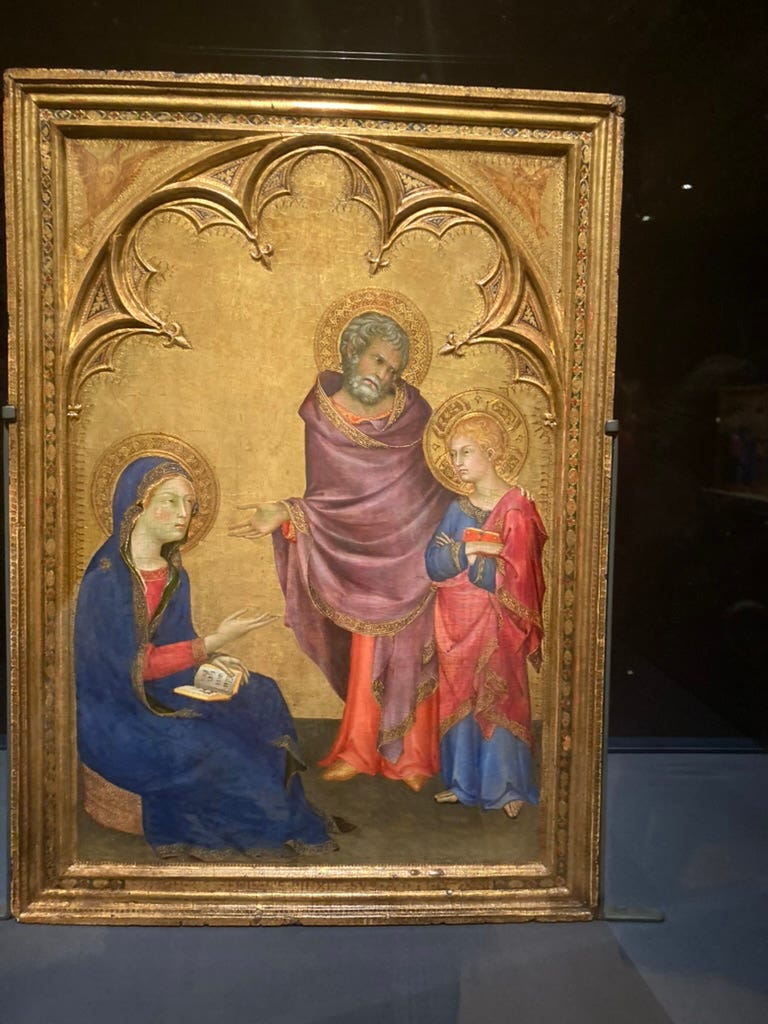
I saw the Siena exhibition at the National Gallery a few weeks ago. The above is Christ Discovered in the Temple. 1342, by Simone Martini. As a child, Christ abandoned his parents during a visit to the Temple in Jerusalem and stayed behind to teach among the scholars there. His mother’s words on finding him again are written in Latin on the book she holds: ‘Son, why have you dealt with us like this?’
I wish you all a great weekend and Holy Week coming up.
You can read more from Laura on her substack.