Footage of An Taoiseach Leo Varadkar vowing to introduce Hate Speech legislation in the immediate aftermath of the Dublin riots went across the world this weekend.
Many people, not only in Ireland, were understandably incredulous that instead of a national conversation about the harmful effects of government inaction, the horrific stabbings at a primary school in Dublin are being used to push a law that could silence those who criticise the actual policies which have landed us in this mess.
It seemed to me that we were witnessing pure deflection, when the Taoiseach took to the airwaves to announce his plans to hasten in the Hate Speech legislation which has been so vigorously objected to by free speech advocates and leading Senators and civil rights advocates.
As Gript’s Ben Scallan discovered, a staggering 73 per cent of respondents to the government’s own consultation on hate crime stood firmly against its introduction.
Yet, as Varadkar addressed the nation for the first time since Thursday’s harrowing attack, which left three small children and their heroic carer in Dublin hospitals, tackling ‘hate speech’ was the issue at the forefront of his mind, and the curious solution to the events which have left the country reeling.
“We’re going to make sure that we make those changes to our laws in the next couple of weeks to allow the gardai to use that evidence, and go through that evidence and identify the people who were involved in these actions, and we are going to get them,” he said.
He continued: “In addition to that, I think it’s now very obvious to anyone who might have doubted it, that our incitement of hatred legislation is just not up to date. It’s not up to date for the social media age, and we need that legislation through – and we need it through within a matter of weeks.
“Because it’s not just the platforms who have a responsibility here, and they do; there’s also the individuals who post messages and images online that stir up hatred and violence. And we need to be able to use laws to go after them individually as well.”
Taoiseach Leo Varadkar says to the far-right protesters who rioted in Dublin last night 'ask everyone you know what they fear most on our streets. They're afraid of you. Afraid of your violence and your hate and how you blame others for your problems'.https://t.co/jSqOhnwgMh pic.twitter.com/5WxxSoT5Rw
— Sky News (@SkyNews) November 24, 2023
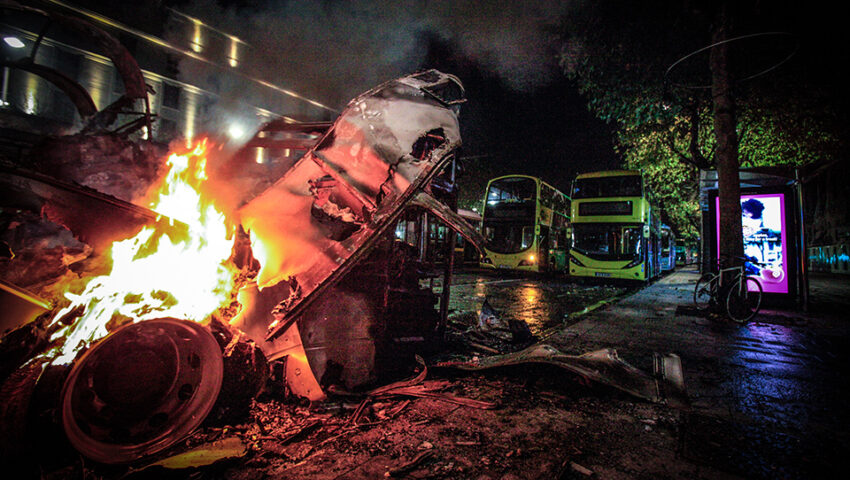
The address was most illuminating. For months, we have been told that hate speech laws are about tackling racism, xenophobia, homophobia, and of course, hatred at its core. Yet for many viewers right across the world, what was most obvious from Varadkar’s speech, made as smashed glass was still scattered over the streets of Dublin, as burned out gardai cars were being town away, was that this law is about none of those things – but rather, about quenching the spread of the accelerating dissent over the government’s own destructive policies.
Today, Micheál Martin is also out promising Hate Speech laws would be enacted before Christmas. Neither he nor Leo Varadkar has made any comment as to how they will tackle the State’s failings over which they presided which have led to children being stabbed coming out of primary school.
The world is watching, and all of a sudden, the land of a thousand welcomes, Tayto, and pints of Guinness, is burning, engulfed in a fireball of angry rage, directed at a government which has stubbornly refused to listen to the outcry, despite months of peaceful back-to-back protests over the policies which have left the country falling apart at the seams, and national morale on the ground.
The anger is also, as can be so clearly seen from social media, levelled at the Irish media, and high-profile journalists, who have for the most part, been completely unwilling to speak to those with concerns about our immigration system, and the influx of mainly male migrants, into communities where people were genuinely fearful, and where the resources were not there to cope.
Those people were, instead, lazily pigeonholed as far-right, along with the few journalists who were willing to speak to them and class their protestations as newsworthy. Ordinary people, in their droves, were accused of fear-mongering, and racism, when they peacefully protested government policies, despite their position being an increasingly mainstream one — one Business Post poll found that 75 per cent of people believe we are taking in too many refugees.
Ordinary people were deliberately made to feel like they were positioned on the fringes, in order to protect a government which has lost control of the country. They were silenced and suppressed and browbeaten.
The government knows full well that most of those who rioted and looted were disenfranchised or thuggish youths who aren’t motivated by either the far-right or the far-left. But, they are happy to pretend otherwise in order to make it illegal to speak your mind on a whole rage of issues from transgenderism to immigration.
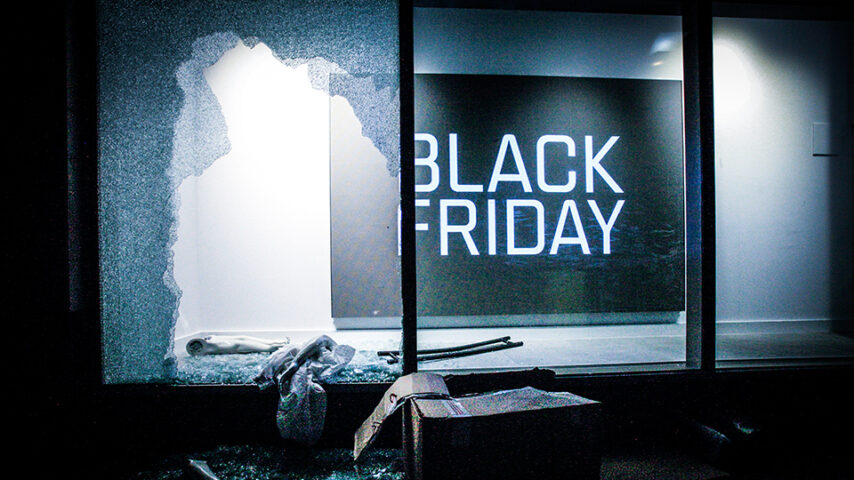
No-one who riots and smashes the windows of Foot-locker gives a hoot about the effects of hate-speech legislation. It to be used to silence free speech and to quell criticism of the establishment, not to enforce law and order.
It’s certainly not needed to quell most of the media who are happy to censor themselves. The censorship was evident last week, when the majority of Irish newspapers refused to print parts of the victim impact statement written by the boyfriend of school teacher Ashling Murphy – the parts where he dared point out that his beloved girlfriend had been murdered by a man who had come to Ireland from abroad, and who had not worked in a decade, while enjoying social housing.
The part where Ryan Casey shared his belief that under this government, Ireland had become a less safe place for women.
When An Taoiseach Leo Varadkar made his declaration to the world, when children had been stabbed and unrest had spilled into violence and looting, that the problem was somehow about hateful speech, he would have known that the suspect in Thursday’s attack was well-known to the Gardaí.
He would have, most likely, been aware that the suspect had been arrested earlier this year for possession of a knife, as we learned from a report in Saturday’s Irish Daily Mail.
To make matters worse, the Algerian-born suspect, as per the Mail, was not convicted due to a mental health report, and he was living in city centre emergency accommodation, in an inner city Dublin that looks increasingly like a dilapidated dumping ground.
The refusal to take accountability is shameful, but the attempt to make the issue about the need to restrict free speech is downright insidious. In my view, the government’s focus on cracking down on hurtful words and what one ought not to say, has come at the cost of law and order and dealing with the multitude of issues which have left our capital city in tatters. Their focus is on silencing speech, not dealing with actual crime.
The establishment’s instant reaction to unrest, in response to their own failures, is to play the ‘far right’ card, at every turn – as was evidenced in the response of Garda commissioner Drew Harris, who said a “hooligan faction driven by a far-right ideology” was to blame for Thursday’s scenes.
But as much as Thursday’s incident was a tipping point, it was not an isolated act of violence perpetrated on the streets of our nation. The anger we are seeing has not happened in a vacuum.
In November alone, there was a woman stabbed in Dublin city centre (just last week); a man and a woman hospitalised with slash wounds in a daylight attack in Wolfe Tone Square; and a knife-wielding man was arrested for threatening post office workers at the GPO. These incidents explain the boiling-point tension underpinning the Dublin riots, more than “far right” elements ever will.
Spiralling random violence, coupled with the perception that migrants – many of them single males – being moved into accommodation ahead of the thousands of Irish people on waiting lists, as the number of homeless exceeds record levels, has been overseen by a government who want nothing more than to appear as the virtuous boys of Europe.
They are much more concerned about exaggerating and quashing ‘far-right’ elements, and shifting the blame, by focusing on hate speech legislation which they say is so urgent – than about dealing with the lawlessness and division they themselves have sown.
As we prepare for what will likely be a headlong rush to make the legislation a reality in the aftermath of the riots, we ought to remember what is being proposed. In essence, the most draconian hate legislation in all of the EU. Under the bill, possessing material on your phone or computer which the State deems likely to incite hatred, even if it is never shared with anyone, would be a criminal offence. Misgendering a trans person could land you in prison.
This Bill, is, unbelievably, according to our Taoiseach, the answer to our problems. But this just shows how out of touch our government is when it comes to immigration. We should recognise our Taoiseach’s response for what it is – a sheer deflection, and one which should insult us all.