In Seán Ó Tuama’s essay on Aodhagáin Ó Rathaille, Filí Faoi Sceimhle, he makes an interesting observation; that the 17thCentury in Ireland saw a consciousness emerge of the connection between the nationalistic and the religious question. Nationalism, not only in Ireland but throughout Europe becomes tied with a question of religious expression.
This was where Aodhagáin Ó Rathaille’s pioneering use of the Aisling (the vision poem) ties a spiritual connectedness with nation, with Catholicism as a political identity. The Aisling itself is derived of a pre-Christian idea of a supernatural connection between people and nation.
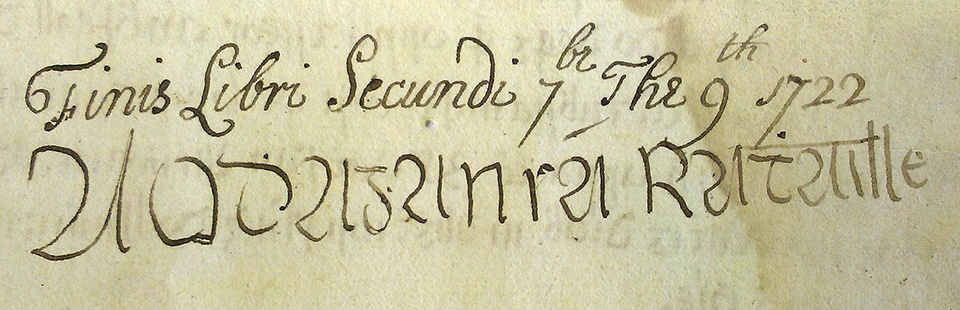
The signature dated 9 Sept 1722 of the poet Aodhagán Ó Rathaille. “7br” is an old abbreviation for September. Photo Credit: HumphrysFamilyTree
_ _ _ _ _ _ _ _ _ _ _ _ _ _
This supernatural characterization of nationalism is a concept that goes back beyond Christianity. We can see it in the ancient monuments of the country that stand sentinel on the landscape. The stone tombs that announce “my people are buried here”, and the alignment monuments that align with the stars as if to say that by the mandate of the stars and the earth we exist on this land.
Such is the concept of a nation, an identity connected with a bounded place.
It’s no stretch of the imagination to say that places such as Newgrange go beyond this theme. It’s not just a tomb, but at some point in the year it becomes the womb of the earth, the womb from which the New Year is born. Is this a sacred statement that the heavens and the earth align to give legitimacy to the people who had built the monument, and to proclaim them intrinsically of this place; its past, present, and future?
This is a concept of identity that is alien to modern derascinated man, whose identity is no longer intrinsically connected with place. Identity is connected with ideas; with concepts; and intellectualized and despiritualised concept of what it is to be. Something which can be self created. Something which can be agnostically liberated from the fetters of the reality of place and landscape.
The identity that the Aisling leans on, expresses a spiritual yearning. Patrick Pearse understood this when he took the form of the Aisling and expressed a much darker message of self sacrifice. His Fornocht Do Chonaic Thú compels its witness to a terrible fate. It is a fate, like the prophesy of an oracle, unavoidable and tied to something eternal.
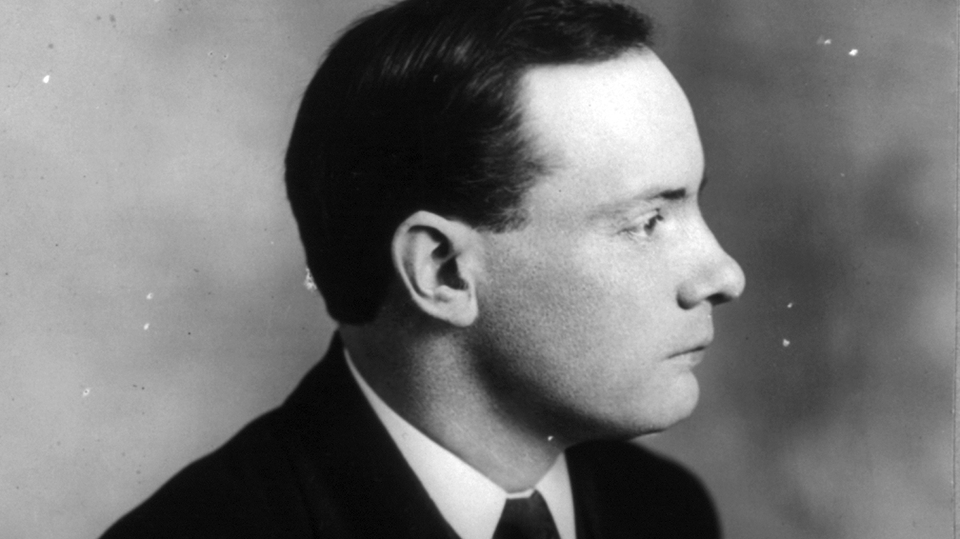
An Phiarsach
_ _ _ _ _ _ _ _ _ _ _ _ _ _
The Aisling occurs in the dream state because this is where the subconscious may surface and become intensely felt. The subconscious is where the transcendent is impressed upon the mind, and what is materialized here is a supernatural revelation.
We can trace the Aisling as we know it today to that period after the battle of the Boyne when Gaelic Ireland received its ultimate defeat, and the long suffering of the penal laws changed our social and political circumstances to that of destitution and impoverishment. Ó Rathaille, gave us the form of the political Aisling which has become so recognizable to nationalist and Gaelic scholars since.
Ó Rathaille was not the first to use the device of the vision poem, though he was the first to give it the particular form of the political Aisling. Earlier vision poems include the Prophet Fidelm’s visions of the invasion of Ulster in the Táin. She represents a fate that connects people to “tearman” and “dúiche,” sanctuary and territory. She paints a terrible vision:
“many corpses will ensue
Cries resound in the walled courts
Ravens shall feast on men’s feet”
On the night before the Battle of Clontarf, the accounts in the Cogadh Gaedhel Re Gallaibh tell us that Aoibhill na Craige Liath visited Brian to prophesise the death of him and three generations of his family in the coming day.
Aoibhil is one of the Sí, a being from a different supernatural dimension, and so she can pierce the veil of time with the gift of prophesy
Ó Rathaille lived a century after the battle of Kinsale. The flight of the Earls in 1607 was a cataclysm for Gaelic bardic patronage and for Gaelic culture. This was the beginning of the inevitable train of Anglicisation and Gaelic subversion; and it was in this social condition that the political Aisling was born. In 1610, the first indication of this new form of poem appeared. Aonghus Mac a Bhaird composed “Adchiú aisling im iomadhaidh” where he prophesises a return of the warrior Gael back over the seas.
“Do-chonnarc mar is léir leam
ag teacht d’fóirthint na hÉireann
drong do longabh thar lear
ós maoilinnibh tonn taoibh-gheal.”
“I saw clearly to my eyes
Coming to the aid of Ireland
A fleet of vessels from Spain
Sailing the white foamed waves”
But it was Aodhagáin Ó Rathaille who took all of these things; the supernatural visitation and the political aspiration of a returning hero, and molded them into the political Aisling. The Sí woman – the prophetess – is transformed into an anthropomorphic maiden under duress in captivity, and she visits the poets dreams. Her message is one of urgency and uncertainty.
His most beautiful poem, “Gile na Gile”, expresses the desperate grief of a fallen and betrayed nation. The vision is elusive, tragic, and unattainable. She is beset by boors; interlopers, who harry and abduct her. Ó Rathaille cannot do much but witness the tragedy and hope for deliverance some day.
O Rathaille’s vision poem begins with the striking encounter of the anthropomorphic spirit of the Gaelic nation. Her beauty is equaled only by her sorrow.
“Gile na gile do chonnaic ar slighe i n-uaigneas
Criostal an chriostail a guirm-ruisc rinn-uaine
Binneas an bhinnis a friotal nar chrion-ghruamdha
Deirge is finne do fionnadh n-a grios-ghruadhnaibh”
“Brightness of brightness I glimpsed on the lonely roadside
Crystal of crystal clear eyes, purest blue-green
Sweetness of sweetness her speaking, ever youthful
Complexion pale, brushed with a hint of roses”
In this dream she shares her bitter fate with the poet. Ó Rathaille is transfixed by her sorrow; the injustice of her grievous state felt keenly by the poet. The distress of the nation, a source of pain and grief to each of her children. She shares her grief explicitly:
“The fairest of maids so gentle, affectionate, sweet
In thrall to a horned clown and his doleful breed
Without rescue until our heroes come over the sea.”
So in the 17th Century the Aisling takes this notion of identity and nationhood from a pre-Christian origin and connects it with a Catholic political question. In Ireland the religious becomes political.
It’s a schismatic time. For Catholicism by definition is universal. According to its teachings, it is not of a nation, it is for all humanity. For Catholicism to be connected with nationality, creates a problem. This was also a problem in the early Celtic church as the Synod of Whitby, where these questions were played out, is testament to.
The Celtic church had done its own exegesis on the word of God and tied it to Celtic ideas of spirituality and where God is to be found and how he should be worshiped. The synod of Whitby was about bringing the Celtic church to heel with a more Universalist vision of what the words of Christ and his church meant.
For a while in Ireland in the 17th Century, while Catholicism was seen as a political threat, there was quite a clear division between the Catholic and nationalist on one side, and the protestant and illegitimate State on the other. When Catholicism was deemed to be no longer a threat to the state – as the Jacobite cause evaporated – Maynooth was granted to the Catholics, probably as a means of securing Catholic loyalty by giving it a place within the state hierarchy.
All throughout the 17th and 18th Century the underground church provided succor to the disenfranchised Gael, but a state legitimized position of Catholicism opened division between the nationalist element of the Catholic fraternity, and the universal church, which was willing to align with the political order of the day. The Christian Brothers were left to educate the poor, and a review of their readers shows a clear nationalistic Tír Ghrá. They take from the sources of the old Irish legends and of romantic literature of the 19th Century – sources which valourise Irish history and Ireland’s heroes.
Aodhagáin Ó Rathaille is interesting to us not only because he was there at the fall of the old Gaelic system of patronage. Ó Rathaille saw his aspirations fade from one of expecting patronage to one of accepting with bitter remorse that the Irish File would no longer be patronized, but that he would live the pecuniary life as the landless labourer.
His creation of the political Aisling, something which tied an old Irish literary device with a prospect for the future was the beginning of a revolution in Gaelic poetry and literature. Gaelic poetry and literature adapted in response to this traumatic change. Formerly panegyric; the work of a rarefied class who were patronized by the rich and wealthy in order to uphold their position, Gaelic literature became the poetry of the tenant farmer; the dispossessed and landless. The Aisling was one of the transformations of this.
Within 50 years of the death of Ó Rathaille the most famous Gaelic poet of his time, Eoghan Rua Ó Súilleabhán, accepted that the place of a Gaelic File was to live the life of an itinerant. Most of the names that remain with us from the era of penal poets died in poverty. Connaught’s most famous poet, blind Raftery; Ulster’s Art Mac Cumhaigh, and many others, wrote the songs of the people and died shivering and penniless.
Seán Ó Tuama, in his essay says,
“Ní dócha gur mhair aon File Gaeilge, nó Béarla, in Éireann, ó bhriseadh Cionn tSáile, go dtí tosach na haoise seo ba mhó le rá ná hAodhaghán Ó Rathaille”.
He places O Rathaille as the most pre-eminent poet in Irish literature, writing in either Irish or English, since the breaking of Ireland at Kinsale.
“No poet had a greater commentary on the politics and direction of culture of Ireland than Ó Rathaille.” His poetry speaks of the times with elegance of language that still shines.

Muckross Abbey, where Ó Rathaille is buried
Lorcán Mac Mathúna