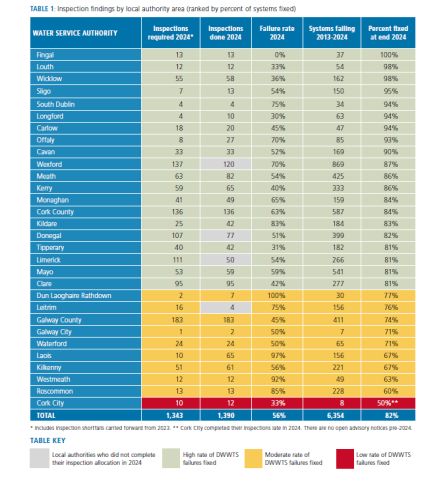
Over half of the septic tanks inspected across Ireland last year failed to meet the required standard, with a significant number identified as “a risk to human health and the environment”.
Of the 1,390 Domestic Waste Water Treatment System (DWWTS) inspections completed by local authorities last year, 56 percent (773) failed inspection.
Almost half a million DWWTS treat household waste water in Ireland, with most DWWTSs being septic tanks.
This information comes from the Environmental Protection Agency’s (EPA) Domestic Waste Water Treatment System Inspections 2024 report, which additionally found that 82 percent of septic tanks that failed between 2013–2024 were fixed by the end of 2024 which is an improvement from 75 percent at the end of 2021.
The EPA National Inspection Plan (NIP) requires local authorities to complete a minimum of 1,200 inspections annually.
Over 12 years nearly 13,000 inspections were completed, targeting areas at “greatest risk from pollution”, with the majority near rivers known to be at risk from domestic waste water systems and in areas where such systems are co-located with household drinking water wells.
According to the EPA, faulty treatment systems can see household drinking water wells contaminated with harmful bacteria and viruses. People may also be exposed to improperly treated waste water if it surfaces in gardens or runs off into ditches and streams.
They also pose a risk to the environment, according to the EPA, in that “excessive releases” of nitrogen and phosphorus from faulty systems can cause pollution in receiving waters.
Domestic waste water is considered “a significant pressure” on water quality in 148 (9 percent) at-risk water bodies in Ireland.
The report states that Donegal, Leitrim, Limerick and Wexford local authorities did not complete their full 2024 allocation of inspections and are required to make these up in 2025, the EPA noting that it may issue a legal direction to local authorities if inspection shortfalls are not rectified.
The annual inspection failure rate has varied between 44 percent and 57 percent since the NIP started in 2013.
“Not maintained” was the reason for the highest number of failures (almost 40 percent), followed by “not desludged” in second (25 percent) and “leaks” in third place (18/19 percent).
On the topic of local authority enforcement, the number of advisory notices open more than two years was found to have decreased for the first time from 576 at the end of 2023 to 523 at the end of 2024, a development the EPA attributes to the increase in grants for DWWTS remediation from €5,000 to €12,000 from the start of 2024.
However, there are “significant differences across local authorities and enforcement remains inconsistent”.
The number of legal cases since inspections commenced in 2013 increased from 62 at the end of 2023 to 66 at the end 2024, with 95 percent of those cases taken by four local authorities: Kerry, Limerick, Mayo and Wexford.
The EPA advises households that their DWWTS should be properly built and maintained, and their drinking water wells tested to ensure that their health and local environment are not jeopardised.