Amidst increasing concerns that rocketing energy prices will send Europe into a deep recession, the European Union is to convene an emergency meeting of ministers to try to agree measures to deal with the crisis.
With the Czech Republic holding the rotating European Council Presidency, Czech Prime Minister, Petr Fiala, said that energy ministers should meet “to discuss specific emergency measures to address the energy situation”. His trade minister, Jozef Sikela, said the meeting should take place “at the earliest possible date”.
.@EU2022_CZ will convene an urgent meeting of Energy Ministers to discuss specific emergency measures to address the energy situation.
— Petr Fiala (@P_Fiala) August 26, 2022
The enormous jump in gas prices after the invasion of Ukraine and subsequent sanctions on Russia have sent energy concerns ratcheting ever-higher as European gas prices hit an unprecedented high of above €343 per megawatt hour.
This graph from the Financial Times shows the stratospheric rise in gas prices, as the amount now being paid on the Title Transfer Facility, Europe’s leading trading hub, reached record highs.
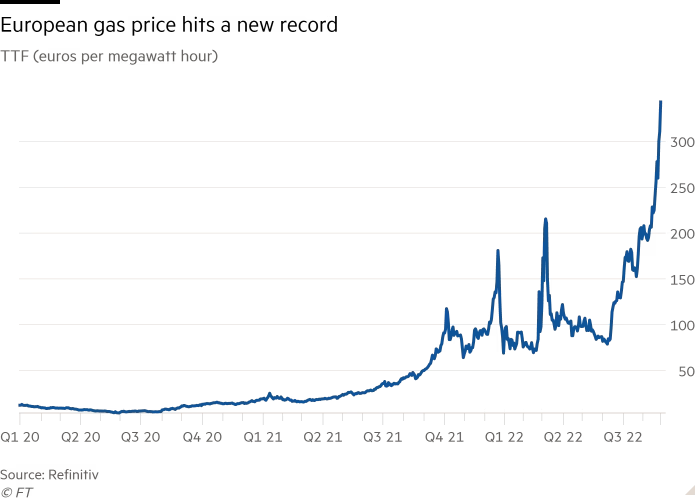
The contrast with the price being paid for gas just a year ago is striking – a more than ten-fold increase on the same quarter in 2021. The Financial Times said that the EU was rushing to bring ministers together because of fears the region would enter a “deep recession”.
The wild climb in gas prices has left not just households and heavy industry struggling but also hit producers across many sectors with knock-on effects for transport, food production, and more.
Of particular concern is the price of fertilizer which is key to food production, with Bloomberg reporting that an alarming two-thirds of production capacity could be “halted by soaring gas costs”, with disturbing implications for both farmers and consumers alike.
“We are extremely concerned that as prices of natural gas keep increasing, more plants in Europe will be forced to close,” Maximo Torero, chief economist at the United Nations Food and Agriculture Organization told Bloomberg. “This will switch the EU from being a key exporter to an importer, putting more pressure on fertilizer prices and consequently affecting the next planting season.
More than 70% of fertilisers manufactured in Europe – and used for food production – rely on nitrogen from air and hydrogen from gas, which are combined to generate ammonia. Gas is therefore used both as a raw material and then an energy source to synthesise essential supplies of fertilizer.
Accelerating gas prices have driven up prices already rising after the Covid lockdown, and spiraling inflation rates have forced the European Central Bank to raise interest rates, with further increases next month, hitting mortgage holders hard as the bank struggles to get to grips with spiralling prices.
European Central Bank officials warned that a larger “sacrifice” was needed with Isabel Schnabel, an ECB executive board member, saying on Saturday that “Central banks are likely to face a higher sacrifice ratio compared with the 1980s, even if prices were to respond more strongly to changes in domestic economic conditions, as the globalisation of inflation makes it more difficult for central banks to control price pressures.
This morning, analysts at Goldman Sachs Group Inc. said it was expected that the UK economy will slip into recession later this year, and warned of a risk of a deep contraction.
Goldman’s research note said that GDP for the UK would fall in 2023, by about 1% according to their projections, and they revised previous estimates of a 1.1% expansion in Britain’s output into a shrinking of 0.6%.